
These platforms help agencies increase project output, protect margins, and launch sites faster than building from scratch. But many agencies hit a wall once volume climbs or client requests get complex, requiring custom code, multiple platforms, or the kind of dedicated project management builders weren't designed to handle.
This guide reviews the top white label website builders of 2026, breaks down how to choose one, and shows where a fully managed white-label web development partner like Mavlers Agency fits when a builder alone isn't enough.
Key Takeaways
- White label builders are self-serve software; white-label services use managed teams building under your brand
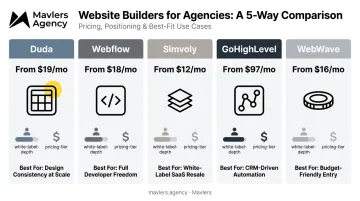
- Top 5 picks: Duda, Webflow, Simvoly, GoHighLevel, and WebWave — each suited to different agency needs
- Choose based on customizability, scalability, pricing structure, and client-facing branding depth
- Agencies delivering across WordPress, Shopify, Webflow, and HubSpot often outgrow DIY builders and turn to managed partners
Overview of White Label Website Builders in the Agency Market
A white label website builder is software that lets an agency design, build, and host client websites under its own brand, no third-party logos, logins, or watermarks in sight.
This matters more than ever because most agencies aren't massive operations. 87% of North American digital agencies employ fewer than 50 full-time staff, according to a Promethean Research digital agency industry report, and production roles make up nearly two-thirds of typical agency talent.
With teams this lean, agencies can't afford tools that add friction. They need platforms that multiply output without multiplying headcount.
Freelancers and marketing firms use these builders the same way: to deliver more websites in less time while keeping the agency's brand front and center, not the software vendor's.
The list below ranks the top builders serving agencies in 2026, evaluated on the depth of their white labeling, the breadth of each platform's feature ecosystem, and how well it scales as client volume grows.
Top 5 White Label Website Builders of 2026
We ranked each builder on four criteria: brand customizability, feature ecosystem, ease of client management, and pricing transparency.
Duda
Duda is a design-first, agency-grade builder for teams producing dozens (or hundreds) of client sites without sacrificing polish. It's less about flashy templates and more about structured, repeatable web production.
What makes it stand out:
- A structured responsive editor that keeps output consistent across large teams
- Team collaboration tools built for multi-person workflows
- Content collection forms that let clients submit their own copy and images
- Dynamic pages for spinning up similar sites, think multi-location businesses, at scale
| Duda | |
|---|---|
| Pricing | White Label plan: $149/month billed annually (or $199 month-to-month), including 4 sites. Extra sites: $14/month ($168/year) each |
| Key Features | Branded dashboard, login, and support portal; automated client billing via Stripe; content collection forms; white-label mobile editor |
| Best For | Done-for-you agencies prioritizing design consistency across many client sites |
Webflow
Webflow built its reputation as the developer-friendly platform for teams that want pixel-perfect control without touching a database. It's less "white label out of the box" and more "white label with the right settings."
Where it delivers:
- Client Payments lets you bill clients directly for site plans and add-ons
- Paid Site plans remove the "Made in Webflow" badge from published and exported sites
- Custom code and CMS flexibility give designers near-total creative freedom
| Webflow | |
|---|---|
| Pricing | Agency Workspace: $35/month billed annually (or $42 month-to-month). Site plans billed separately, per client site: Basic $14/month, CMS $23/month, Business $39/month |
| Key Features | Direct client billing, badge removal on paid plans, CMS flexibility, custom code and scripts |
| Best For | Agencies wanting design freedom with partial white labeling |
Simvoly
Simvoly started as a website builder and evolved into a full SaaS ecosystem covering websites, funnels, and communities, all rebrandable under an agency's own name.
The standout capabilities:
- Deep UI/UX rebranding makes the dashboard, login, and editor look entirely like your own software
- Custom CSS/JS access for teams that want more than template tweaks
- Automated client billing turns Simvoly into a genuine "SaaS-in-a-box" resale model
| Simvoly | |
|---|---|
| Pricing | WL Basic: $59/month annually (2 sites, 10 funnels). WL Advanced: $129/month (5 sites, unlimited funnels). WL Ultimate: $429/month (unlimited sites and funnels) |
| Key Features | Funnel engine with A/B testing, community builder, integrated CRM, full white-label branding |
| Best For | Agencies wanting to resell software under their own brand |
GoHighLevel
GoHighLevel positions itself as an all-in-one CRM and marketing automation platform, with a website and funnel builder bundled in rather than sold as the main event.
What sets it apart:
- SaaS Mode automates client account creation and subscription billing
- Workflow automation handles lead nurturing, pipelines, and follow-ups without manual work
- Niche "Snapshot" templates let agencies deploy pre-built systems for specific industries fast
One tradeoff worth flagging: the learning curve is steep. GoHighLevel packs in enough functionality to run an entire agency's client operations, which also means new users spend real time learning the platform before they're productive.
| GoHighLevel | |
|---|---|
| Pricing | Agency Pro (with SaaS Mode): $497/month or $4,970/year, unlimited sub-accounts. Starter: $97/month (3 sub-accounts). Unlimited: $297/month |
| Key Features | CRM pipelines, automation workflows, branded mobile app (add-on), Snapshot template marketplace |
| Best For | Lead-gen and automation-focused agencies |
WebWave
WebWave is a free, design-flexible drag-and-drop builder with an unusual Photoshop-style interface and an Agency Account built for white labeling.
The details that matter:
- The Photoshop-like interface gives designers granular design control most builders don't offer
- Agencies earn commission-based revenue from client hosting and domain purchases
- Discounted agency pricing knocks 50% off standard hosting tiers
| WebWave | |
|---|---|
| Pricing | Free to start; Agency Account gives 50% off Starter, Pro, and Business hosting plans |
| Key Features | Full brand integration on login/dashboard, client comment mode, template library monetization |
| Best For | Freelancers and small agencies wanting low-cost entry with design control |
DIY White Label Builders vs. Fully-Managed White Label Web Development
Builders and managed development solve the same problem in fundamentally different ways.
A white label builder is self-serve software: someone on your team still has to log in, build the site, troubleshoot the CMS, and handle every client revision.
Managed white-label web development flips that equation. An outside team designs, builds, QAs, and delivers the finished site under your brand, and you never touch the editor.
That distinction matters more as agencies grow. A builder works fine for five client sites. At 50 sites spread across WordPress, Shopify, Webflow, and HubSpot, someone on staff becomes a full-time platform operator instead of a strategist or account manager.
How a Managed Partner Removes the Bottleneck
Mavlers Agency, for example, replaces the builder-operator role entirely. Agencies submit a project brief; the team builds, QAs, and hands back a finished, quality-checked site — no new software to learn, no per-site license to manage.
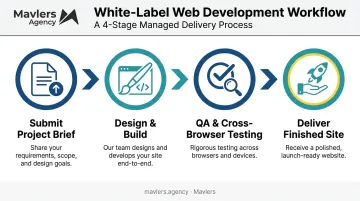
The process includes checks a self-serve builder simply doesn't run:
- Usability and cross-browser testing across Chrome, Safari, Firefox, and Edge
- WCAG accessibility verification
- AI-assisted code and performance audits
- Design approval before development starts, not after
Multi-platform coverage is where the gap shows up fastest. Rather than one generalist juggling four platforms, dedicated specialists handle WordPress, Shopify, Webflow, and HubSpot CMS work separately, so a single brief can move between tech stacks without retraining anyone.
The same client-facing invisibility a builder promises still applies here. Deliverables carry the agency's branding throughout, reinforced by confidentiality agreements, and the agency stays the sole point of contact with the end client.
Cost, Time, and Capacity Compared
| Self-Serve Builder | Managed White-Label Partner | |
|---|---|---|
| Cost predictability | Subscription plus per-site fees that creep up with volume | Project- or retainer-based, scoped upfront |
| Time-to-launch | Depends on in-house skill and bandwidth | Team-driven, running in parallel across projects |
| Capacity ceiling | Limited by staff hours and platform-switching overhead | Scales with brief volume, not headcount |
For context, general managed web-development projects average $66,499 and roughly 9 months for a full build, according to Clutch's 2026 web development pricing guide, though your actual scope and platform will shift both numbers.
This model fits best for 10-75 person agencies juggling multiple platforms and client types. They've outgrown what one generalist can handle inside a builder, but they're not big enough to justify hiring dedicated WordPress, Shopify, and Webflow developers in-house.
How We Chose the Best White Label Website Builders
Agencies evaluating builders tend to make the same mistakes: prioritizing sticker price over true brand customizability, or ignoring how per-site costs creep once volume climbs past a handful of client projects.
We weighed four factors, each tied back to agency profitability and scalability:
- Depth of white labeling - does the branding cover the dashboard, login, and mobile experience, or just the published site?
- Ecosystem breadth - funnels, CRM, e-commerce, and automation built in, or bolted on through integrations?
- Ease of client management - can non-technical team members handle revisions without a developer?
- Pricing transparency - are per-site and per-project fees clear upfront, or buried in add-ons?
Builders that scored well across all four made this list. Those that excelled at one factor but fell short elsewhere—strong design tools paired with opaque per-site pricing, for example—are flagged in their individual reviews above.
Conclusion
The right white label builder depends on your agency's operational goals and client mix, not just brand reputation or a long feature list. Consider how each platform fits your workflow:
- Duda suits design-heavy production shops
- Webflow suits developers who want creative control
- Simvoly and GoHighLevel suit agencies reselling full software stacks
- WebWave suits freelancers testing the model on a budget
Before committing, weigh ongoing scalability, hidden per-site costs, and how much hands-on building the platform still demands from your team.
If you'd rather skip the builder learning curve altogether, a fully-managed white-label web development partner like Mavlers Agency can scale your output across WordPress, Shopify, Webflow, and HubSpot, without hiring a single developer.
Frequently Asked Questions
What is a white-label website?
A white-label website is built by one company but branded and delivered under another company's name, with no visible logos, credits, or watermarks pointing back to the original developer.
How much does it cost to white label a website?
Builder subscriptions typically range from $35 to $497 per month, plus per-site fees. Managed development projects run higher, averaging around $66,499 for a full project, depending on platform and scope.
What is a white-label website builder?
It's software that lets agencies build and rebrand client sites under their own domain, login, and branding, without ever showing the platform's name to the end client.
Is white labeling a website legal?
Yes, as long as it's covered by the platform's terms of service or a formal white-label agreement. Most builders explicitly license this use case in their terms.
Can clients tell if a website was white labeled?
Not usually. With a custom domain, branded login, and an NDA in place, clients typically can't detect the underlying builder or development partner.
What's the difference between a white label website builder and a white-label web development agency?
A builder is self-serve software your team operates. A managed agency like Mavlers Agency designs, builds, and delivers the finished site for you.