That's a lot of demand for businesses without the years or the millions it takes to build a bidding engine in-house.
White-label advertising platforms solve this gap. Instead of building, you rent proven ad tech infrastructure and put your own brand on top of it. This guide breaks down what these platforms actually are, how they work under the hood, who uses them, and how to pick the right one for your business.
Key Takeaways
- White-label platforms let you launch branded ad tech in weeks, not years.
- Three flavors exist: DSP (buying), SSP (publisher monetization), and ad server (creative delivery).
- Agencies, ad networks, publishers, and performance advertisers benefit most.
- Custom builds run $150K-$1.5M+; white-label setups cost $0-$20K.
- Top providers manage infrastructure, uptime, and compliance while you own the front end.
What Is a White Label Advertising Platform?
A white-label advertising platform is ready-built ad tech, meaning a DSP, SSP, or ad server, that you operate under your own brand while a provider maintains everything on the backend. You get the storefront while they run the factory.
Think of it as a landlord-renter relationship. The provider builds and maintains the engine: the bidding logic, the servers, the integrations. You control the branding, set the pricing, and own the entire client experience. Your clients never know the underlying technology belongs to someone else.
What "white label" typically includes:
- A custom domain (yourplatform.com, not theirs)
- Branded dashboards with your logo and colors
- Your own admin accounts and user permissions
- Client-facing reports that show your brand exclusively
White Label vs. Self-Serve: Not the Same Thing
These terms get confused constantly, but the difference matters. Self-serve means you're using someone else's platform under their brand and their rules. You log into their interface, follow their pricing structure, and your clients might even see the provider's name.
White-label flips that: same underlying technology in many cases, but full brand control. Your domain, your dashboard, your pricing model: the provider stays invisible to your clients.
Core Components That Make Up the Platform
Every white-label platform, regardless of type, shares the same core building blocks:
- Bidding/RTB engine - evaluates real-time bid requests and applies auction logic
- Ad server - stores, prioritizes, and delivers the actual creative assets
- Data and analytics layer - powers reporting dashboards and performance tracking
- User-facing dashboard and API - the branded interface your team and clients actually touch
In a white-label setup, the provider hosts and maintains all of this, while you only ever see your own branded front end.
According to StackAdapt's breakdown of programmatic infrastructure, building this stack independently requires engineering, data science, integrations, security, and privacy compliance, all before you serve a single impression.
How Does a White Label Advertising Platform Work?
The operational flow looks similar across most white-label DSPs, SSPs, and ad servers, even though the business logic differs.
- Setup - You configure campaigns or inventory (depending on whether you're running a DSP or SSP), set pricing rules, and connect demand or supply partners.
- Bid request - A real-time opportunity fires off to demand or supply partners the moment an ad slot becomes available.
- Evaluation and delivery - The auction runs, selects a winner, and delivers the creative, typically in under 100 milliseconds.
- Reporting - Performance data flows back into your branded dashboard for you and your clients to review.
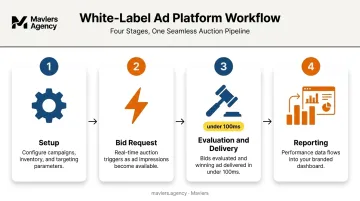
Your business gets its own domain, login credentials, and branded UI. The provider handles uptime, compliance, and the technical maintenance you never have to think about.
Infrastructure You Don't Have to Build
Most providers host their platforms on scalable cloud infrastructure, think AWS or Google Cloud, built to absorb high traffic volumes without buckling. AWS, for example, commits to 99.99% monthly uptime for compute instances deployed across multiple availability zones, compared to 99.5% for a single instance, according to Amazon's Compute Service Level Agreement. That's the kind of reliability most businesses couldn't replicate cheaply on their own.
White-label platforms usually allow API access too. You can connect proprietary supply sources, first-party data, or private marketplace deals, while the core codebase itself stays locked. Your clients, whether they're publishers, agencies, or advertisers, never interact with the original technology provider. Every report, every login, every conversation happens through your branded platform.
Key Benefits and Who Actually Uses These Platforms
Businesses choose white-label over building or renting third-party tools for a handful of concrete reasons:
- Brand ownership - your name stays on everything clients see
- Faster launch timelines - weeks instead of years
- Monetization control - you set your own pricing and margins
- Lower infrastructure costs - no server farms, no dedicated engineering team
Vendor pricing benchmarks from BidsCube's white-label DSP cost breakdown lay out the gap clearly:
| Factor | Custom DSP Development | White-Label Platform |
|---|---|---|
| Setup cost | $150,000 to $1.5 million+ | $0 to $20,000 |
| Time to launch | 12 to 24 months | 2 to 8 weeks |
| Monthly maintenance | $20,000 to $80,000 | $2,000 to $50,000+ |
That cost and speed gap is exactly why so few businesses build from zero.
Who Gets the Most Value
- Digital and marketing agencies managing multiple client accounts under one branded system
- Ad networks and media resellers aggregating supply from various sources
- Publishers with meaningful traffic who want direct pricing control
- Performance advertisers who need log-level data for optimization
Agencies in particular lean on white-label platforms to hide internal margins, present clients with branded dashboards, and strengthen retention. When a client logs into a dashboard bearing your logo, not a third-party vendor's, that relationship stays yours.
A Real-World Result
Blueseed, a global digital-content company, adopted Epom's white-label ad server and reported a 30% reduction in ad-serving costs, according to Epom's white-label programmatic case study. The source doesn't specify the exact measurement window, but the direction is clear: swapping proprietary infrastructure for a white-label solution cut real operating costs.
White-label isn't the right fit for every business, though. Skip it if you're dealing with:
- Very small ad spends that don't justify licensing fees
- Limited programmatic expertise to manage bidding strategy in-house
- A need for fully custom-coded functionality no vendor offers off the shelf
Types of White Label Advertising Platforms: DSP vs. SSP vs. Ad Server
"White-label advertising platform" is an umbrella term. Underneath it sit three distinct technologies, each solving a different problem.
| Platform Type | What It Does | Best For |
|---|---|---|
| DSP (Demand-Side Platform) | Buying and managing ad campaigns across exchanges | Agencies and advertisers |
| SSP (Supply-Side Platform) | Helping publishers monetize their ad inventory | Publishers with meaningful traffic |
| Ad Server | Creative delivery, tracking, and reporting | Businesses selling inventory directly |
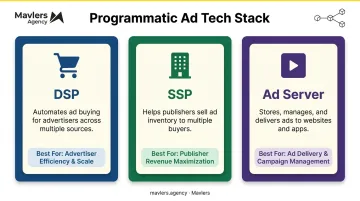
Match the platform to your business model:
- DSP: You're an agency or advertiser buying media across exchanges
- SSP: You're a publisher managing yield and demand relationships
- Ad server: You're selling inventory directly, without an auction
These lines blur in practice, since many SSPs now bundle ad-serving functionality alongside their core tools.
What to Look for When Choosing a White Label Advertising Platform
Not every provider is built the same. Before signing a contract, check for these fundamentals:
- Multi-format support - display, video, native, and audio, not just banners
- Standard protocol integrations - OpenRTB compatibility with demand and supply partners
- Analytics depth - reporting that goes beyond surface-level impressions and clicks
- Scalable infrastructure - handles rising traffic without performance drops
- Fraud protection - built-in detection, not an afterthought add-on
- Onboarding support - a team that actually helps you launch, not just a login link
- Transparent pricing - no hidden fees buried in fine print
- Free trial or demo - test the platform before you commit budget
Verify Supply-Chain Transparency
Beyond built-in fraud detection, supply-chain transparency tools add another layer of protection. Standards like ads.txt and sellers.json confirm you're buying or selling authorized inventory, not something a bad actor slipped into the chain.
Scaling Beyond Ad Tech: Why Agencies Are White-Labeling Their Full Service Stack
A white-label ad platform solves the media-buying half of an agency's business. But campaigns still need somewhere to send that traffic. Landing pages, full websites, and ongoing web maintenance are what actually convert clicks into revenue, and that's a different bottleneck entirely.
Agencies scaling their ad services often hit the same wall on the development side: hiring specialists for every platform a client needs, whether that's WordPress, Shopify, Webflow, or HubSpot, gets expensive fast. Recruiting takes months, and training takes even longer. Clients rarely wait.
That gap is where a parallel white-label model steps in for web development and design. Mavlers Agency works invisibly behind agencies, delivering websites and ongoing maintenance across multiple platforms so agencies can offer full-service campaigns (ad platform plus the site that converts the traffic) under one brand.
How this plays out in practice:
- WordPress builds handled end-to-end, with over 2,000 sites delivered for 500+ agency partners
- Shopify development, including custom apps and Plus migrations, through certified specialists
- Post-launch maintenance and support, so agencies aren't fielding technical fire drills themselves
- Every deliverable, from Figma files to code, carries the agency's branding with zero Mavlers Agency attribution

The agency gets full credit. The client never learns a delivery partner exists. That's the same principle behind white-label ad tech, just applied to the part of the funnel that turns impressions into actual customers.
Frequently Asked Questions
Is a white-label advertising platform the same as a self-serve platform?
No. Self-serve means using a provider's platform under their brand and their rules. White-label gives you full branding and pricing control over the same underlying technology.
How much does it typically cost to use a white-label ad platform versus building one?
White-label setups run roughly $0 to $20,000 to launch versus $150,000 to $1.5 million+ for custom DSP development. Monthly costs stay in the $2,000 to $50,000 range compared to $20,000 to $80,000 for in-house maintenance.
Do I need a technical team to run a white-label DSP or SSP?
Coding isn't required since the provider maintains the backend. You do need a team that understands bidding strategy, targeting, and campaign optimization to actually get results.
What's the difference between a white-label DSP, SSP, and ad server?
DSPs handle buying and campaign management for advertisers. SSPs help publishers monetize inventory. Ad servers manage creative delivery and tracking regardless of which side of the transaction you're on.
Which businesses benefit most from a white-label advertising platform?
Agencies managing multiple client accounts, ad networks aggregating supply, publishers wanting pricing control, and performance advertisers needing log-level data all see strong returns from white-labeling.
Can a white-label ad platform be fully customized to match my brand?
Yes, for the parts that matter to clients: your domain, dashboards, and reporting all carry your branding. The core backend technology remains the provider's, and that's by design.