
If that sounds familiar, you're not alone. Many stores follow every SEO best practices checklist to the letter, but product discovery stays weak and revenue from organic search barely moves.
Here's why: the gains left on the table in 2026 come from signals most sites ignore entirely. Review language, internal search logs, filter logic, product feed hygiene, and visibility inside AI answer engines now matter as much as your on-page basics.
This guide covers 10 advanced, often-overlooked eCommerce SEO tactics built for stores that already have the fundamentals covered and need the next layer of growth.
Key Takeaways
- Structured data beats metadata: search engines and AI need machine-readable catalogs, not just keyword tags
- Reviews, Q&A, and search logs are free, shopper-specific keyword research goldmines
- Selective filter indexing and smart internal linking protect crawl budget and link equity
- Outsourcing developer-heavy execution ships these tactics faster, without adding headcount
Why Basic eCommerce SEO Isn't Enough Anymore
Title tags, meta descriptions, basic schema, and mobile-friendliness are table stakes now. Every competitor in your category has already checked those boxes. The differentiation has moved elsewhere: search itself is fragmenting.
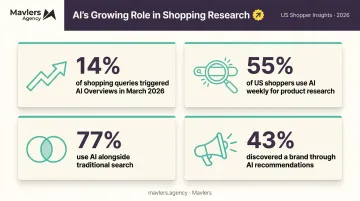
Google AI Overviews appeared on 14% of shopping queries in March 2026, up nearly 6.7x from just 2.1% in November 2025, according to Search Engine Land's analysis of Visibility Labs data. That's a massive swing in a few months, and it's still climbing.
Shoppers have changed their habits to match. Consumer research shows:
- 55% of US shoppers use AI tools for product research weekly
- 77% use AI alongside traditional search, not instead of it
- 43% have discovered a brand through AI recommendations
Search engines are becoming answer engines. That shift means product data consistency and demonstrated E-E-A-T (Experience, Expertise, Authoritativeness, Trust) now carry more weight than keyword density ever did.
The 10 tactics below target the specific gaps basic SEO checklists never touch: weak product discovery, mid-funnel drop-off, wasted crawl budget, and thin content that neither Google nor ChatGPT can trust enough to cite.
10 Advanced eCommerce SEO Tactics to Boost Rankings and Revenue
These tactics assume your foundational SEO is already solid. Don't try to implement all 10 simultaneously. Pick two or three that address your biggest visible gaps first.
Turn Reviews and Q&A into Semantic SEO Fuel
Your customers already wrote your best keyword research. Mine recurring phrases from reviews and Q&A threads: durability comments, fit descriptions, sensory language, maintenance questions, use-case mentions.
Feed that language into:
- Product description bullets
- Category page copy
- FAQ schema markup
A footwear brand that embeds phrases like "true to size but tight in the toe box" directly into PDP copy captures long-tail searches no keyword tool would surface, because that exact phrasing lives only in customer language.
Mine Internal Site Search Data for Hidden Keywords
Your on-site search bar is a keyword research tool competitors can't access. Export top queries, zero-result searches, and high-exit searches from your site search platform or GA4.
A simple monthly workflow:
- Export query data from internal search and analytics
- Cluster results by intent (informational, navigational, transactional)
- Map clusters to categories, filters, or missing PDPs
- Refresh monthly as inventory and demand shift
Zero-result searches are especially valuable. They reveal synonym gaps and category mismatches your own shoppers are hitting in real time.
Build Mid-Funnel Content for Comparison Shoppers
Decision-stage searches like "best trail runner for wide feet" or "Product A vs Product B" need dedicated content, not just PDPs. Build comparison guides, fit tools, and structured FAQ pages that link into category and product pages.
Source your comparison criteria from:
- Returns data (what shoppers cite when items come back)
- Review themes (recurring pros/cons mentions)
- Product-viewed-in-sequence behavior (what buyers compare before purchasing)
Brands using structured comparison tables to reduce purchase hesitation see this content rank for exactly the queries that stall conversions elsewhere on the site.
Index Filters and Facets Selectively, Not All-or-Nothing
Faceted navigation can generate near-infinite URL combinations. Google itself warns this creates overcrawling and slows discovery of pages that actually matter. It recommends robots.txt rules or URL parameter controls when facet combinations don't need to be crawled, per Google's own guidance on faceted navigation.
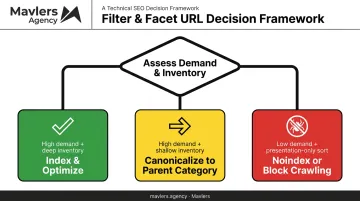
A simple decision framework:
| Signal | Action |
|---|---|
| High search demand + deep inventory | Index and optimize the page |
| High demand + shallow inventory | Canonicalize to the parent category |
| Low demand + presentation-only sort | Noindex or block crawling entirely |
Evaluate each filter combination against demand, inventory depth, and shopper intent before deciding its fate.
Design Internal Linking as a Product Graph, Not Just Breadcrumbs
Breadcrumbs alone aren't a linking strategy. Google uses links both to discover pages and as a relevance signal, so important pages need at least one internal link pointing to them.
Build three link types deliberately:
- Vertical: category-to-product links
- Lateral: product-to-product ("customers also bought")
- Contextual: guide-to-product links from editorial content
Audit high-value PDPs with few inbound internal links using a crawler tool, then prioritize adding links from categories, buying guides, and recommendation modules, not just the homepage.
Handle Out-of-Stock and Discontinued Products with Precision
Temporary and permanent stockouts need different treatment entirely.
Temporary unavailability:
- Keep the page live
- Show a restock date if known
- Add a waitlist CTA
- Update
Productstructured data and Merchant Center availability
Permanent discontinuation:
- 301 redirect to a true successor product
- Or leave the page live with alternative suggestions
- Return a real 404/410 if no replacement exists
Never redirect to your homepage or a broad category page. Google treats this as a soft 404, and it erodes the link equity that page had built up.
Prioritize Stable Inventory in Site Architecture
Calculate a stability score for each SKU: the percentage of days it stayed in stock over the past 6-12 months. Products with high stability scores make reliable anchors for category grids, comparison modules, and internal links.
Frequently out-of-stock or fast-turnover variants shouldn't anchor your architecture. When they're your primary internal-linking hub and go out of stock, you're left patching links across the entire site instead of maintaining stable, compounding rankings.
Convert Support Tickets, Returns, and Complaints into Content
Your support inbox holds content gold. Analyze tickets and return reasons for recurring themes: fit issues, durability questions, care instructions, edge-case use scenarios.
Translate these into:
- PDP bullet points addressing the specific concern
- Dedicated FAQ entries
- Standalone help articles for complex topics
- Updated care and maintenance content on existing PDPs
This content is genuinely useful because it reflects real post-purchase friction, which is exactly why it tends to win People Also Ask placements and AI Overview citations that manufacturer copy never earns.
Sync Product Data Across PDPs, Schema, and Feeds
Your PDP should be the single source of truth. Titles, attributes, identifiers, price, and availability all need to match across the page, structured data, and product feed.
Google is explicit that incorrect or missing product information causes disapprovals, limited eligibility, or incorrect product displays, according to Google Merchant Center's product data specification. Mismatches between feed data and landing pages can trigger preemptive item disapproval.
Run a recurring feed and schema health check to catch:
- Missing GTINs or MPNs
- Price mismatches between feed and PDP
- Disapproved items sitting silently unfixed
- Attribute mismatches like color, size, or material
This directly affects whether products surface in Google Shopping, Search, and increasingly, AI shopping surfaces.
Add Expert and First-Hand Insights to Product Pages
Manufacturer spec sheets are everywhere. Experience-based content isn't. Google's own guidelines call for demonstrating real product knowledge: what it's genuinely like to use, quantitative measurements, honest benefits and drawbacks, and comparisons against competitors.
Add:
- "Best for / not ideal for" guidance based on actual testing
- Performance notes under specific conditions
- Expert Q&A marked up for structured visibility
This is the content that differentiates a PDP from a recycled catalog entry, and it's the type of firsthand experience AI systems are increasingly built to surface.
How to Measure Impact and Prioritize Rollout
Don't attempt all 10 tactics at once. Choose two or three that address your most visible gaps: weak PDPs, messy filters, or unstable category pages.
Track these core KPIs after implementation:
- Organic revenue (not just traffic volume)
- Conversion rate on affected pages
- Internal search zero-result rate (should decline as gaps close)
- AI Overview/citation appearance for target keywords
At Mavlers Agency, we track AI visibility specifically through a GEO Visibility Index (GVI) framework, which measures citation rate across engines like ChatGPT, Gemini, and Perplexity, competitive share of voice, and AI-referral traffic inside GA4. That gives eCommerce clients a concrete number instead of a screenshot when proving whether these tactics moved the needle.
Once tracking is in place, give any rollout a full quarter before judging results. Ahrefs' polling of over 3,600 SEO professionals puts typical results at three to six months, and eCommerce gains compound similarly. Double down on what shows lift; adjust what doesn't.
Turning Strategy into Execution Without Overloading Your Team
Here's the honest gap: schema and feed syncing, internal linking overhauls, selective indexing logic, and JS rendering fixes all require ongoing development capacity. Most lean marketing teams and even mid-sized agencies don't have that bandwidth in-house.
This is where a white-label development partner earns its keep. Mavlers Agency works alongside agencies to implement these exact technical builds across WordPress, Shopify, Webflow, and HubSpot storefronts.
The engagement stays entirely behind the scenes:
- Full client-facing credit stays with your agency
- NDA protection covers the entire partnership
- Reports and deliverables carry your branding, not ours
- Engagement runs as a monthly retainer, project scope, or dedicated specialist, depending on what the work requires
That structure keeps the focus on outcomes: shipping these recommendations as working code, consistently, across every client site on your roster — without adding headcount to make it happen.
Frequently Asked Questions
How do I improve SEO for eCommerce?
Beyond metadata basics, real improvement comes from using actual customer language pulled from reviews, internal search, and support tickets. Keep product data, schema, and site structure consistent and fully crawlable across every touchpoint.
Is SEO dead or evolving in 2026?
SEO is evolving into "search everywhere optimization." Visibility now spans Google, AI answer engines like ChatGPT, and platforms such as YouTube and TikTok, not just traditional rankings.
How long until advanced eCommerce SEO tactics show results?
Plan for a full quarter of consistent implementation before reliably measuring lift in organic traffic and conversions. Some signals move faster, but compounding gains typically need three to six months.
Do filters and facets really affect eCommerce SEO?
Yes. Unmanaged facets create thin, duplicate URLs that drain crawl budget, while selectively indexed filter combinations with real search demand can capture valuable long-tail traffic instead of wasting it.
What's the difference between basic and advanced eCommerce SEO?
Basic SEO covers metadata, keywords, and technical hygiene: necessary but no longer differentiating. Advanced SEO focuses on data signals, content depth, and structural decisions that compound in value over time.
How does AI search change eCommerce SEO priorities?
Consistent, structured product data and experience-based content are now essential for surfacing in AI Overviews and LLM-driven shopping recommendations. ChatGPT referrals convert at 15.9% versus 1.8% for Google Organic, per Search Engine Land's ChatGPT Shopping report, making this visibility worth chasing.