Introduction
Marketing budgets keep shifting toward SEO, paid search, and social. Gartner's 2024 CMO survey found paid media now eats up 27.9% of total marketing spend, with search and social advertising leading the charge. But here's the catch: every dollar in that budget eventually funnels through one place: the website.
Most teams treat website development as a launch-day checkbox, not an ongoing lever. Once the site goes live, developers move on and marketers inherit whatever technical foundation they were handed. That foundation directly limits how well every campaign performs afterward.
This article breaks down how website development directly shapes digital marketing ROI, covering load speed, technical SEO, and conversion architecture.
Key Takeaways
- Website development determines whether ad clicks and organic traffic convert into revenue
- Core Web Vitals and technical SEO factors are set at the development level, not the content level
- Weak infrastructure inflates acquisition costs regardless of campaign quality
- Flexible CMS setups and integrations control how fast marketing teams can test and launch
- Agencies facing development capacity limits increasingly outsource to partners like Mavlers Agency
What Is Website Development (Brief Context)
Website development is the technical build of a site — its structure, functionality, and backend systems. It's distinct from visual design, though the two work hand in hand.
The U.S. Bureau of Labor Statistics draws a clear line here: web developers "create and maintain websites," handling performance and technical capacity. Web and digital interface designers, meanwhile, focus on layout, usability, and navigation. Different jobs, same site.
Development covers:
- Site architecture and information hierarchy
- CMS setup (WordPress, Shopify, Webflow, HubSpot)
- Page speed and backend performance
- Third-party integrations (CRM, analytics, chatbots, payment systems)
- Security protocols and cross-device functionality
None of this is the end goal; development is the engine. SEO, PPC, email, and social all depend on it to actually convert traffic into results.
Key Advantages of Website Development for Digital Marketing
The advantages below aren't abstract design preferences. They're operational, and they map directly to metrics marketing teams already track: conversion rate, organic visibility, and speed-to-market.
It Determines Whether Paid and Organic Traffic Converts
Every ad click, organic ranking, and social referral lands on the website. If that page is slow or confusing, the spend behind it is wasted, no matter how sharp the targeting or creative was upstream.
Clean site architecture, obvious CTAs, and fast load times are what turn a visit into a lead or sale. Poor on-site performance is one of the most common reasons visitors abandon a page before converting, and the data backs this up hard.
A Google and Deloitte study of 30 million mobile sessions found that a 0.1-second speed improvement correlated with 8.4% more retail conversions and 10.1% more travel conversions. That's a tenth of a second, not a redesign.
Here's the decision-making trap this creates: marketing teams often blame targeting or ad creative when ROI drops. In reality, the leak is usually on the site itself.
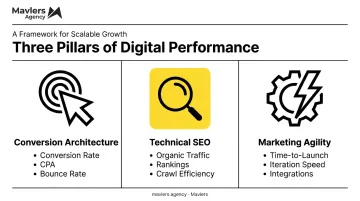
KPIs impacted:
- Conversion rate
- Cost per acquisition
- Bounce rate
- Average session duration
When this matters most: high-spend paid campaigns, seasonal promotions, and any period where traffic volume scales faster than the site's technical capacity to handle it.
It Powers Technical SEO and Organic Visibility
Search engines rank sites on technical factors set at the development level — Core Web Vitals, mobile responsiveness, crawlability, and structured data. Content quality and backlinks can't fully compensate for a technically weak foundation.
Google confirms Core Web Vitals feed directly into its ranking systems, though it's clear that passing scores alone don't guarantee a top spot. Moz's analysis of 10,000 keywords found that pages passing all three CWV thresholds held only a marginal 0.39-position advantage after the 2021 rollout, up from 0.38 before it. Moz itself called that shift likely within margin of error.
The honest takeaway: CWV is a confirmed ranking input that works alongside dozens of other ranking signals. But it still matters because:
- Slow, unresponsive sites get crawled less efficiently
- Poor mobile experience directly affects indexing since Google uses mobile-first evaluation
- Missing or broken structured data limits eligibility for rich results
Businesses pouring budget into content and backlinks while ignoring dev-level issues tend to plateau. They're building a house on a foundation that was never inspected.
KPIs impacted:
- Organic traffic
- Keyword rankings
- Crawl efficiency
- Page indexation rate
When this matters most: competitive keyword landscapes, post-algorithm-update recovery, and mobile-first or AI-search-driven markets where technical parity is table stakes.
It Enables Marketing Agility, Integration, and Scale
A flexible CMS and backend let marketing teams launch pages, run A/B tests, and connect CRM or chatbot tools without waiting on developer availability. Proper API integrations mean campaigns get built and adjusted within hours, cutting what used to be a multi-week dev cycle down to an afternoon.
This matters because marketing speed-to-market is frequently bottlenecked by development capacity rather than strategic thinking. Companies known for aggressive experimentation, like Booking.com running roughly 25,000 tests a year, depend on infrastructure built to support rapid, low-friction deployment. Without that backend flexibility, testing culture stalls before it starts.
Teams that can't scale development often delay launches or, worse, turn down growth opportunities entirely because the site can't keep pace with demand.
KPIs impacted:
- Time-to-launch
- Campaign iteration speed
- Integration reliability
- Marketing team throughput
When this matters most: multi-client agencies scaling delivery, businesses running frequent campaigns, and teams juggling platforms like WordPress, Shopify, Webflow, or HubSpot simultaneously.
What Happens When Website Development Is Neglected or Ignored
Skip development as an ongoing practice, and the consequences show up slowly, then all at once.
- Inconsistent campaign results. Strong ad spend and solid SEO work still underperform because the site itself is leaking conversions somewhere in the funnel.
- Rising technical debt. Quick-fix code and outdated CMS setups pile up fast. McKinsey pegs remediation costs at 10% to 20% above normal project budgets industry-wide.
- Missed growth opportunities. Agencies without spare development capacity turn down new client work or delay campaigns, creating a hiring bottleneck that compounds every quarter.
None of these show up as a single dramatic failure. They show up as flat growth curves that everyone assumes are a targeting or budget problem.
How to Get the Most Value from Website Development
Development delivers compounding marketing returns when it's treated as continuous, not a one-and-done project that ends at launch.
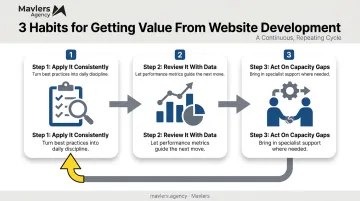
Three habits separate teams that get this right:
- Apply it consistently. Run regular audits of site speed, Core Web Vitals, and mobile experience alongside every major marketing push — not just once a year.
- Review it with data. Pair GA4 analytics with development sprints so fixes target what's actually costing conversions, not guesswork.
- Act on capacity gaps. Agencies hitting development capacity limits increasingly partner with dedicated white-label web development teams to scale delivery without the overhead of hiring.
This last point is where Mavlers Agency fits into the picture. Agencies partnering with Mavlers Agency get access to certified specialists across platforms like WordPress, Shopify, Webflow, and HubSpot, delivered entirely under the agency's own brand. The client relationship stays intact; the development bottleneck disappears.
Rick Murray, Founder and CEO of JXT Global, has worked with Mavlers Agency across hundreds of website projects over six-plus years:
"Structured processes, scalable team, and partnership-driven approach make them a dependable extension of our business."
That consistency is what turns development into a compounding asset instead of a recurring headache.
Conclusion
Website development is the operational backbone of digital marketing. It determines whether every dollar of marketing spend actually converts.
The advantages compound over time: technically sound sites rank better, better rankings bring more qualified traffic, and well-converted traffic funds the next round of growth. Skip development maintenance, and that entire cycle stalls in the background.
Treat website development as an ongoing practice tied to every campaign, not a project that ends the day the site goes live.
Frequently Asked Questions
What is website development in digital marketing?
Website development is the technical build that enables marketing channels to actually drive traffic and conversions. It covers site architecture, speed, integrations, and backend functionality that support every campaign running through the site.
Do digital marketers build websites?
Most marketers don't write code, but they work closely with developers on site structure, page speed, and conversion elements. Understanding development basics helps marketers diagnose why campaigns underperform.
Is web design still worth it in 2026?
Yes. Evolving standards like Core Web Vitals and AI-driven search results mean technical and design quality still directly affect visibility and conversions. Sites that ignore these standards typically see declining rankings and lower conversion rates as AI-optimized competitors pull ahead.
What's the difference between web design and web development in a marketing context?
Design covers visual layout, UX, and navigation usability. Development covers the technical backend: CMS setup, integrations, speed, and functionality that make design elements actually work at scale.
How does website development affect SEO rankings?
Technical factors like site speed, mobile responsiveness, crawlability, and structured data are all set at the development level and directly feed into how search engines index and rank pages. Strong content can't fully offset a weak technical foundation.
How can agencies scale website development without hiring more developers?
Many agencies partner with white-label development providers like Mavlers Agency, which delivers development work under the agency's own brand. This adds capacity without the overhead of recruiting, hiring, and managing new in-house staff.