That changes everything about how SEO needs to work. Treat B2B SEO like a B2C playbook, chasing volume and quick wins, and you'll rank for keywords that never turn into pipeline. Meanwhile, competitors with sharper, funnel-mapped content quietly capture the leads you wanted.
This guide breaks down what actually separates B2B SEO from B2C, the core building blocks, the practices that make or break execution, and how to measure success in revenue terms instead of vanity metrics.
Key Takeaways
- B2B SEO prioritizes buyer intent and pipeline impact over vanity rankings
- Content must map to every funnel stage and each buying committee member
- Technical SEO, on-page content, and backlinks must work as one connected system
- Execution determines whether most B2B SEO plans succeed or fail
B2B SEO vs B2C SEO: Core Differences
B2C SEO chases impulse. Someone searches "best running shoes," compares three options, and buys within minutes. B2B SEO deals with a completely different animal: slower decisions, more people involved, and higher stakes for whoever signs off on the purchase.
Getting this distinction wrong shows up fast in your numbers. You'll see traffic climb while conversions stay flat, because the content, keywords, and calls-to-action were built for the wrong buyer.
Longer, Multi-Stakeholder Sales Cycles
A single B2B deal pulls in stakeholders across marketing, IT, procurement, finance, and the C-suite, and each one needs different proof points:
- IT wants integration details
- Finance wants ROI math
- Leadership wants strategic fit
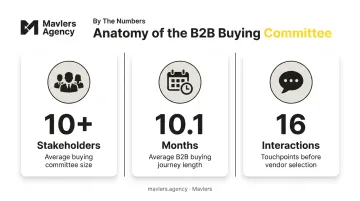
That number keeps climbing. 6sense's 2025 research across nearly 4,000 buyers found that buying groups now average 10+ members, with journeys stretching to 10.1 months and each person logging roughly 16 interactions before a vendor wins the deal. You're writing content for an entire committee, each with a different priority.
Low-Volume, High-Intent Keywords Win
B2B keywords rarely pull big search volume, and that's fine. Ahrefs' analysis found that about 93% of keywords in its US database receive fewer than 10 monthly searches, and most niche B2B terms fall firmly into that camp.
Compare "running shoes" (a broad consumer term with massive volume) to "reporting software for finance teams" (a specific, low-volume B2B phrase). The second one signals a buyer who already knows their problem and is evaluating solutions. Low volume, high commercial value.
Trust and Thought Leadership Are Non-Negotiable
A B2B buyer puts their professional reputation on the line every time they recommend a vendor. Flashy copy doesn't close that gap. What does:
- Detailed case studies with measurable outcomes
- Named client testimonials, not anonymous quotes
- Original research or data your competitors don't have
- Content written by actual subject-matter experts, not generic copywriters
Success Is Measured by Pipeline, Not Pageviews
Ranking #1 for a keyword that brings in 500 monthly visitors means nothing if none of them fill out a form. B2B SEO success should be judged by qualified leads, sales-accepted opportunities, and revenue attribution, not traffic charts that look good in a slide deck.
The Building Blocks of a Winning B2B SEO Strategy
Technical SEO, content, and authority-building work as one interconnected system, not three separate projects. Weak technical foundations undercut great content, and even great content struggles to rank without backlinks. Skip any piece and the whole strategy wobbles.
Technical SEO: The Foundation
This is the plumbing nobody sees until it breaks. Get it wrong and even brilliant content won't rank.
- Page speed and Core Web Vitals: Google's benchmarks for "good" scores are LCP under 2.5 seconds, INP under 200 milliseconds, and CLS under 0.1, measured at the 75th percentile
- Clean semantic site structure: Logical navigation and URL hierarchies that help both users and crawlers
- XML sitemaps and structured data: Help search engines discover and understand your pages, though neither guarantees indexing or rich results
- Regular audits: Catch broken links, redirect chains, and duplicate content before they drag down rankings
Don't overlook the small stuff either. Image compression and proper alt text are low-effort fixes that still improve crawlability.
On-Page SEO and Full-Funnel Content
The pillar-and-cluster model is the backbone of topical authority. One comprehensive pillar page covers a broad topic; supporting cluster pages target specific subtopics and link back, distributing relevance and improving internal linking across the site.
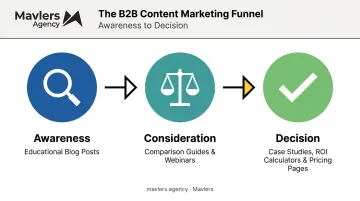
Map content to where the buyer actually stands in their journey:
- Awareness stage: Educational blog posts that address a problem the buyer just identified
- Consideration stage: Comparison guides and webinars that help them evaluate approaches
- Decision stage: Case studies, ROI calculators, and pricing pages that push a shortlisted buyer to commit
On-page fundamentals still matter here: clear heading hierarchy, keyword-optimized copy that doesn't read stuffed, and meta titles/descriptions written to earn the click, not just fit the character limit.
Off-Page SEO and Authority Building
Backlink quality beats quantity every time. Link quality hinges on relevance, authority, and placement, not raw count, and that's the right lens for B2B niches. A single link from a respected industry publication outweighs a dozen generic directory links.
Effective tactics include:
- Digital PR built around original research or data your industry doesn't have yet
- Guest contributions to publications your buyers actually read
- Partner and resource page placements relevant to your niche
Internal linking matters just as much. Strategic links from blog content to pillar and service pages distribute authority where it counts while helping visitors find what they need.
B2B SEO Best Practices and Common Pitfalls to Avoid
Most B2B SEO strategies look fine on paper. They fall apart in execution. Here's what separates the teams that hit pipeline targets from the ones stuck explaining flat numbers in quarterly reviews.
- Start with buyer-intent keywords, not raw volume. A term with 40 searches a month from decision-ready buyers beats one with 4,000 searches from people who'll never convert.
- Track pipeline, not vanity metrics. Rankings and pageviews look good in a report. Qualified leads and revenue attribution are what actually matter to leadership.
- Write like a person, not a whitepaper. Skip the jargon. A busy VP scanning your page on their phone wants clarity, not fifteen-syllable buzzwords.
- Align sales and marketing content. If prospects keep asking sales the same objection on every call, that objection belongs in your content, not just in a rebuttal script.
- Bring in internal experts. Thought leadership written by someone who actually does the work reads differently, and it tends to rank and convert better than generic contractor copy.
- Fix UX issues alongside SEO. A slow page or a confusing CTA wastes every visitor your SEO strategy worked hard to earn.
The strategy document rarely fails. The follow-through does.
Tools and Metrics for Measuring B2B SEO Success
You need visibility into three layers: demand and competitors, technical health, and actual business outcomes, since no single tool covers all three.
| Tool | Best for |
|---|---|
| Semrush / Ahrefs | Keyword research, competitor gaps, rank tracking |
| Screaming Frog | Technical site audits, broken links, metadata issues |
| Google Search Console | Clicks, impressions, indexing status straight from Google |
| HubSpot (or your CRM) | Connecting organic traffic to pipeline and closed-won revenue |
Those tools generate plenty of data, but rankings and traffic alone don't tell you if SEO is working. The KPIs that actually matter:
- Organic conversions and lead quality
- Time on page for key funnel content
- Revenue-per-visit from organic channels
These KPIs also take time to move, so don't expect overnight results. Most businesses see initial movement within four to six months, with stronger, more durable gains building by nine to twelve months. If someone promises page-one rankings in three weeks, that's a red flag, not a shortcut.
Why the Right Execution Partner Powers Your B2B SEO Strategy
A technical audit almost always surfaces work that needs developer hands: site speed fixes, structured data implementation, a platform migration, or a full redesign. That's where a lot of SEO strategies stall. In-house teams don't have spare dev capacity, and agencies often don't either, especially when several client projects need the same fixes at once.
This is the bottleneck nobody puts on the strategy slide, but it's the one that actually kills timelines.
Mavlers Agency works as a white-label execution partner for agencies handling exactly this problem. We build and fix the technical foundation, everything from Core Web Vitals remediation to schema markup, across Shopify, WooCommerce, Magento, and BigCommerce. That means the SEO recommendations in an audit actually get implemented instead of sitting in a backlog.

The practical upside for agencies:
- Keep strategy, keyword research, and client relationships in-house
- Scale technical delivery without hiring additional developers
- Hit SEO timelines because the fixes actually ship on schedule
Agency clients never see a third party involved. The work shows up under the agency's own brand, which is the entire point of a white-label model working the way it should.
Frequently Asked Questions
Does SEO work for B2B?
Yes, when it's paired with intent-driven keywords and content mapped to your funnel, all sitting on a conversion-ready website. It builds compounding organic pipeline that keeps generating leads long after a campaign ends.
What is the best SEO for B2B?
The best approach combines technical SEO with content mapped to every funnel stage and authoritative backlinks, all built around buyer intent rather than chasing high search volume alone.
How long does B2B SEO take to show results?
Initial movement is usually visible within four to six months. More substantial gains typically build over nine to twelve months, depending on your industry's competitiveness.
How is B2B SEO different from B2C SEO?
B2B involves longer sales cycles with multiple stakeholders per deal, targeting lower-volume but higher-intent keywords. B2C moves faster, driven by impulse purchases from individual buyers.
How much does B2B SEO cost?
Costs vary based on technical debt and content needs, with industry competitiveness playing a role too. Budget for both strategy work and execution resources, since a plan without implementation capacity won't move the needle.
What role does content play in B2B SEO?
Content is the primary vehicle for both ranking and nurturing buyers. It needs to span every funnel stage, from awareness-level guides through comparisons to decision-stage case studies.