The low-code market driving this demand isn't slowing down. Gartner projects the global low-code development technologies market will hit $58.2 billion by 2029, growing at a 14.1% CAGR, fueled by agentic AI and citizen development trends.
White label Webflow development has become the go-to fix. A specialized partner builds the site, and your agency delivers it under your own brand. This guide covers what it actually is, what it costs, and how to vet a partner properly.
One quick clarification before we start: white label Webflow development is not the same as Webflow's own "Editor whitelabeling" feature. We'll untangle that confusion in the next section.
Key Takeaways
- White label Webflow development means a partner team builds under your brand
- Solves capacity and hiring problems without adding full-time developers to payroll
- Pricing depends on the delivery model (project, hourly, retainer), not just page count
- Outsourcing is fully legal when NDAs and contracts are properly handled
- Top partners offer confidentiality guarantees, multi-platform coverage, and real post-launch support
What Is Webflow White Label Development?
White label Webflow development is a delivery model where a specialist team designs and builds Webflow sites on an agency's behalf. The end client never interacts with the partner directly. They see your logo, your invoices, and your project manager.
This is a different animal from Webflow's own Editor whitelabeling feature, which simply swaps the Webflow logo in the legacy Editor interface for your client's logo.
That feature only applies to sites on Growth or Agency Workspaces and doesn't work on Ecommerce sites. Webflow has confirmed the legacy Editor itself will be retired on August 4, 2026, making it a temporary UI rebrand rather than an outsourced development arrangement.
Demand for the outsourced version keeps climbing. W3Techs data shows Webflow's CMS market share grew from 0.9% in January 2023 to 1.1% in January 2025, roughly 22% relative growth in two years. As more businesses adopt the platform, agencies need a way to deliver Webflow projects without waiting on a hiring cycle.
How the White Label Model Works
The workflow is straightforward once you've done it a few times:
- Scope the project with your client directly, gathering requirements, timelines, and brand assets
- Hand off requirements to your white label partner, who reviews scope and confirms feasibility
- Partner designs, builds, and QA's the site on their own environment, separate from client-facing channels
- You review and rebrand the deliverable, checking it against your client's expectations
- Deliver to the client under your agency's name, with no mention of the partner involved
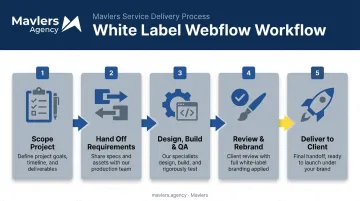
NDAs and confidentiality agreements are what keep step 5 believable. A properly structured agreement restricts the partner from any client contact, branding, or public case study mentions. Without that paperwork, you're relying on trust alone to stay invisible.
White Label vs. Freelancers vs. In-House Hiring
Agencies typically weigh three options for Webflow capacity. Here's how they stack up:
| Model | Cost Structure | Reliability & Scalability |
|---|---|---|
| Freelancer | Lower hourly cost, no overhead like office space or benefits | Solo contributor, limited review process; Clutch notes freelancers often lack the personnel and tools for complex projects |
| In-house hire | Fixed salary plus benefits, recruiting time | Capacity tied directly to headcount; ramp-up takes months |
| White label partner | Pay per delivery, no salary commitment | Team-based review, established processes, flexes with project volume |
Agencies are already leaning outsourced. A 2023 Agency Benchmarks survey of 121 agencies found only 19% outsourced none of their work, while 41% outsourced under 10% and 27% outsourced 11-30%. That trend is only growing for platform-specific work like Webflow, where freelancer inconsistency and hiring lead times hurt project timelines the most.
Why Agencies Choose Webflow White Label Solutions
Capacity is usually the first driver. A white label partnership lets you say yes to more Webflow projects without adding a single headcount line to your budget. That directly expands revenue capacity without the risk of a slow quarter leaving you overstaffed.
Margins improve too. You're paying for delivery, not salaries, benefits, or onboarding time, so every project protects profitability instead of eating into it through fixed overhead.
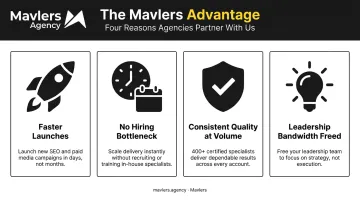
Beyond cost, agencies choose this model for:
- Faster launches: dedicated Webflow teams with established processes typically move quicker than in-house staff juggling multiple platforms at once
- No hiring bottleneck: sourcing skilled Webflow developers in competitive Western markets takes weeks or months; a partner is already staffed and ready
- Consistent quality at volume: structured, process-driven partners like Mavlers Agency use AI-assisted QA workflows to catch issues before handoff, no matter how many projects run in parallel
- Leadership bandwidth freed up: when execution is handled externally, agency owners can focus on client acquisition and strategy instead of babysitting builds
The common thread: agencies stop treating Webflow capacity as a fixed constraint and start treating it as something they can scale up or down on demand.
Webflow White Label Services Agencies Can Offer
Once you have a reliable partner, the service menu you can offer clients expands considerably. Typical categories include:
- Custom Webflow design and development: full builds from scratch, tailored to client brand and functionality needs
- Figma-to-Webflow conversion: turning finished design files into live, responsive Webflow sites
- Webflow CMS builds: structured content models for blogs, resource hubs, or other content-heavy sites
- Ecommerce development: Webflow's native ecommerce tooling for product catalogs and checkout flows
- Platform migrations: moving existing sites from WordPress, Wix, Squarespace, or HubSpot into Webflow
Two services extend the relationship past launch day: SEO optimization and ongoing maintenance. These give clients a reason to keep paying monthly instead of treating the project as a one-time transaction, which is often where the real margin sits.
How Much Does It Cost to White Label Webflow?
Pricing for white label web development generally follows three models. No source publishes Webflow-specific rate cards, so treat these as general web development benchmarks, not guarantees:
| Pricing Model | Typical Range | Best For |
|---|---|---|
| Project-based | $1,000 to $150,000+ per site | Defined-scope builds with clear deliverables |
| Hourly | $25 to $100+ per hour (varies by region) | Ongoing or evolving scope work |
| Monthly retainer | $500 to $3,000 per month | Continuous design, dev, or maintenance work |
These figures come from general web development pricing surveys by GoodFirms, Clutch, and Upwork, not Webflow-specific benchmarks. Actual quotes shift heavily based on:
- CMS complexity: how many collections, dynamic fields, and content relationships the site needs
- Ecommerce functionality: product volume, payment integrations, and checkout customization
- Third-party integrations: CRMs, marketing automation tools, or custom APIs
- Migration scope: how much content, redirects, and SEO equity need preserving
The real comparison agencies should make is against in-house hiring. The U.S. median annual wage for web developers was $90,930 in May 2024. That figure excludes benefits, which the Bureau of Labor Statistics estimates add roughly 30% on top of wages for private-industry roles.
A full-time hire easily costs six figures once benefits, onboarding, and ramp-up are factored in. A white label partner such as Mavlers Agency, by contrast, is paid only for delivered work.
How to Choose the Right White Label Webflow Partner
Not every partner delivers the same reliability. Before signing anything, run through this checklist:
- Verify Webflow-specific expertise through live site examples, not a generic "we build everything" service list
- Confirm NDA protection is standard practice, not an optional add-on you have to request
- Evaluate their communication process — how they handle revisions, staging environments, and escalations when something breaks
- Check post-launch support terms with defined turnaround expectations, since this is where many partnerships fall apart
- Assess multi-platform coverage across WordPress, Shopify, Webflow, and HubSpot, so you're not locked into a single-CMS partner as your client roster diversifies
- Match their pricing model to how you bill clients, whether that's project-based, hourly, or retainer
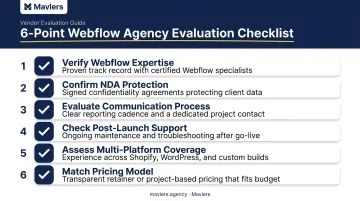
That fifth point matters more than agencies expect. Client rosters rarely stay single-platform for long. A partner like Mavlers Agency, built to deliver across WordPress, Shopify, Webflow, and HubSpot, means one relationship covers your agency regardless of what CMS your next client walks in with.
Frequently Asked Questions
Can you white label Webflow?
Yes. Specialized development partners build Webflow sites under your agency's brand while staying invisible to the end client. This differs from Webflow's own Editor-branding feature, which only rebrands the interface, not the underlying build.
How much does it cost to white label Webflow?
Costs typically fall into three models: project-based ($1,000 to $150,000+), hourly ($25 to $100+), or monthly retainer ($500 to $3,000). Complexity, not page count, drives the final quote.
Is white labeling illegal?
No. White labeling is a standard, legal business practice used across industries, including software and web development. It works as long as contracts, NDAs, and client agreements are properly structured.
What's the difference between white label and private label web development?
White label means a partner builds under your brand, invisible to the client, often serving multiple agencies with similar processes. Private label implies a pre-built, exclusive product resold with your branding attached.
Will my clients ever find out I'm using a white label Webflow partner?
With proper NDAs, code audits, and agency-only communication protocols, clients typically never learn a third party was involved. The partner never contacts your client directly, and all deliverables carry your branding exclusively.
What's included in ongoing white label Webflow support?
Typical post-launch support covers bug fixes, CMS updates, and performance monitoring, usually under a defined support-window SLA. Always confirm turnaround expectations in writing before the project launches, not after.