
Introduction
Picture a small business owner staring at a spreadsheet, trying to decide whether to spend her last $500 on Google Ads or just "keep posting on Instagram and hope." It's a familiar crossroads. Organic marketing feels safer, but it's slow — and slow doesn't pay rent.
Paid advertising, when structured correctly, gets you in front of ready-to-buy customers immediately rather than waiting months for search rankings to climb.
Competition for that attention keeps intensifying. More than 1.1 million new small-business establishments opened in the US between March 2023 and March 2024 alone, according to the SBA Office of Advocacy. That's a lot of new competition fighting for the same searches and scroll-stopping ad space.
This guide breaks down realistic budgets, platform selection, proven ROI strategies, and the mistakes that drain ad budgets without warning.
Key Takeaways
- Paid ads generate faster, trackable growth than organic reach for small businesses
- Budget 5-10% of gross revenue as a benchmark, adjusting for industry and growth stage
- Platform fit matters more than total spend: Google Ads, Meta, and niche channels differ
- Landing pages, tight targeting, and tracking separate profitable campaigns from waste
Why Paid Advertising Is Essential for Small Business Growth
Paid advertising runs on an auction model. You bid to show your ad when someone searches a keyword, scrolls past a certain audience segment, or matches a behavioral profile — and you pay only when they click, view, or convert. No auction win, no charge.
That structure creates a built-in advantage for small operators: you never overcommit. Unlike a billboard lease or a print ad buy, you can:
- Start with $10 a day and scale up only when results justify it
- Pause a campaign instantly if it's underperforming
- Shift budget between campaigns in real time based on what's working
Precision Targeting Beats Guesswork
Smart budgeting only works if the right audience sees the ad. Platforms let you layer targeting by demographics, location, interests, and past behavior. A local plumber can show ads only to homeowners within a 15-mile radius searching "emergency drain repair," not to random browsers three states away.
You Can Measure Everything
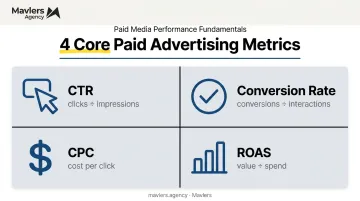
Precision targeting narrows who sees your ad, but proving it pays off is next. Every paid channel reports the numbers that matter:
- CTR (click-through rate) — clicks divided by impressions
- Conversion rate — conversions divided by trackable ad interactions
- CPC (cost per click) — what you actually pay per click
- ROAS (return on ad spend) — conversion value divided by spend
Small businesses are already leaning into this shift. A 2025 Intuit survey found 27% of small businesses used paid search advertising and 75% used social media advertising, according to QuickBooks' 2025 Small Business Advertising Trends Report.
If most of your competitors are already bidding on the same keywords or audiences, sitting out costs you ground you can't easily win back.
How Much Should a Small Business Budget for Paid Advertising?
There's no universal magic number, but 5-10% of gross revenue is a widely used starting benchmark for advertising spend overall. A business generating $500,000 annually might allocate $25,000-$50,000 a year toward paid channels, adjusting up during growth pushes or down during lean quarters.
Before committing to a monthly figure, test small:
- Start with a modest daily budget ($15-$30) for the first one to two weeks
- Watch early click and conversion data before scaling
- Commit to a larger monthly budget only after confirming the campaign isn't bleeding money
Typical Cost Ranges Across Platforms
Costs vary widely by platform and industry. Here's what recent benchmark data shows:
| Platform | Average CPC | Notes |
|---|---|---|
| Google/Microsoft Search | $5.42 | Based on WordStream's 2026 benchmark of 13,474 US campaigns |
| Meta (traffic campaigns) | $0.70 | Lower cost, awareness-focused |
| Meta (lead campaigns) | $1.92 | ~7.7% conversion rate, ~$27.66 cost per lead |
| TikTok | ~$13.26 CPM | Cost measured per thousand impressions, not per click |
Your goal shapes your budget allocation. Brand awareness campaigns optimize for reach and impressions, while lead generation campaigns chase a low cost per lead and direct sales campaigns chase a strong ROAS. Don't judge a display campaign by the same yardstick as a search campaign chasing conversions.
A simple budgeting formula: Take your target customer acquisition cost, multiply by your expected monthly conversions, and that's your baseline ad spend. Adjust based on your average order value — if a $200 sale only costs $40 to acquire, you have room to scale aggressively.
Review performance monthly, not annually. Reallocate toward what's converting and cut what isn't.
Best Platforms and Agencies for Paid Advertising for Small Businesses
Platform choice should follow your business model, not trends.
| Business Type | Best-Fit Platform |
|---|---|
| Local service business | Google Ads (Search + Local) |
| Ecommerce / DTC brand | Meta (Facebook & Instagram) |
| Younger consumer audience | TikTok |
| Visual/inspiration-driven products | |
| B2B / professional services |
Top Paid Advertising Platforms to Consider
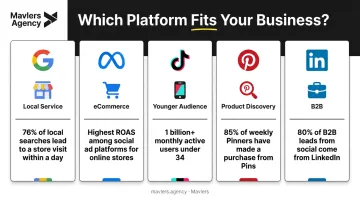
Google Ads wins for high-intent search, particularly for local and service-based businesses. Google/Ipsos research found that 76% of people who searched for something nearby on their smartphone visited a business within a day, and 28% of those searches resulted in a purchase. When someone types "emergency electrician near me," they already intend to buy.
Meta Ads (Facebook & Instagram) shine for ecommerce and DTC brands thanks to granular audience targeting and retargeting tools. Pew Research found 71% of US adults use Facebook and 50% use Instagram, giving Meta broad reach with precise segmentation.
Niche platforms fill specific gaps:
- TikTok: best for reaching adults under 30, where roughly half check the app daily
- Pinterest: strong for product discovery; 80% of weekly Pinners say the platform inspires purchases
- LinkedIn: the default for B2B lead generation, though it publishes no fixed CPC benchmark since pricing is entirely auction-driven
In-House Management or an Agency?
Running campaigns yourself costs less upfront but demands real time investment: learning bid strategies, writing ad copy, and interpreting reports weekly. Agencies cost more but bring faster optimization and scaling expertise.
Consider DIY if:
- Your budget is under $1,000/month
- You have one straightforward campaign goal
- You can dedicate a few hours weekly to management
Consider an agency if:
- You're running multiple campaigns across platforms
- You lack time for weekly optimization
- Complexity is growing faster than your team's bandwidth
One overlooked bottleneck: agencies taking on more small business ad clients often need extra hands to manage campaign builds, tracking, and reporting without expanding their core team.
This is where white-label partners fit in. Mavlers Agency, for example, works behind the scenes with marketing agencies to manage Google Ads and Meta campaign execution under the agency's own branding, letting agencies scale client work without hiring additional staff or slowing down delivery.
Proven Strategies to Maximize Your Paid Advertising ROI
Getting ads live is easy. Getting them profitable takes discipline.
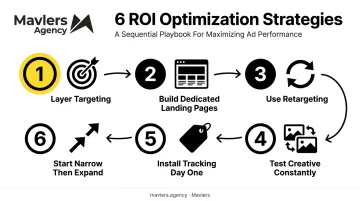
Layer your targeting by combining demographic, geographic, and behavioral filters, which consistently outperforms broad targeting on tight budgets. A yoga studio targeting "women, 25-45, within 10 miles, interested in wellness" wastes far less money than one targeting "everyone in the state."
Build dedicated landing pages instead of sending ad traffic to your generic homepage, which dilutes intent. In one PPC A/B test cited by Unbounce, a dedicated landing page produced 73% higher conversions than the homepage control. Match the page message exactly to the ad that brought the visitor there.
Use retargeting since most visitors won't convert on their first visit. Retargeting pixels let you re-engage people who browsed but didn't buy, keeping your brand visible as they move closer to a decision.
Test creative constantly by rotating ad copy, images, and formats every few weeks. Audiences develop banner blindness fast, and stale creative quietly tanks performance even when targeting stays sharp.
Install tracking from day one by adding conversion pixels and UTM parameters before you spend a single dollar. Without this, you're flying blind — unable to tell which campaign, ad, or keyword actually drove a sale.
Start narrow, then expand by picking one or two platforms first. Review performance weekly, then shift budget toward what's converting before adding a third or fourth channel.
Common Paid Advertising Mistakes Small Businesses Should Avoid
Most wasted ad budgets trace back to a handful of repeatable errors:
- Spreading spend too thin: Running $200 across five platforms rarely generates enough data on any single channel to optimize properly
- Using overly broad targeting or keywords: Skipping negative keywords means paying for clicks from people who were never going to buy
- Skipping tracking setup: Without pixels or UTMs in place, you can't tell which campaigns are actually driving revenue
- Setting and forgetting budgets: Campaigns need weekly attention, not a "set it once" mindset
Fix these four issues and most small business ad accounts improve within weeks.
Frequently Asked Questions
How much should a small business budget for paid advertising?
A common starting benchmark is 5-10% of gross revenue, though this should flex based on your growth goals, industry, and early campaign performance.
Which agencies or platforms are best for paid advertising for small businesses?
It depends on your business type. Google Ads works well for local and service businesses, while Meta suits ecommerce brands better. B2B companies and those targeting younger audiences often turn to LinkedIn or TikTok instead. Agencies can help scale execution once complexity grows.
What's the difference between paid advertising and organic marketing?
Paid advertising is a promotional tactic you pay for directly, offering faster and more controllable reach. Organic marketing builds visibility over time through content, SEO, and unpaid engagement.
How long should a paid ad campaign run before evaluating results?
Give campaigns at least one to two weeks before making major changes. Platforms need time and data volume to optimize delivery accurately.
Can a small business succeed with paid ads on a very tight daily budget?
Yes. Even $10-$15 daily can work if targeting is narrow and creative is strong. Meta, for instance, recommends a minimum of roughly $5 sustained over six or more days.
Should a small business hire an agency or manage paid ads in-house?
In-house management works fine for simple, low-budget campaigns. As spend and platform complexity grow, agencies typically add enough value in expertise and time savings to justify their fees.