This scenario plays out constantly. 78% of agencies now offer SEO services, according to a 2024 SparkToro survey of 612 agency owners and consultants, making it the most commonly offered service category in the industry. Falling behind on SEO capacity isn't a minor gap anymore. It's a competitive liability.
This guide breaks down what white label SEO actually is, the services it covers, why agencies use it, whether it's legal, and how to vet a provider you can trust.
Key Takeaways
- White label SEO is a three-party model: providers do the work, agencies rebrand and resell it, and clients stay unaware
- Core services include keyword research, technical SEO, content, link building, local SEO, and branded reporting
- It's completely legal, comparable to private labeling in retail and manufacturing
- The right partner combines transparency, proven results, and flexible pricing
- Agencies hitting SEO hiring walls often face the same challenge in web development, worth exploring similarly
What Is White Label SEO?
White label SEO is a business arrangement where an agency buys SEO work from a specialized provider and sells it to clients under its own brand name. The client never sees the provider's name on anything.
Think of it like store-brand groceries. The same manufacturer often produces the cereal sold under a supermarket's private label and the name-brand version next to it on the shelf. Shoppers buying the store brand get comparable quality without ever knowing who actually made it. White label SEO works the same way, just with rankings and reporting instead of cereal boxes.
Breaking Down the Three Parties Involved
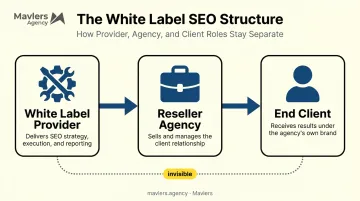
Every white label SEO arrangement involves three distinct roles:
- The white label provider handles the technical execution: audits, content production, link building, and rank tracking. This role stays completely invisible to the end client.
- The reseller agency owns the client relationship, sells the service, and presents the results as its own work.
- The end client pays for SEO, typically unaware that a third party is doing the heavy lifting.
Picture a content marketing agency that's great at editorial strategy but has zero technical SEO staff. A client asks for full SEO support.
Instead of turning them down, the agency partners with a white label provider, who runs the audits, builds the links, and produces the reports. The agency then packages everything under its own logo and presents it to the client as its own deliverable.
This differs from simply hiring a freelance SEO consultant. With a freelancer, there's often direct client contact and looser confidentiality expectations. White label arrangements run on strict non-disclosure protocols and unbranded deliverables specifically designed so the reseller keeps full ownership of the client relationship.
Types of White Label SEO Services You Can Offer
White label providers typically cover the full SEO stack, so agencies can offer a complete package rather than piecing together fragments.
This includes:
- Keyword research: Identifying high-value, intent-driven search terms—including non-branded, research-stage queries—that drive conversions, not just traffic.
- On-page and technical SEO: Optimizing title tags, meta descriptions, header structure, site architecture, page speed, and structured data (schema/JSON-LD) so search engines can crawl and understand a site properly.
- Content creation and optimization: Blog posts, landing pages, and other content built around identified demand gaps, paired with proper title, meta, and internal linking structure.
- Link building: Earning backlinks from relevant, authoritative sites through outreach and guest posting to build domain authority over time.
- Local SEO: Google Business Profile optimization, citation building, and NAP (name, address, phone) consistency across directories for businesses with physical locations.
- White label reporting: Branded dashboards covering rankings, traffic, and conversions, formatted so resellers can present them as their own.
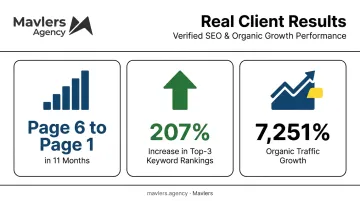
These services deliver measurable results when they work together. In one Mavlers Agency engagement with a multi-location real estate brand, fixing NAP inconsistencies and optimizing 14 Google Business Profiles helped the client move from page six to page one within eleven months, alongside a 207% increase in top-3 keyword rankings.
Another client, Airtasker, saw 7,251% organic traffic growth through combined technical audits, link building, and content syndication across 50+ publications.
Benefits of White Label SEO for Agencies
Cost and Speed Advantages
Building an in-house SEO team means recruiting, training, and retaining specialized talent, an expensive, slow process. The average US SEO Specialist salary sits at $96,559 a year, according to Salary.com, and that figure doesn't include benefits, recruiting costs, software subscriptions, or ramp-up time.
White label partnerships convert that fixed cost into a variable one tied directly to client revenue.
Agencies also move faster. Instead of spending months hiring, they can start delivering SEO services within weeks, immediately becoming a one-stop shop rather than turning away work.
Capacity Without Constraints
Beyond cost, white label partnerships solve a structural problem: capacity.
- Specialized tools and workflows: providers bring proven systems agencies would otherwise spend months building
- Sharper strategic focus: agencies handle client relationships while execution happens behind the scenes
- Scalability without hiring: agencies take on more clients and larger projects without added headcount
This is the model behind Mavlers Agency' positioning as an invisible delivery engine: agencies scale project output and improve margins without adding a single employee. As the company puts it, "Your clients get results. You get the credit."
Is White Label SEO Illegal or Unethical?
No. White label SEO is completely legal. It's a standard business practice, structurally similar to private labeling used across retail, manufacturing, and software. Reseller and white-label agreements are recognized contract categories, covering intellectual property, confidentiality, quality standards, and liability terms, not some legal gray area.
Here's the nuance worth understanding: legitimacy depends on how the SEO is executed, not on the reseller model itself. Whether or not an agency discloses outsourcing to its client is a business decision, not a legal requirement.
Where things actually go wrong is when a provider uses black-hat tactics. Google's Spam Policies explicitly prohibit:
- Cloaking: showing search engines different content than what users see
- Keyword stuffing: cramming pages with repetitive or irrelevant keywords to manipulate rankings
- Link spam: buying links or running excessive link exchanges purely to game rankings
- Doorway pages: creating multiple pages that funnel users to the same destination to manipulate rankings
According to Google's Spam Policies, these practices carry real penalty risk, but the risk comes from the technique, not from the white label arrangement itself. A reseller working with a provider that follows Google's Search Essentials guidelines has nothing to worry about legally.
How to Choose the Right White Label SEO Partner
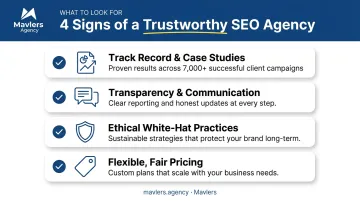
Not all providers are equal. Before signing a contract, check for these four things.
- Track record and case studies: Ask for documented results across multiple industries, not vague promises. Mavlers Agency, for example, grew one client's Domain Authority from 10 to 37 with 2,900 new linking root domains.
- Transparency and communication: Expect regular, detailed reporting and quick responses to your questions. If a provider goes quiet between reports, that's a red flag.
- Ethical, white-hat practices: Confirm the provider follows Google's Search Essentials and avoids anything that could get a client's site penalized.
- Flexible, fair pricing: Packages should let you mark up services profitably while still tailoring solutions client by client.
Beyond SEO: Pairing With a White Label Web Development Partner
Agencies that scale SEO delivery through white labeling often hit the same capacity wall in web development. Design and dev talent is just as hard to hire and retain as SEO talent.
Mavlers Agency extends its white label model to web development across WordPress, Shopify, Webflow, and HubSpot, operating entirely behind the agency's brand under strict confidentiality agreements.
No Mavlers Agency branding ever appears on a deliverable. A dedicated project manager runs point, so the agency's clients never know a third party is involved.
For agencies already comfortable outsourcing SEO, pairing it with white label development is a natural next step, letting them scale their entire service stack, not just one line item, without hiring anyone new.
Frequently Asked Questions
What is white label SEO?
White label SEO is a three-party setup: a specialized provider does the SEO work, and a reseller agency brands and sells it as its own. The end client typically never learns a third party was involved.
Is white label SEO illegal?
No, it's fully legal and comparable to private labeling used in retail and manufacturing. Legal risk only comes from unethical, black-hat techniques like cloaking or link spam, not from the reseller model itself.
Which tag is most important for on-page SEO?
The title tag is the strongest on-page element, since Google often uses it to generate the headline searchers click on. Meta descriptions and header tags matter too, but neither carries the same weight for relevance and click-through rate.
How much does white label SEO typically cost?
Pricing varies by scope and provider. Basic local packages start around $300 to $500 per month, broader campaigns run $700 to $1,000, and comprehensive strategies reach $1,500 or more monthly.
Can white label SEO be combined with other white label services like web development?
Yes. Many agencies pair white label SEO with white label web development to offer full-service delivery, letting clients get design, dev, and search all under one roof without the agency expanding its internal team.
What's the difference between white label and private label SEO?
The terms are often used interchangeably in SEO. When there's a distinction, "private label" implies the client shapes the offering, while "white label" usually means reselling a standardized service as-is under a new brand.