Introduction
Online shoppers now have hundreds of nearly identical stores to choose from, and ad costs keep climbing while ad ROI keeps shrinking. Many brands still treat content as an afterthought: a blog post here, a random Instagram Reel there, no connective tissue between them.
That approach doesn't survive contact with today's buyer. Shoppers research across five or six touchpoints before they ever add something to a cart, and they expect brands to show up with answers, not just ads.
Content marketing consistently ranks among the best-ROI channels for B2C brands, alongside email and paid social. But scattered content doesn't earn that ROI. An interconnected strategy does.
This post breaks down 15 actionable strategies, grouped into three phases: foundation, creation, and distribution, and measurement.
Key Takeaways
- A structured content strategy blends audience research, high-impact formats, and consistent measurement
- Product pages, guides, video, and UGC each serve a distinct part of the buyer journey
- SEO, social distribution, and influencer partnerships determine whether content gets seen
- Business stage and catalog size should dictate which strategies you prioritize first
- Tracking traffic, conversions, CLV, and CAC shows which content actually drives sales
Building the Foundation: Strategies for Audience Insight & Planning
No content format works if you skip the groundwork first. Before writing a single blog post, you need to know who you're talking to and where they stand in their buying journey. These five strategies build that foundation.
Strategy 1: Develop Detailed Buyer Personas
Demographics alone won't tell you why someone buys. Personas need to capture motivations, hesitations, and the specific problem your product solves for them.
Personalization pays off directly. 76% of consumers say personalized communications influence which brands they'll even consider, and 78% say personalized content makes them more likely to buy again, according to McKinsey's research on personalization.
Consider a skincare brand selling the same serum to two different buyers:
- Budget-conscious buyer: Wants proof it works before spending more. Content should emphasize value, ingredient efficacy, and honest before/after results.
- Premium buyer: Wants status and ritual. Content should lean into luxury packaging, formulation science, and exclusivity.
Same product, two completely different content angles.
Strategy 2: Conduct a Competitive Content Audit
Tools like Ahrefs or Semrush let you see exactly what competitors rank for, and where they're falling short. The goal is spotting gaps competitors leave open.
A common finding: a competitor dominates blog content but has almost no video presence, or ranks well for informational terms but has thin, unhelpful review pages. That gap is your opening.
Strategy 3: Map Content to Every Stage of the Customer Journey
Content needs a job at every stage:
- Awareness – Educational blog posts, guides, and quizzes that address a problem, not a product
- Consideration – Comparison content, explainer videos, and case studies
- Decision – Reviews, FAQs, demos, and cart-recovery emails
- Loyalty – Post-purchase guides, referral prompts, and loyalty content
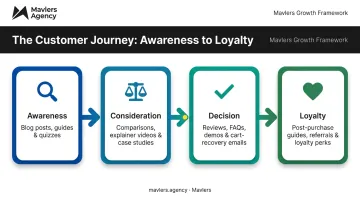
Skip the decision stage, and you'll see traffic without conversions. It's one of the most common reasons content generates clicks but not sales.
Strategy 4: Build a Consistent Content Calendar with Repurposing in Mind
A content calendar should track content type, target keyword, distribution channel, and reuse plans for each piece, going beyond simple publishing dates.
Example repurposing chain: One in-depth blog post becomes a five-slide social carousel, a 60-second product video, and a short email snippet promoting the full guide. One piece of work, four touchpoints.
Strategy 5: Create Topic Clusters for SEO Authority
The pillar-and-cluster model organizes content around a broad "pillar" page that links out to narrower "cluster" posts, which link back to the pillar. This internal linking structure signals topical authority to search engines and gives users a clear path to related content.
Example: A "complete skincare routine" pillar page links to cluster posts on cleansers, serums, SPF, and night creams — each targeting a specific search term while reinforcing the pillar's authority.
Creating High-Converting Content: Formats That Drive Sales
With the foundation set, the next priority is producing content in formats proven to turn browsers into buyers. These five strategies focus on execution.
Strategy 6: Master Product Page Content
Your product page is a 24/7 salesperson. Too many brands waste that opportunity with a bullet list of specs and one stock photo.
Weak version: "100% cotton t-shirt. Available in 5 colors. Machine washable."
Strong version: "Soft, breathable cotton that holds its shape wash after wash — built for long days on your feet. Available in 5 colors, true to size."
Non-negotiables for high-performing product pages:
- Include multiple high-quality images and at least one product video
- Add an FAQ section addressing sizing, materials, and shipping concerns
- Display reviews above the fold, not buried at the bottom
Scaling this across a catalog of 500+ SKUs is where most in-house teams stall. Agencies without spare content bandwidth increasingly lean on white-label content and SEO partners like Mavlers Agency to write and optimize product page copy at scale across Shopify, WooCommerce, and similar platforms, without adding headcount.
Strategy 7: Publish In-Depth Educational Content
How-to guides and buying guides position your brand as an educator first, seller second. This builds long-term SEO equity because it answers questions people are already typing into Google.
The key is grounding topics in real customer search queries, not generic "10 tips" listicles. A mattress brand writing "how to choose a mattress firmness for back pain" will outperform a vague "sleep tips" post every time, because it matches actual buyer intent. Link each guide directly to the relevant product category, turning that organic traffic into visitors who are already primed to buy.
Strategy 8: Dominate with Video Marketing
Product demos, unboxing videos, and shoppable live streams reduce purchase hesitation by showing exactly what a buyer is getting before it arrives.
Short-form video consistently outperforms other formats for marketer-reported ROI, with nearly half of marketers naming it their top-performing format ahead of long-form and live video, according to HubSpot's 2024 State of Marketing report. A skincare brand's 15-second application demo, for instance, can answer sizing and usage questions a static product photo never could. It works because short-form video meets shoppers where their attention already is: quick, mobile, and skimmable.
Strategy 9: Build Trust with User-Generated Content (UGC)
Polished brand photography looks nice. It doesn't always convert. Real customer photos, unboxing clips, and honest reviews do the heavier lifting because shoppers assume brands only show their product's best angle.
89% of shoppers consult reviews before buying, according to Bazaarvoice's research on user-generated content, and the same study found most shoppers trust UGC more than branded product photography.
Simple ways to generate more of it:
- Run a branded hashtag contest with a small prize incentive
- Email customers a review request 7-10 days post-delivery
- Feature customer photos directly on product pages
Strategy 10: Personalize Content with AI
AI now supports every stage of content production: generating topic ideas, drafting faster first passes, and serving personalized product recommendations to each visitor based on browsing behavior.
The revenue impact is measurable at the retail level. According to McKinsey's research on personalization at scale, AI-enabled targeted promotions can lift total sales by 1% to 2% and improve margins by 1% to 3%, with one North American retailer seeing a 3% margin boost during initial testing. Modest on paper, but meaningful at scale across a full catalog.
Distributing, Optimizing & Measuring Content for Maximum Reach
Even excellent content fails without smart distribution, solid technical SEO, and consistent measurement. These final five strategies cover getting content seen and proving it works.
Strategy 11: Integrate SEO Best Practices Throughout
Every piece of content needs keyword research, on-page optimization (titles, alt text, meta descriptions), and a technically sound site behind it: fast load times, mobile-friendly layouts, clean indexing.
Category pages are the most overlooked opportunity here. Brands pour effort into blog SEO while leaving category pages with zero unique copy, missing an easy ranking win for high-intent, commercial search terms.
Strategy 12: Amplify Through Social Media and Email
Channel selection should follow your audience, not marketing trends. If your buyers live on Pinterest, don't force a TikTok strategy.
Email remains the workhorse for repeat purchases. Segmenting by purchase history, browsing behavior, or engagement level consistently drives stronger open and click rates than blanket sends. This is why so many e-commerce brands treat their email list as their most valuable owned asset.
Strategy 13: Collaborate with Influencers and Subject-Matter Experts
Micro-influencers (10,000–50,000 followers) typically post more engaged content than macro-influencers, because their audiences feel like peers rather than celebrities.
That said, influencer content shouldn't replace customer proof. Edelman's trust research found that 84% of people trust brand information from friends and family, and 80% trust customers like themselves, compared to just 58% who trust influencers. Use influencer partnerships to extend reach, and pair them with real reviews to build actual trust.
Strategy 14: Explore Emerging Channels and Formats
Three areas worth watching:
- Voice search: Optimizing content for conversational, question-based queries as smart speaker use grows
- Marketplace content: Amazon A+ Content, which Amazon itself states can lift sales by up to 20% when done well
- Headless/composable commerce: Decoupling your front-end experience from the back-end platform for faster, more flexible content delivery
Headless architectures future-proof your content distribution, but the migration carries real technical SEO risk, including broken redirects, lost schema, and indexing gaps. This is exactly the kind of technical SEO audit work where agencies managing several e-commerce clients often bring in a specialized partner like Mavlers Agency rather than pulling developers off other projects.
Strategy 15: Measure Content Marketing ROI Consistently
Track these core metrics on a recurring basis, not just at campaign launch:
- Organic traffic – Are the right people finding you?
- Conversion rate – Is content actually driving purchases?
- Customer lifetime value (CLV) – Are content-acquired customers worth more over time?
- Customer acquisition cost (CAC) – Is content lowering your blended acquisition cost?
- Engagement metrics – Time on page, scroll depth, video completion rate
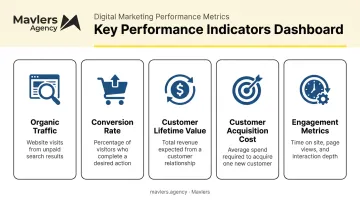
Google Analytics and attribution modeling remain the standard tools here. Content marketing typically costs less and delivers higher ROI than paid acquisition over the long run, largely because content assets keep working long after a paid campaign budget runs dry.
How to Prioritize These Strategies for Your Business Stage
Not every brand needs all 15 strategies running simultaneously. A new or small store should start narrow:
- Build 2-3 buyer personas
- Get product pages right (Strategy 6)
- Nail basic on-page SEO (Strategy 11)
- Pick one content format to master before adding more
Layer in AI personalization, headless commerce, or influencer programs only once the fundamentals are converting consistently.
Even with priorities set, most teams stall on execution, not strategy. Full topic cluster rollouts, product page rewrites, and ongoing technical SEO all demand more writing and optimization hours than most internal teams have spare.
Agencies juggling multiple e-commerce clients increasingly turn to white-label content and SEO partners like Mavlers Agency to execute this work reliably across Shopify, WooCommerce, Magento, and BigCommerce, all without expanding headcount.
Before adding anything new, audit your current content against these 15 strategies and identify your three biggest gaps.
Conclusion
Content marketing for e-commerce compounds over time, functioning as infrastructure you build steadily rather than a campaign you launch once and forget. Consistency across all 15 strategies, not a burst of activity on one, produces sustainable growth.
Start with the foundation: personas, journey mapping, and a real content calendar. Advanced tactics like AI personalization mean little without that groundwork in place.
When internal teams lack the bandwidth to build and maintain content-heavy web experiences, pairing that strategy with a reliable execution partner often turns a good plan into results.
Frequently Asked Questions
What is the main goal of content marketing in e-commerce?
The goal is building trust and educating buyers who can't physically touch or try the product before purchasing. Done well, it also drives long-term brand loyalty alongside direct sales.
How do you measure the success of an e-commerce content strategy?
Track organic traffic, conversion rate, engagement metrics, and customer lifetime value together, not in isolation. No single metric tells the full story.
What is the difference between a B2B and B2C e-commerce content strategy?
B2C content tends to be emotional and lifestyle-driven, focused on how a product fits someone's life. B2B content leans on logic, ROI, and data to justify a purchase decision to multiple stakeholders.
How often should e-commerce brands publish new content?
Consistency matters more than raw frequency. A content calendar built around repurposing helps maintain a sustainable, regular cadence without burning out your team.
What type of content converts best for online stores?
Product page content, video demos, and UGC/reviews tend to have the most direct impact on conversion. The exact mix varies by product category and price point.
Do small e-commerce brands need to implement all 15 strategies at once?
No. Smaller brands should prioritize foundational strategies, personas, strong product pages, and basic SEO, before scaling into advanced tactics like AI personalization or emerging channels.