Get the timing wrong, and you end up with generic campaigns, wasted budget, and a sales team that doesn't trust the leads coming in. Outsource too early, before you know your ideal customer, and an agency ends up guessing at strategy you should already own. Wait too long, and burned-out teams keep missing deadlines while competitors move faster.
This guide breaks down the signals that indicate you're actually ready, the scenarios where outsourcing backfires, and what to do about it either way.
Key Takeaways
- Readiness hinges on specific triggers, not a calendar date, like burnout or a stalled pipeline
- Capacity strain, missing skills, new launches, or leadership gaps are the clearest signal to outsource
- Outsourcing before product-market fit or ICP clarity wastes months and budget on guesswork
- Pairing internal strategy with outsourced execution usually offers the lowest-risk path
- Getting timing right improves cost efficiency, speed to market, and campaign quality
Why Timing Matters for B2B Marketing Outsourcing
Outsourcing doesn't create strategy. It executes strategy. When you bring in outside help before your internal direction is set, you're not accelerating growth, you're just paying someone to move faster in the wrong direction.
The data backs this up. In Gartner's 2024 survey of 403 CMOs, 84% reported high levels of strategic dysfunction caused by unclear or conflicting objectives. Organizations with high dysfunction were 36% less likely to report strong business and marketing performance. Hand a confused strategy to an outside team and the confusion just gets executed at scale.
Speed-to-Value Differences
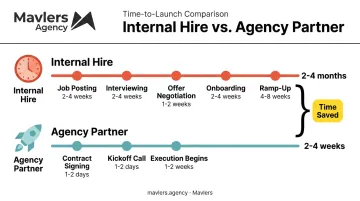
Strategic clarity determines direction, but speed determines how quickly that direction turns into results. Hiring an internal specialist means writing a job description, interviewing, negotiating an offer, then onboarding someone who still needs time to learn your product and market before they're truly productive. An established agency partner, by contrast, already has the tooling, processes, and specialists in place. They can typically start executing within weeks rather than months.
That speed gap matters most when the following scenarios apply:
- Your product launch has a hard, non-negotiable date
- Funding pressure demands proof of pipeline growth, fast
- A new competitor just entered your market
Risk and Quality Considerations
Speed and strategic alignment aren't the only variables worth weighing, though. Outsourcing at the wrong stage risks losing control over brand voice and messaging consistency. It also creates misalignment between agency KPIs (leads generated, content published) and sales team goals (qualified pipeline, closed revenue). When those metrics aren't agreed upon upfront, friction follows fast.
Signs It's the Right Time to Outsource B2B Marketing
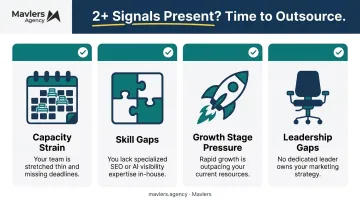
Think of this as a validation checklist. If two or more of these signals are present, outsourcing is likely to solve a real problem rather than mask one.
Based on Team Capacity and Workload
Overburdened teams operating in constant reactive mode rarely produce their best work. A Marketing Week analysis of 600 B2B marketers found that 58.8% had been asked to deliver more with fewer resources over the preceding year. Another 42.2% had gone through team restructuring in that same window.
Watch for these patterns:
- Slipping deadlines despite reasonable effort
- Declining new initiatives due to bandwidth constraints
- Slowing campaign cadence despite steady demand
If your team has hit its ceiling, outsourcing adds capacity without adding headcount risk.
Based on Skill Gaps
A missing specialized skill (SEO, ABM, paid media, or marketing ops) that blocks a critical initiative is one of the clearest triggers. Training someone internally takes months. Hiring a full-time specialist takes even longer, and specialist salaries aren't cheap.
For context, national salary benchmarks put a Senior SEO Specialist at roughly $115,175 per year, and a Digital Marketing Manager around $115,281 per year, according to Salary.com's compensation data. That's before recruiting costs, benefits, or the ramp-up period a new hire needs before they're fully productive.
An outsourced partner gives you access to that same expertise immediately, without the fixed cost of a full-time role.
Based on Growth Stage or Market Events
New market entry, a product launch, or a funding round often demands execution speed that a lean internal team simply can't match alone. These moments compress timelines. There's no room to hire and train someone new.
Another signal: a pipeline that's stalled for two or more consecutive quarters despite consistent internal effort. That pattern usually points to a strategy or skill gap, not a lack of hours worked.
Based on Leadership Gaps and Delivery Capacity
Having no marketing leader, or being caught between hires, is a strong trigger for a fractional or agency model that keeps momentum going while you search.
This applies differently if you're an agency yourself. Agencies that hit project capacity limits or run into hiring bottlenecks on execution-heavy work, like web development, face a specific choice: turn down client briefs, or white-label that delivery to a specialized partner.
This is the exact gap Mavlers Agency fills. Agencies in the 10 to 75 person range use Mavlers Agency to handle overflow WordPress and Shopify development work under strict confidentiality, so client-facing teams keep saying yes to new briefs without adding headcount.
When You Should Avoid Outsourcing B2B Marketing
Timing mistakes cut both ways, and here's when bringing in outside help does more harm than good.
- Before product-market fit is confirmed. Outsourcing amplifies a message the market hasn't validated yet. Founder-led discovery, talking directly to early customers, needs to come first.
- Without a defined ICP. An agency without a clear ideal customer profile has to reverse-engineer basics you should already own, burning months on foundational work instead of execution.
- No internal owner assigned. If nobody on your team can dedicate a few hours a week to managing the relationship, the partnership drifts into unaligned busywork with no one steering it.
- For core strategic work. Brand positioning, executive messaging, and customer relationships depend on proprietary knowledge no outside partner has. Keep that in-house.
What Happens If You Outsource at the Wrong Time
Bad timing has consequences that compound quickly.
Performance degradation. Without a clear strategic foundation, campaigns come out generic. Conversion rates suffer, and ad spend gets wasted testing messages nobody validated first.
Increased costs and rework. You end up paying twice: once for outsourced work built on a shaky foundation, and again to redo it once your ICP and positioning get clarified internally.
Control and alignment issues. A survey of 250+ senior marketers found only 24% were satisfied with agency collaboration, with the top friction point being a lack of agreed success metrics.
When qualification criteria between an outsourced marketing team and internal sales were never agreed on, that friction surfaces fast. Leads pile up that sales won't touch, and brand voice slowly drifts off course.
Best Practices for Timing Your Outsourcing Decision Correctly
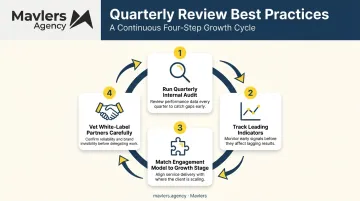
Getting the timing right takes continuous attention, revisited every quarter as your team and pipeline evolve.
- Run a quarterly internal audit of team capacity, skill gaps, and pipeline health to catch outsourcing triggers before deadline pressure forces a reactive scramble.
- Track leading indicators over time. Team utilization and campaign cadence reveal readiness signals long before burnout or stagnation sets in; pipeline growth is the third piece of that puzzle.
- Match the engagement model to your growth stage. Project-based, fractional, full retainer, or hybrid, don't default to whatever's first available. A stalled-pipeline problem needs different support than a leadership gap does.
- Vet white-label partners carefully. For execution-heavy work, prioritize confidentiality agreements and tight client-facing integration. Mavlers Agency backs this with named resources per account, pre-ship QA checks, and 24-48 hour SLA turnarounds, helping 10-75 person agencies scale output without adding headcount.
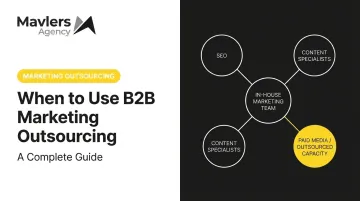
A hybrid setup, where strategy stays internal and execution gets outsourced, tends to be the most economical and lowest-risk path for most growing B2B companies.
Frequently Asked Questions
What is B2B outsourcing?
B2B outsourcing is when one business delegates a specific function, such as marketing, sales, or IT, to an external specialized partner instead of building that capability internally. It lets companies access expertise without the overhead of hiring.
What are the 4 types of B2B marketing?
The common categories are content marketing, account-based marketing, demand generation, and inbound/SEO-driven marketing. Each of these can be outsourced independently based on where your internal gaps are.
When should you avoid outsourcing B2B marketing?
Avoid outsourcing before you've confirmed product-market fit, before you've defined your ideal customer profile, or if nobody internally has time to manage the partnership. Any of these turns outsourcing into wasted spend.
How much does B2B marketing outsourcing typically cost?
Fractional marketing leadership often runs $200-$350 per hour or roughly $5,000-$10,000 a month, while execution retainers vary widely by scope. These figures shift with market conditions, so verify current rates before budgeting.
How long does it take to see results from outsourced B2B marketing?
The first few weeks usually focus on onboarding and strategy alignment. Measurable pipeline results tend to emerge within a few months, depending heavily on your sales cycle length.
What's the difference between outsourcing and hiring a fractional CMO?
Outsourcing typically delegates execution to a team, while a fractional CMO provides part-time senior strategic leadership. Many companies use both together, with a fractional CMO setting direction and an outsourced team executing it.