That shift breaks a lot of standard SEO playbooks. Many B2B teams still chase broad keywords and publish thin content built for quick consumer decisions. It doesn't hold up against long sales cycles and buying committees that include five or more people, each searching for different proof before they'll sign off.
This guide covers a complete, execution-ready B2B SEO strategy for 2026: technical foundations, keyword and content mapping, authority building, and AI search readiness.
Key Takeaways
- B2B SEO speaks to buying committees, not single consumers, over longer sales cycles
- Technical SEO (speed, mobile, schema) now drives both rankings and AI-generated answers
- Long-tail, high-intent keywords outperform broad terms for B2B lead quality
- AI Overviews and LLM-based search reward structured, citable content over generic pages
- Industry-relevant backlinks remain a core trust signal for credible B2B brands
What Is B2B SEO and How Is It Different From B2C?
B2B SEO is the practice of optimizing a website and its content so decision-makers actively researching a solution can find it, evaluate it against alternatives, and trust it enough to bring it to their team. It's less about traffic volume and more about reaching the right handful of people at the right moment.
The structural difference from B2C comes down to audience size and intent. B2B keywords typically carry:
- Lower search volume: hundreds of monthly searches, not tens of thousands
- Higher cost-per-click: reflecting the value of a single closed deal
- Longer research windows: weeks or months, not a same-day purchase
- Multiple searchers per deal: not one consumer making an isolated decision
Why Buying Committees Change Your SEO Approach
B2B purchases aren't decided by one person. Forrester's 2024 State of Business Buying research found that the average B2B buying decision involves 13 people inside the purchasing organization, and 89% of purchases involve at least two departments.
That means an economic buyer, a technical evaluator, an end user, and procurement are all searching different queries and looking for different evidence. A single landing page built for "software features" won't satisfy the finance stakeholder who needs ROI math or the procurement lead comparing vendor risk.
Is SEO Worth It for B2B in 2026?
Yes, and the data backs it up. HubSpot's 2024 State of Marketing research found that website, blog, and SEO ranked first among the marketing channels driving ROI for B2B brands, ahead of paid social and social-shopping tools.
The "SEO is too slow" objection misses how B2B actually buys. Since committees research for months before engaging sales, compounding organic visibility fits the sales cycle instead of fighting it. A prospect who finds your comparison guide in month one and your case study in month three is still in your funnel when procurement finally gets involved.
Building a Technical SEO Foundation for B2B Websites
Keyword and content work can't pay off on a broken foundation. Site speed, mobile-friendliness, secure HTTPS, and clean architecture all determine whether search engines, and increasingly AI crawlers, can even read your site properly.
Core Technical SEO Checklist for 2026
Before investing in content, confirm these are solid:
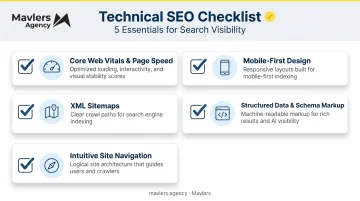
- Core Web Vitals and page speed — loading, interactivity, and visual stability benchmarks
- Mobile-first design — most B2B research now starts on a phone, even if the final purchase happens on desktop
- XML sitemaps — help search engines and AI crawlers find every page
- Structured data and schema markup — clarifies what your content means, not just what it says
- Intuitive site navigation — keeps multi-stakeholder visitors from bouncing before they find proof
Speed matters more than most teams assume. Portent's analysis of over 100 million page views across 14 B2B lead-generation sites found that pages loading in 1 second converted 3 times better than pages loading in 5 seconds. Pages loading in 10 seconds converted 5 times worse than that 1-second benchmark, according to Portent's site speed research.
Where Most B2B Teams Get Stuck: Execution
Audits are easy. Fixing what they uncover is where teams stall. Marketing and SEO staff routinely flag schema gaps, slow load times, and CMS-specific quirks, then wait weeks for developer time that isn't available.
This is where a white-label execution partner earns its keep. Mavlers Agency handles technical SEO implementation across Shopify, WooCommerce, Magento, and BigCommerce builds, so agencies don't have to hire developers just to close audit findings. Outcomes Mavlers Agency has delivered through this model include:
- 40% average organic traffic increase after a full technical SEO fix program
- 30% higher click-through rate from rich results after schema implementation
- 2x faster crawl and indexing following architecture cleanup
- 48-hour onboarding SLA for new client briefs
Clean technical formatting doesn't just help traditional rankings, either. It's also what determines whether AI-generated search results surface and cite your content at all, a theme we'll come back to.
Keyword Research and Content Strategy Mapped to the B2B Buyer Journey
B2B keyword research prioritizes intent and CPC over raw volume. Decision-makers search in specific, problem-aware language, not generic category terms, because they already understand their problem and are hunting for a fix.
Building Bottom-of-Funnel and Top-of-Funnel Keyword Lists
Two keyword types serve different jobs:
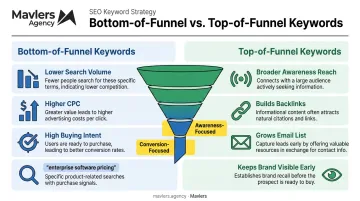
- Bottom-of-funnel, high-intent terms: lower volume, higher CPC, but they convert. Someone searching "enterprise inventory management software pricing" is close to a decision.
- Top-of-funnel "shoulder topic" terms: broader awareness content that won't convert immediately but builds backlinks, grows your email list, and keeps your brand visible early in the research process.
Skipping the top-of-funnel layer means competitors capture that early research phase, and often the eventual conversion too. Once a buyer builds trust with a competitor's content, switching evaluators mid-journey rarely happens.
Creating Content for Every Stage of the Buying Committee
Map content types to where a stakeholder sits in the journey:
| Funnel Stage | Content Type | Primary Audience |
|---|---|---|
| Awareness | Educational guides, blog posts | Practitioners, researchers |
| Consideration | Case studies, comparison pages | Technical evaluators, managers |
| Decision | Demos, ROI calculators | Economic buyers, finance |
The same page often needs to satisfy several readers at once. A comparison guide should offer practitioners technical depth, hand finance a clear cost breakdown, and leave leadership with a strong case for approval.
Use competitor keyword analysis and search-suggest tools to spot gaps competitors haven't filled: these gaps are usually the fastest path to ranking without a fight.
Off-Page SEO: Building Authority and Backlinks for B2B Brands
For B2B, backlink quality from industry-relevant sources matters more than raw link volume. A single link from a respected trade publication, such as a leading manufacturing or supply-chain journal, signals more credibility to both search engines and a buying committee than fifty links from unrelated directories.
Core tactics worth prioritizing:
- Digital PR: pitch original research or survey data to industry publications instead of generic press releases
- Guest contributions: thought leadership posts on sites your buyers already read
- Partner and customer page exchanges: mutual links with implementation partners or happy customers
Beyond outreach, free tools and calculators built around your industry also act as natural link magnets, including:
- Pricing calculators
- ROI estimators
- Benchmark tools
These give other sites a reason to cite you organically, rather than asking for a link.
Future-Proofing Your Strategy: AI Search Optimization and Continuous Measurement
Search results don't look like they did two years ago, and B2B buyers have adopted AI research tools faster than most teams expected.
Optimizing for AI Overviews and Answer Engines
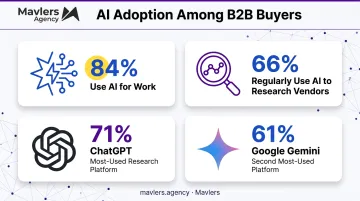
A 2026 Semrush survey of 622 US B2B professionals found that 84% use AI for work, and 66% regularly use AI to research vendors. Among those buyers, ChatGPT was the most-used platform at 71%, followed by Google Gemini at 61%.
To get cited in that environment, content needs to be structured, not just well-written:
- Use Q&A formatting that mirrors how buyers phrase questions to AI tools
- Implement schema markup so machines can parse entities and facts, not just text
- Keep claims specific and sourced, since AI tools favor citable, well-attributed content over vague marketing copy
BrightEdge's 2025 analysis found that PR and media coverage supplied 34% of AI citations, which shows off-page authority now directly fuels AI visibility.
Tracking Performance and Iterating
B2B SEO runs on continuous cycles of measurement and refinement, not one-time launches. Track:
- Organic traffic and keyword rankings across priority terms
- Conversion rate from organic sessions to qualified leads
- AI citation and visibility tracking — how often your brand appears in AI-generated answers, the metric Mavlers Agency' GEO Visibility Index is built to measure
Audit quarterly, refresh underperforming content instead of abandoning it, and expect algorithm and AI platform shifts to keep reshaping what "ranking well" even means.
Frequently Asked Questions
What is B2B SEO?
B2B SEO is the practice of optimizing a website and its content so business decision-makers researching a solution can find, evaluate, and trust it. It targets multiple stakeholders rather than a single consumer.
Is SEO worth it for B2B?
Yes. HubSpot's research ranked website, blog, and SEO as the top ROI-driving channel for B2B brands in 2024. Its value compounds over the same months-long window B2B buyers already spend researching.
How is B2B SEO different from B2C SEO?
B2B SEO targets smaller, high-intent audiences across longer sales cycles involving multiple stakeholders. B2C SEO targets broad audiences chasing faster, often single-person purchase decisions.
How long does it take to see results from a B2B SEO strategy?
Most B2B SEO programs need several months to a year to show significant results. That timeline actually aligns with typical B2B sales cycles, so early content is often still working when a deal finally closes.
What are the best tools for B2B SEO in 2026?
Focus on four categories: keyword and buying-intent research, technical crawling and auditing, search performance and attribution, and emerging AI visibility tracking. No single tool covers all four well.
Do I need a developer to fix technical SEO issues?
Many fixes, such as schema markup, Core Web Vitals, and mobile UX, do require development work. Agencies without in-house capacity often partner with a white-label technical SEO team like Mavlers Agency to execute these efficiently under their own brand.