Introduction
Half your ad budget might be landing on a page that was never built to convert it. Unbounce's latest benchmark study, which analyzed 41,000 landing pages and more than 464 million pageviews, found a median conversion rate of just 6.6% across industries.
That leaves a lot of clicks going nowhere.
Meanwhile, the math behind every click keeps getting worse. WordStream's 2025 benchmark data, pulled from over 16,000 US Google Search campaigns, shows median CPC hit $5.26, up 12.88% year-over-year, with nearly 87% of industries seeing costs climb.
Every unoptimized landing page now erodes ROAS faster than it did a year ago.
This guide breaks down the 2026 best practices, testing frameworks, and common mistakes shaping high-performing PPC landing pages, plus how agencies can build them faster without adding headcount.
Key Takeaways
- Dedicated landing pages beat homepages with tight message match and a single offer
- Mobile speed, simple forms, and one clear CTA remain 2026's top conversion levers
- Continuous A/B testing beats "set and forget," even without a clear winner
- White-label partners help agencies scale landing page output without hiring developers
What Is a PPC Landing Page?
A PPC landing page is the dedicated destination a visitor reaches after clicking a paid ad, built to match that specific ad's promise. It's not your homepage, not your "About Us" page, and not a blog post repurposed for traffic it wasn't designed to hold.
This narrow focus is exactly what separates a PPC landing page from every other page on a site. Unbounce defines a PPC landing page as intentionally narrow: one offer, one audience, one action. Homepages, by contrast, are built to serve every visitor type, every product line, and every stage of the buying journey at once.
That difference in design freedom is the whole point:
- PPC pages can strip navigation, cut unrelated links, and push one CTA relentlessly
- Homepages need menus, multiple paths, and broad messaging to serve everyone
- Organic/SEO pages are built for search intent and long-term ranking, not a single ad promise
A branded-search A/B test cited by Instapage found a dedicated landing page converting at nearly three times the rate of a homepage for the same paid traffic. It's one case study rather than an industry-wide average, but it illustrates why a page trying to serve five products or three campaign goals typically underperforms one built for a single purpose.
Core PPC Landing Page Best Practices for 2026
This playbook covers the specific elements most likely to move your conversion rate this year, ranked by impact.
Match Message & Intent Precisely
Message match means your landing page headline, keywords, and offer language mirror the ad that got the click, word for word where possible. If someone clicked an ad promising "Free 15-Minute SEO Audit," the landing page headline shouldn't say "Grow Your Business With Our Marketing Services."
Google explicitly ties this to performance. Ad relevance and landing-page experience are two of the three components of Quality Score, which directly affects your cost per click and ad rank.
Beyond static copy, agencies are increasingly using:
- Dynamic text replacement to swap headline copy based on the exact keyword that triggered the ad
- Location-based personalization to show city or region names automatically
- Audience segment swaps so a page reads differently for a returning visitor versus a cold click
Craft Headlines, Copy & CTAs That Convert
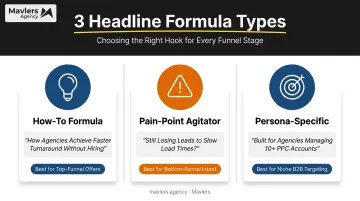
Three headline formulas consistently perform well for paid traffic:
- How-to formula – "How [Audience] Achieves [Outcome] Without [Pain Point]" – works well for educational or top-funnel offers
- Pain-point agitator – "Still Losing Leads to Slow Load Times?" – strong for bottom-funnel, high-intent clicks
- Persona-specific – "Built for Agencies Managing 10+ PPC Accounts" – ideal when targeting a narrow B2B segment
CTA wording matters just as much as headline choice. A generic "Sign Up Now" gives visitors nothing to visualize. Specific, outcome-driven CTAs like "Grow Your Traffic" or "Get My Free Audit" tie the click directly to the benefit promised in the ad.
Keep body copy scannable:
- Use short bullet points instead of dense paragraphs
- Tie every line back to one goal: avoid introducing a second offer halfway down the page
- Break copy into digestible chunks, not a wall of persuasive text
Optimize for Mobile Speed & UX
Page speed functions as a direct conversion lever on mobile. Google Ads reports that a 1-second delay on mobile can affect conversions by up to 20%, based on its foundational study of 900,000 mobile ad landing pages across 126 countries.
That same research found average full load time sat at 22 seconds, with bounce probability jumping 113% as load time stretched from 1 to 7 seconds.
Quick technical fixes that move the needle:
- Compress images before upload instead of relying on the platform to do it
- Enable browser caching so repeat visitors load pages faster
- Use a CDN to serve assets closer to the visitor's location
- Size CTA buttons for thumbs, not cursors — a button that's easy to click on desktop can be nearly unusable on mobile
Reduce Friction With Smart Forms & Social Proof
Every extra form field is a small tax on your conversion rate. HubSpot's analysis of over 40,000 landing pages found conversion rates declined as field count increased, with multiple dropdowns and open text areas doing the most damage.
For pure lead-gen offers, keep it to name, email, and maybe one qualifying field. Sales-qualified or high-ticket offers can justify a longer form, since the friction filters for serious buyers.
Trust signals do real work here too. G2's survey of over 1,900 B2B software buyers found 31% consult review sites more than any other information source before buying. A few testimonials, client logos, or a review badge near the CTA can reinforce credibility without cluttering the page.
Another high-impact change: remove your site navigation entirely. Every link that isn't the CTA is an exit ramp.
Personalize With Segmentation & AI Tools
Basic demographic targeting only gets you so far. Behavioral and psychographic segmentation, meaning device type, time of day, and browsing interest, sharpens relevance in ways demographics alone can't.
In 2026, AI tools are speeding up how fast agencies can test variations:
- AI-generated headline, copy, and CTA variants for A/B testing
- Automated routing that sends visitors to the highest-performing page variant based on their attributes
- Faster iteration cycles that used to require a designer and a developer for every version
These are genuine capability shifts in landing page tools today, though independent studies haven't yet published a standard conversion lift tied specifically to AI-generated variants. AI's clearest proven benefit right now is testing speed; conversion gains still require your own measurement.
Testing, Metrics & Tools for Continuous Optimization
A landing page you launch and never touch again is a page slowly losing money to CPC inflation. Continuous testing is what separates accounts that improve quarter over quarter from ones that plateau.
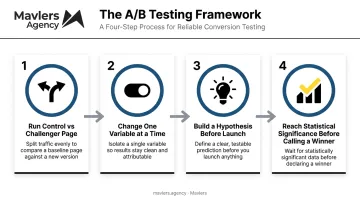
The A/B testing framework is simple in principle:
- Run a control page against a single challenger variant
- Change one variable at a time (headline, CTA, form length)
- Build a hypothesis before you launch, not after you see results
- Let the test run long enough to reach statistical relevance before calling a winner
Once a test reaches significance, the real question becomes which numbers prove the change actually worked.
Metrics That Actually Signal Something
| Metric | What it tells you |
|---|---|
| CTR | Whether your ad copy earns the click |
| Conversion rate | Whether the page delivers on the ad's promise |
| Avg. CPC | What each click actually costs you |
| Quality Score | How Google rates ad relevance and landing-page experience |
| CPA | Cost per completed conversion |
| ROAS | Revenue generated per dollar spent |
| Bounce rate | Whether visitors engage or leave immediately |
Pair analytics platforms like GA4 with behavioral tools such as heatmaps and session recordings. GA4 tells you what happened; heatmaps tell you why, showing exactly where visitors stall, scroll past, or abandon a form.
Failed tests aren't wasted tests. A challenger that loses still tells you what your audience doesn't respond to, sharpening your next hypothesis instead of leaving you guessing.
Common PPC Landing Page Mistakes to Avoid
Most underperforming PPC pages fail for the same handful of reasons:
- Serving multiple offers on one page. A page selling three products or capturing two lead types dilutes focus and confuses visitors about what to do next.
- Mismatched ad-to-page messaging. A headline that doesn't match the ad's promise spikes bounce rate and drops Quality Score, since Google explicitly evaluates landing-page relevance in ad performance.
- Overloaded forms. Asking for a phone number, company size, and three dropdown fields before visitors know if you're a fit kills conversions early.
- Pop-ups and clutter. Anything competing with the primary CTA for attention pulls focus from the page's single purpose.
- Failing to remove navigation. Leaving your main site menu on a landing page invites visitors to wander off before converting.
Scaling Landing Page Production Without Hiring: A Note for Agencies
Here's the operational bind most agencies hit eventually: every new PPC client engagement demands fresh, optimized landing pages, fast. Building each one from scratch, on whatever platform that client happens to use, strains a small team quickly. Hiring more developers eats into margins, while turning down new business stalls growth entirely.
This is where white-label partners fit in. Mavlers Agency works behind the scenes with agencies to build and launch landing pages across WordPress, Shopify, Webflow, and HubSpot, without the agency adding a single developer to headcount.
A recent project shows the model in action: a 35-page WordPress build delivered in 21 days, five days ahead of schedule, using AI-assisted development workflows to keep quality consistent across every page.
The arrangement works because the agency keeps full control of the client relationship:
- Deliverables carry the agency's branding, never Mavlers Agency'
- Clients interact only with the agency, start to finish
- The agency retains strategy and campaign performance ownership
- Mavlers Agency handles the build, QA, and platform-specific execution in the background
For agencies juggling multiple PPC accounts, this means faster turnaround on new landing pages and one less bottleneck standing between a campaign launch and a live, optimized page. It frees internal teams to spend time on strategy and performance, not repetitive page-building work.

Frequently Asked Questions
What is PPC optimization?
PPC optimization is the ongoing process of refining ads, keywords, bids, and landing pages to improve conversion rates and lower cost per acquisition. It's never a one-time setup, since costs and competition shift constantly.
What is a PPC landing page?
A PPC landing page is a dedicated, targeted page built specifically to match a paid ad's message and drive one conversion action. It excludes navigation and unrelated offers to keep visitors focused.
Should SEO and PPC have different landing pages?
Yes, in most cases. Paid traffic arrives with a specific promise that requires exact message match, while organic pages need to satisfy broader search intent and long-term ranking factors. Combining the two usually weakens both.
How long should a PPC landing page be?
Length should match funnel stage and offer complexity. Most paid campaigns perform better with concise, scannable content rather than long-form copy, though complex or high-ticket offers can justify more detail.
What is a good conversion rate for a PPC landing page?
Unbounce's cross-industry data puts the median landing page conversion rate around 6.6%, with top performers reaching well above that. "Good" varies by industry, offer, and traffic quality, so compare against your vertical rather than a flat benchmark.
How often should you test or update your PPC landing pages?
Run continuous A/B testing cycles rather than one-off tests, and conduct a full audit before major campaign changes or seasonal shifts. Pages that haven't been reviewed in three to six months are usually overdue.