Yet many companies still treat website development as a one-time technical checkbox — build it, launch it, forget it. Its real value shows up daily in traffic numbers, conversion rates, and how much a visitor trusts you within seconds of landing on your homepage.
This article breaks down what website development services actually cover, why they matter in practice, and what happens when businesses under-invest in them.
Key Takeaways
- Website development spans front-end, back-end, full-stack work, CMS, e-commerce, and security
- Professional development drives credibility, conversions, and scalability, not just visual polish
- Skipping proper development compounds costs through security gaps and costly rebuilds
- Maximum value comes from treating development as an ongoing practice, reviewed and improved continuously
- Choosing the right delivery model, whether in-house, freelance, or white-label, shapes both quality and cost
What Is Website Development (Brief Context)
Website development services are the professional processes of designing, building, securing, and maintaining a website so it functions reliably and meets business goals. That's the plain version, without the jargon.
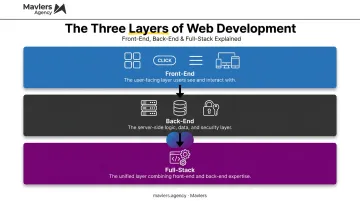
Development typically splits into three core areas:
- Front-end: everything the user sees and interacts with, including layout, buttons, navigation, and responsive design
- Back-end: the server and database logic running behind the scenes, handling data, authentication, and processing
- Full-stack: work spanning both layers, often needed for complex builds like e-commerce or web apps
These skills get applied across very different use cases: corporate marketing sites, e-commerce stores, custom web apps, and CMS-driven platforms like WordPress, Shopify, Webflow, and HubSpot.
Here's the part businesses often miss: development is a means to an outcome (visibility, trust, revenue, efficiency), not an end in itself. A site that was built well two years ago but never maintained delivers shrinking returns every month it's ignored.
Key Advantages of Website Development Services
The advantages below tie to metrics businesses actually track: cost, conversion, visibility, risk, and growth. None of this is abstract design theory.
These benefits also compound. A site that's fast, secure, and well-structured tends to rank better and convert better at the same time: one improvement feeds the next.
Advantage 1: Establishes Professional Online Presence and Brand Credibility
A professionally developed site works as a 24/7 digital storefront. Clean code, fast load times, and mobile responsiveness shape a visitor's first impression before they've read a single word of your content.
That first impression forms faster than most people realize. A peer-reviewed study found that users form stable judgments about a website's visual appeal within 50 milliseconds — faster than a blink.
A separate Stanford study covering 2,684 participants across 100 live websites found that nearly half of all credibility comments referenced design and visual presentation.
In practice, this means:
- Visitors use website quality as a proxy for business legitimacy, often before making contact
- Poor design increases bounce rates and shortens time-on-site, both signals search engines penalize
- Trust-sensitive industries (healthcare, finance, professional services) feel this impact hardest, since credibility drives the entire first conversion step
KPIs impacted: bounce rate, average session duration, brand trust and perception scores.
Advantage 2: Drives Conversions and Revenue Through Optimized User Experience
Development shapes the mechanics that determine whether someone becomes a customer or leaves: navigation flow, checkout steps, page speed, and call-to-action placement.
Developers implement SEO-friendly code structures, responsive layouts, image compression, caching, and CDNs, all working to keep visitors engaged rather than clicking away. The financial impact of speed alone is substantial. Deloitte's analysis of 37 brands and 30 million sessions found that a 0.1-second mobile speed improvement correlated with 8.4% higher retail conversions and 9.2% higher average order value.
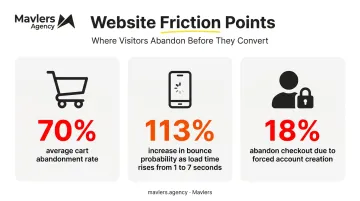
Other friction points compound this problem:
- Cart abandonment averages around 70% across e-commerce sites
- Mobile bounce probability jumps 113% when load time moves from one second to seven
- Roughly 18% of shoppers abandon an order simply because a site forces account creation before checkout
KPIs impacted: conversion rate, page load speed, organic traffic, cart and form abandonment rate.
This matters most for e-commerce, lead-generation sites, and any business where the website functions as a primary sales or booking channel, not a brochure.
Advantage 3: Enables Scalability, Security, and Long-Term Cost Efficiency
Development services build in scalable architecture, integrations (CRM, payment gateways, APIs), and security protocols like SSL, encryption, and regular patching. That foundation protects a business as it grows instead of buckling under new demands.
The cost of skipping this is well documented. IBM's 2025 Cost of a Data Breach Report puts the global average breach cost at $4.4 million. Downtime carries its own price tag: over 90% of mid-size and large enterprises surveyed by ITIC valued one hour of downtime above $300,000, with 41% reporting figures between $1 million and $5 million-plus.
Scalable resourcing matters just as much as scalable code. Businesses and agencies avoid capacity bottlenecks by mixing in-house teams, freelancers, and dedicated white-label partners rather than over-hiring for project volume that fluctuates month to month.
For agencies specifically, partnering with a white-label web development provider like Mavlers Agency lets them accept more client projects and maintain consistent quality without the cost or delay of hiring additional developers in-house.
KPIs impacted: uptime and reliability, security incident rate, project turnaround time, cost per project.
This advantage hits hardest during rapid growth phases, seasonal traffic spikes, multi-platform expansion, or when agencies need more delivery capacity without expanding headcount.
What Happens When Website Development Services Are Missing or Ignored
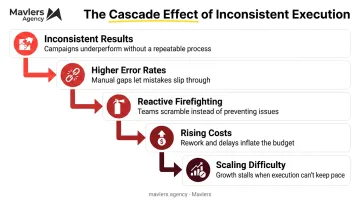
Skipping professional development doesn't just mean a "less polished" site. It creates operational problems that compound over time.
- Inconsistent results across pages, campaigns, or client projects, since there's no standardized process behind the work
- Higher error rates: broken integrations and security vulnerabilities creep in from outdated or poorly maintained code
- Reactive firefighting replaces proactive management: site crashes, slow pages, and lost leads become routine instead of rare
- Rising costs as technical debt piles up, eventually forcing an expensive full rebuild instead of incremental fixes
- Scaling difficulty as the business or agency grows, because ad hoc solutions don't hold up under increased volume
Outdated CMS environments illustrate the risk. Sucuri's research found that 39.1% of compromised CMS applications were already outdated at the time of infection, and nearly half contained a backdoor. Patchstack recorded 7,966 new WordPress ecosystem vulnerabilities in 2024 alone — a 34% jump from the year before, with 96% of them located in plugins.
None of that happens overnight. It builds quietly until a crash, breach, or lost sale forces the issue.
How to Get the Most Value from Website Development Services
Website development delivers the most value as an ongoing practice, extending well beyond the initial launch.
That means:
- Apply it consistently, extending design updates, performance tuning, and security patches well beyond the initial build
- Review performance on a set cadence: track traffic, conversions, and speed metrics monthly or quarterly instead of only at launch
- Act on findings quickly by testing changes, fixing friction points, and retiring outdated features before they become liabilities
Sustaining that cadence takes the right team behind it, which is why choosing a delivery model matters as much as the work itself. Businesses generally pick between three paths:
- In-house teams: full control, but higher fixed costs and hiring overhead
- Freelancers — flexible and often affordable, but harder to scale consistently across multiple projects
- White-label development partners: multi-platform expertise across WordPress, Shopify, Webflow, and HubSpot, with consistent quality control and no in-house hiring overhead
For agencies juggling multiple client projects, that third option often solves the exact bottleneck limiting growth: too few hands, tight timelines, and no simple way to scale without adding headcount.
Conclusion
Website development services deliver more than functional code. They give businesses ongoing control over their digital presence, stronger credibility with customers, and consistent execution across every touchpoint.
These benefits compound when development is reviewed and refined continuously, not treated as a task to check off at launch. That consistency drives stronger conversions and durable scalability as a business grows.
For agencies, a dedicated development partner turns that consistency into an advantage without adding headcount.
Frequently Asked Questions
How much do website development services cost?
Costs vary widely based on complexity, platform, and features. Basic sites or MVPs often run in the low thousands, while custom builds or e-commerce platforms with integrations can climb well beyond that.
What are the big three areas of web development?
Front-end covers what users see and interact with: layout, design, navigation. Back-end handles server-side logic, databases, and authentication. Full-stack spans both layers, often required for complex web apps or e-commerce builds.
What is the difference between web design and web development?
Web design focuses on look, feel, and user experience: layout, imagery, typography. Web development handles the technical build: the code and systems that make the site actually function.
What is typically included in a website development service package?
Most packages cover planning and design, coding and CMS setup, quality assurance testing, and launch support. Many providers also include post-launch maintenance and ongoing updates.
How long does it take to develop a website?
Timelines depend entirely on scope. Simple sites can launch in a few weeks, while custom builds or e-commerce platforms with complex integrations often take several months.
Do small businesses really need professional website development services?
Yes. Even small businesses need professional development for credibility, mobile responsiveness, and room to scale as they grow. Mobile devices drive over half of global web traffic, making responsive design essential for any company size.