
That's a massive spread for what sounds like the same service.
The real answer depends on the pricing model an agency uses, the scope of work you're buying, the agency's size and location, and what you're actually trying to achieve. This guide breaks down each of those variables, plus the hidden fees nobody mentions until the invoice arrives.
Key Takeaways
- Monthly costs range from $1,500 for one channel to $50,000+ for enterprise multi-channel programs
- Retainers dominate pricing in 2026, but hourly and project fees suit narrower needs
- Experience, location, and specialization drive price gaps more than the service type itself
- The lowest quote often costs more later: cheap SEO carries real penalty risk
- ROI timelines vary by channel, so budget patience alongside your dollars
How Much Does a Digital Marketing Agency Cost? (Pricing Overview)
There's no universal price because agencies don't price the same way. One quote might be an hourly rate for a two-week audit. Another might be a 12-month retainer covering four channels. Comparing them side by side tells you almost nothing.
The most common mistake business owners make is assuming every agency charges identically, or worse, stacking an hourly quote against a retainer quote and calling the hourly option "cheaper" without checking total scope.
Common Pricing Models
| Model | Typical Range | Best For |
|---|---|---|
| Hourly | $25-$49/hr (general); $175-$249/hr (specialized, per Promethean's 2025 survey) | Audits, consultations, one-off tasks |
| Monthly retainer | $2,000-$20,000+ (SEO), up to $50,000 (multi-channel) | Ongoing SEO, PPC, social, content |
| Project-based | $10,000-$49,999 typical | Website redesigns, campaign launches |
| Performance/hybrid | Tied to leads, revenue share, or CPA | Results-driven engagements with clear tracking |
Retainers dominate because ongoing channels like SEO and PPC need continuous management, not a single deliverable. Performance-based pricing sounds appealing, but Promethean's research found it appears in just 5% of agency pricing mixes, mostly because attribution gets messy fast. Without solid tracking, nobody can agree on what counts as a "result."
Typical Costs by Business Size
No single survey breaks pricing down cleanly by company size, but scope tends to scale with maturity:
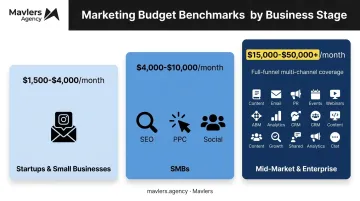
- Startups & small businesses: A single-channel scope with audits, basic optimization, and monthly reporting typically runs $1,500-$4,000/month.
- SMBs: Usually add a second or third channel — SEO plus PPC, or PPC plus social. Combined scopes typically fall between $4,000-$10,000/month.
- Mid-market and enterprise: Multi-channel programs spanning SEO, PPC, content, and CRO run $15,000-$50,000+/month, often split across several specialized agencies.
Key Factors That Affect Digital Marketing Agency Pricing
Pricing reflects technical scope, operational overhead, and business positioning. It's rarely arbitrary once you understand what drives the number.
Scope of Services & Project Complexity
Bundling SEO, PPC, social, and content together costs more than managing a single channel, simply because each discipline requires dedicated expertise and tooling. A client running SEO alone might pay $3,000/month; add PPC management and content production, and that same account can climb past $10,000/month.
Agency Experience, Expertise & Credentials
Agencies with a decade or more of track record, documented case studies, and platform certifications tend to charge more. Google's own Partner requirements illustrate why: agencies need at least $10,000 in managed spend over 90 days, a 70% optimization score, and half their strategists certified. Meeting those bars costs money in training, tools, and dedicated staff time, and that overhead shows up in client rates.
Geographic Location
Where an agency operates changes the math significantly:
| Market | Average Hourly Rate |
|---|---|
| United States / Australia | $100-$149 |
| United Kingdom | $91.07 |
| Philippines | $25-$49 |
| India | Under $25 |
That's according to DesignRush's 2025 global digital marketing report, based on over 16,000 verified agency profiles. A US metro agency and an offshore team can quote radically different numbers for comparable deliverables, though quality control and communication overhead often narrow that gap in practice.
Industry Specialization
Healthcare, finance, and legal clients typically pay more because compliance requirements, not the marketing tactics themselves, drive the added cost. Healthcare marketers, for instance, navigate patient privacy rules and review-governance requirements that add real hours to every campaign. Expect a premium anywhere regulatory review is part of the workflow.
Agency Delivery Model & Operational Efficiency
How an agency delivers work behind the scenes shapes both price and reliability. Agencies that build everything in-house carry the full cost of hiring, training, and retaining specialists, and that cost gets passed to clients whether the work is complex or not.
Agencies that partner with scalable white-label providers operate differently. Mavlers Agency, for example, works behind the curtain for agencies needing web development, SEO, or paid media capacity without the overhead of new hires.
That structure relies on dedicated teams and standardized workflows, with delivery handled under the partner agency's own brand. It lets agencies take on more client work without proportionally raising internal costs, giving end clients steadier, more competitive pricing than the swings that come with in-house staffing gaps.

Hidden Costs & What's Actually Included
The quoted retainer or project fee is rarely the full cost. Several charges get billed separately, and they catch a lot of clients off guard.
| Cost Item | Timing | What It Covers |
|---|---|---|
| Setup/onboarding fee | One-time | Research, account setup, initial strategy |
| Ad spend & platform management | Recurring | Media budget plus a management fee, commonly 10-20% of spend |
| Tools & reporting dashboards | Recurring | SEO/analytics subscriptions sometimes passed through to clients |
| Revision limits & rush fees | Variable | Extra rounds or expedited turnaround add cost |
The ad spend line trips up the most people. That 10-20% management fee sits outside your media budget, not inside it — a $5,000/month ad spend with a 15% management fee means $5,750 total, not $5,000. Ask for this breakdown before signing anything.
Low-Cost vs High-Cost Agencies — What's the Difference?
Price alone tells you little. The real differences show up in who's doing the work and how they're doing it.
| Category | Lower-Cost Agencies | Higher-Cost Agencies |
|---|---|---|
| Team & Talent | Junior generalists, high client-to-strategist ratios | Senior specialists, dedicated strategist per account |
| Strategy Depth | Templated approaches, limited customization | Custom strategy built around specific goals |
| Reporting | Automated or infrequent updates | Regular strategy calls, dedicated account management |
| Long-Term Value | Short-term wins, higher penalty risk | Sustainable growth, lower long-term risk |
That penalty risk isn't theoretical. Search Engine Journal has warned repeatedly that budget SEO packages sometimes rely on low-quality tactics that can trigger a Google penalty, wiping out months of visibility overnight.
The cheapest quote can end up the most expensive mistake you make this year.
How to Budget for a Digital Marketing Agency (and Avoid Common Mistakes)
Budgeting should start with your business goals, not a number you picked because it felt safe.
Gartner's 2024 CMO Spend Survey found total marketing budgets averaging 7.7% of company revenue, down from 9.1% the year before. That figure covers entire marketing departments at large companies, though, not agency fees for a small business. Don't borrow that percentage as a rule for your own budget.
Instead, weigh these factors:
- Current marketing goals: Lead generation, brand awareness, and revenue growth all demand different budgets
- In-house capacity: Consider what your team can handle versus what needs outside expertise
- Growth stage: A scaling startup and an established enterprise have very different risk tolerances
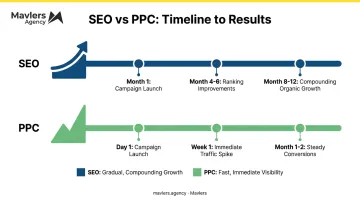
- Timeline to ROI: Google notes that SEO improvements typically take four months to a year to show measurable benefit, while PPC can generate visibility almost immediately
Common budgeting mistakes to avoid:
- Underbudgeting for the scope you actually need
- Comparing quotes on price alone without matching scope
- Ignoring separate ad spend and tool subscription costs
- Choosing the cheapest option without checking references or case studies
Frequently Asked Questions
What is the average fee for a digital marketing agency?
Retainers typically range from $2,000 to $20,000+ per month for single-channel work, up to $50,000 for multi-channel enterprise programs. Scope and pricing model drive most of the variance.
How much should a small business budget for digital marketing?
Most small businesses start with one channel around $1,500-$4,000 a month, expanding as results justify the spend. Base your number on goals and channel needs, not a fixed industry percentage.
Is retainer or project-based pricing better for digital marketing?
Retainers suit ongoing work like SEO and PPC management, where results build over months. Project-based pricing fits one-time deliverables, such as a website redesign or a single campaign launch.
Why do digital marketing agency prices vary so much for similar services?
Experience, location, industry specialization, and delivery model all shift the price. A US-based specialist agency with certifications will quote differently than an offshore generalist team.
What hidden costs should I watch for in agency contracts?
Watch for setup/onboarding fees, ad spend management percentages (often 10-20%), tool subscription pass-throughs, and rush or revision fees beyond the included scope.
How long before I see ROI from a digital marketing agency?
SEO typically needs four months to a year to show real impact, while PPC can generate visibility almost immediately. Set expectations by channel, not a single blanket timeline.