The numbers back this up. In Forrester's 2024 Buyers' Journey Survey, 89% of B2B buyers used generative AI somewhere in their purchase process, and 87% of that group said it led to a better business outcome.
Here's the problem: most "B2B SEO" content out there is either a listicle ranking agencies or a generic SEO 101 explainer. Neither helps a SaaS team build an actual strategy or vet an execution partner. This guide covers what makes B2B SaaS SEO different, the pillars that drive pipeline (not just traffic), the in-house versus agency decision, realistic costs, and how to vet a partner before you sign anything.
Key Takeaways
- Buyer-intent keywords and pipeline attribution, not traffic volume, drive real SEO success
- AEO/GEO visibility in ChatGPT, Perplexity, and AI Overviews is now a core ranking factor
- Agency pricing splits into three tiers: foundation, growth, and enterprise, matched to ARR stage and in-house capacity
- Execution bandwidth is typically the real bottleneck between strategy and shipped results
What Is B2B SEO for SaaS, and Why Does It Work Differently Than B2C?
B2B SaaS SEO is organic strategy built around longer buying cycles, multiple stakeholders, and high-consideration purchases. Compare that to B2C, where a single shopper often converts in one session. SaaS keywords also carry lower search volume but far higher buying intent — a search for "best CRM for 50-person sales team" converts at a completely different rate than "what is a CRM."
Does SEO actually work for B2B? Yes, but only when it's measured against demo requests, MQLs, and closed revenue instead of sessions and rankings.
That distinction matters more now than ever, given how many buyers use AI tools mid-research. If your content and product pages aren't structured to be found and cited by both traditional search and AI engines, you're invisible at the exact moment a prospect is forming their shortlist.
Why Multi-Session Buying Changes the Approach
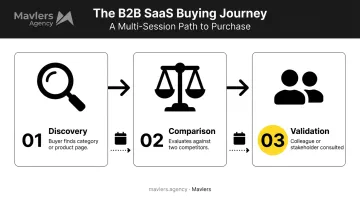
SaaS purchases rarely close in one sitting. A buyer might discover your category page this week, compare you against two competitors next week, then loop in a colleague for validation a month later. That means:
- Content and site architecture need to map to each stage of that journey, not just rank for one keyword
- Comparison and use-case pages have to exist before the buyer looks for them
- Technical structure must support both search crawlers and AI models pulling information across multiple visits
Generic blog content underperforms for SaaS because it answers questions nobody in a real buying committee is actually asking.
Core Pillars of a High-Performing B2B SaaS SEO Strategy
A modern B2B SaaS SEO program rests on four interlocking pillars. Skip any one of them, and it caps how far the rest can take you — you can write brilliant content all day, but if your pages don't render for crawlers, none of it matters.
Technical SEO & AI Search Foundations
Crawlability issues, JavaScript rendering problems, and messy site architecture silently block indexation on exactly the pages that matter most: product and comparison pages. Google's own documentation confirms that content missing from rendered HTML may never get indexed at all, and conflicting canonical tags or misapplied noindex directives compound the problem quietly, page by page.
This isn't just a search-engine problem anymore. Answer Engine Optimization (AEO) and Generative Engine Optimization (GEO) require the same foundation: clear entity signals, structured data, and content organized so AI models can extract and cite your product information accurately.
The payoff for getting this right is real. Ahrefs tracked its own site and found that AI search delivered just 0.5% of visits but 12.1% of signups over 30 days, a 23x conversion advantage over traditional organic traffic. That's one company's data, not a universal guarantee, but it illustrates the upside of showing up correctly in AI-generated answers.
Buyer-Intent Content & Keyword Strategy
"Pain point SEO" flips the usual keyword logic. Instead of chasing high-volume informational terms that never convert, you prioritize lower-volume, high-intent searches tied directly to a buying decision.
One B2B SaaS company grew organic demo signups to more than 150 per month by focusing on:
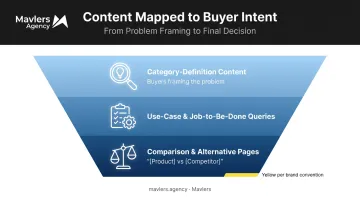
- Category and comparison/alternative searches ("[Product] vs [Competitor]")
- Use-case and job-to-be-done queries
- Direct pain-point phrases a buyer types when they're already frustrated
Content also needs to map to your ICP and funnel stage. Comparison pages serve bottom-funnel evaluators. Category-definition content captures buyers still framing the problem. Generic blog posts, produced without that mapping, tend to rank for nothing that closes.
Authority Building Through Content & Digital PR
Backlinks from credible, relevant publications compound domain authority over time, which matters enormously for competitive SaaS keywords where five or six established players already dominate page one. This pillar simply takes longer to show results than technical fixes: expect months, not weeks.
Mavlers Agency has seen this play out directly. In a link building engagement for Airtasker, target keywords moved from beyond page three to top-five positions on Google, alongside sustained organic traffic growth to category pages, tracked against clear monthly KPIs.
Pipeline Attribution & Reporting
Reporting has to connect organic content to MQLs, demos, and revenue, not stop at traffic and keyword rankings. Many B2B marketing leaders privately admit they don't fully trust their own attribution data, which is exactly why this pillar gets skipped so often.
A solid monthly SaaS SEO report should include:
- Organic sessions by funnel stage, not just total traffic
- Keyword rankings segmented by buying intent, not vanity terms
- Form fills and demo requests attributed to organic source
- CRM-synced lead-to-customer conversion rate for organic traffic
- AI-referral traffic and signups, tracked separately from traditional organic
B2B SEO Agency vs. In-House Team vs. Hybrid Model: Which Fits Your SaaS Company?
Three paths exist here: hire a full agency, bring SEO in-house, or run a hybrid model with an in-house strategy lead and an execution partner. Each comes with real trade-offs for a growth-stage SaaS company.
Cost is the first fork in the road. A full-time US in-house SEO manager typically commands a salary in the $75,000–$95,000 range before benefits and tools. Agency retainers run anywhere from a few hundred dollars a month for a lean solo operator to several thousand for a full-service team — a wide enough gap that budget alone shouldn't drive the decision.
| Model | Best For | Main Trade-Off |
|---|---|---|
| Full agency | Teams with no internal SEO capacity | Ramp-up time to learn your product and voice |
| In-house hire | Companies needing deep product/brand fluency | Limited by one person's skill set and bandwidth |
| Hybrid | Teams with a strong content lead, gaps in AEO/technical | Requires clear division of ownership |
Agencies bring cross-client pattern recognition that's hard to replicate with a single hire. That edge shows most clearly with a newer capability like AEO, where an agency working across a dozen SaaS accounts spots what's working faster than one person testing in isolation. In-house hires, on the other hand, bring product and brand knowledge that outside partners take weeks to build.
For most SaaS teams with a strong in-house content lead but a gap in technical or AEO expertise, the hybrid model tends to make the most sense. You keep the person who knows your product cold, and you bring in outside specialists for the parts that change fastest.
How Much Does a B2B SEO Agency Cost?
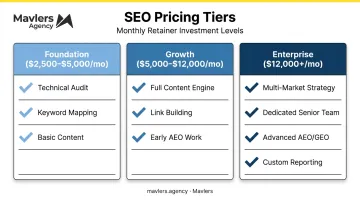
Pricing generally clusters into three tiers, though exact numbers shift by agency size and scope:
- Foundation tier ($2,500–$5,000/month): Technical audit, core keyword mapping, basic content production
- Growth tier ($5,000–$12,000/month): Full content engine, link building, ongoing technical fixes, early AEO work
- Enterprise tier ($12,000+/month): Multi-market strategy, dedicated senior team, advanced AEO/GEO, custom reporting
Broader market surveys back up the wide range here. One Ahrefs poll of 439 SEO providers found the most common retainer band sat between $500 and $1,000 monthly. The calculated agency average landed closer to $3,209 — a gap that shows just how much scope and seniority vary between providers.
Price doesn't correlate with quality. A lean, senior-led team can often deliver more actual strategist attention per dollar than a large agency carrying heavy account-management overhead. Before signing anything, ask exactly who will work on your account and how many other clients that person juggles at once. If the answer is vague, that's your answer.
How to Choose and Vet the Right B2B SEO Agency for Your SaaS Company
Look past the pitch deck. These are the criteria that actually predict a good partnership:
- Case studies tied to pipeline or revenue, not just traffic charts
- Real AEO capability — ask what they've shipped beyond FAQ schema
- B2B industry fluency, not a portfolio full of local service businesses
- A senior team model, with named specialists, not just account managers
- Transparent pricing with published ranges, not "contact us for a quote"
- Reasonable contract terms, ideally month-to-month after an initial period
Watch for these red flags:
- Case studies that only mention traffic or ranking gains
- Keyword lists built purely on search volume, ignoring buying intent
- No pricing ranges offered anywhere, even roughly
- Long-term lock-in contracts with steep early-termination penalties
Checking employee review sites like Glassdoor is a useful (if informal) proxy here. High turnover at an agency usually means an overloaded strategist juggling too many accounts, including yours. But passing this checklist doesn't guarantee the agency can execute its own recommendations.
The Execution Bandwidth Problem
Even a great SEO strategy stalls if the recommendations (site speed fixes, schema markup, new landing page templates, CMS updates) sit in a dev backlog for months. Internal teams and even agencies themselves often lack the developer bandwidth to actually ship the fixes they recommend.
Some agencies solve this by partnering with a white-label execution team like Mavlers Agency, which works invisibly behind the scenes to build and fix WordPress, Shopify, Webflow, and HubSpot sites at scale. That way, technical SEO recommendations turn into shipped changes without the agency or its client needing to hire another developer.

Frequently Asked Questions
How much does an SEO agency cost?
Pricing typically falls into three tiers: foundation ($2,500–$5,000/month), growth ($5,000–$12,000/month), and enterprise ($12,000+/month). Scope and team seniority drive most of the variation, along with how competitive your market is.
Does SEO work for B2B?
Yes, when it's tied to demos, MQLs, and revenue rather than traffic or rankings alone. With most buyers now using generative AI during research, organic visibility across both traditional and AI search drives real pipeline.
What is the best SEO for B2B?
There's no single tactic. The best approach combines technical SEO, intent-driven content mapped to funnel stage, and genuine AEO/GEO capability working together, not any one of them in isolation.
How long does B2B SEO take to show results for a SaaS company?
Early technical and AEO signals can appear within weeks of fixing crawlability or structured data issues. Measurable pipeline impact typically takes a few months, depending on how competitive your keywords are.
Should a SaaS company hire an in-house SEO team or an agency?
It depends on existing capacity. If you already have a strong in-house content lead but lack AEO or technical depth, a hybrid model (internal strategy paired with an external execution partner) usually works best.
What's the difference between B2B and B2C SEO?
B2B keywords carry lower search volume but far higher buying intent, and purchases involve multi-stakeholder research cycles spanning weeks or months. B2C searches tend to serve larger audiences with shorter, more direct paths to purchase.