That speed requirement collides with reality fast. Budgets are tighter. Hiring a marketing automation specialist or a paid media expert takes weeks, sometimes months. Traditional agency retainers lock you into a scope that doesn't flex when priorities shift overnight.
More than 67% of B2B organizations outsourced marketing work in the past year, according to Marketing Week's 2025 survey of over 3,500 marketers. That's not a fringe tactic anymore — it's how modern marketing teams operate.
This guide breaks down what Marketing-as-a-Service (MaaS) actually is, how it works day to day, how it stacks up against agencies and in-house hires, and how agencies themselves are adopting a MaaS mindset to grow without adding headcount.
Key Takeaways
- MaaS delivers a full marketing team on subscription, skipping in-house hiring costs and delays.
- Integrated workflows and embedded collaboration set MaaS apart from siloed agency retainers.
- Startups, SMBs, and scaling B2B companies use MaaS best as a long-term partnership.
- Agencies also adopt MaaS principles, partnering with white-label providers to expand services like web development.
What Is Marketing-as-a-Service (MaaS)?
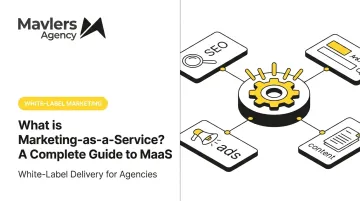
Marketing-as-a-Service is an outsourced, subscription-based operating model that gives a business ongoing access to a dedicated marketing team, covering strategy, execution, and reporting. Rather than a one-off project handoff, it functions as an extension of your internal team, minus the payroll and recruiting headaches.
The core mechanic is simple: you pay for access to capabilities, not individual deliverables. Need heavier content output during a product launch? Capacity expands. Slower quarter? It contracts. That flexibility is the entire point.
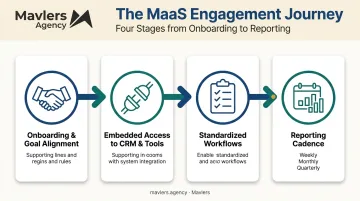
How a MaaS Engagement Typically Works
Most MaaS engagements follow a similar rhythm:
- Onboarding and goal alignment: the provider learns your business, audience, and KPIs before any work starts.
- Embedded or semi-embedded access: the team plugs into your CRM, marketing automation platform, and existing tools rather than working in isolation.
- Standardized workflows: intake requests, execution, and quality checks follow a repeatable process instead of ad-hoc email chains.
Reporting cadence keeps everyone honest. Expect weekly standups for tactical updates, monthly reviews tied to performance metrics, and quarterly planning sessions that revisit strategy against business goals.
Who Is MaaS Best Suited For
MaaS fits a specific set of situations particularly well:
- Startups and SMBs that can't yet justify a full in-house team but still need multi-channel execution.
- Scaling companies entering new markets or launching products who need a burst of specialized capacity fast.
- B2B companies with long, complex sales cycles. 6sense research puts the average B2B buying journey at roughly 11 months, making sustained nurture campaigns more effective than sporadic outreach.
What Services Are Included in a MaaS Model?
A well-built MaaS engagement bundles core marketing disciplines into one coordinated system rather than a patchwork of vendors. Typical service categories include:
- Content marketing (blogs, case studies, video)
- SEO
- Paid media and digital advertising
- Social media management
- Branding and design
- Account-based marketing (ABM)
Beneath the visible services sits an operational layer that makes everything run smoothly: marketing automation and CRM operations, analytics and reporting dashboards, and program management for intake and prioritization.
The Full-Stack Advantage
Single-channel agencies often work in silos — one team handles SEO, another handles paid media, and nobody talks to each other. MaaS eliminates that hand-off problem by putting every function under one coordinated workflow. Fewer gaps, fewer inconsistencies, less time spent chasing status updates.
AI is now a core part of this stack. 81% of B2B marketers use generative AI in their work, up from 72% the year before, according to CMI and MarketingProfs' 2025 B2B benchmark report.
Inside a MaaS model, that shows up as AI-assisted content research, faster campaign optimization, and quicker reporting turnaround.
Many comprehensive MaaS providers extend even further into website design and development, giving clients a single partner for both marketing execution and site builds.
MaaS vs. Traditional Agencies, In-House Teams & Freelancers
Every resourcing option makes a trade-off somewhere. Here's how they compare across the dimensions that matter most:
| Dimension | In-House Team | Freelancers | Traditional Agency | MaaS |
|---|---|---|---|---|
| Cost structure | Fixed salaries + benefits | Low, pay-per-project | Fixed monthly retainer | Predictable subscription |
| Breadth of skills | Limited to hires made | Narrow per contributor | Often channel-specific | Full-stack team |
| Speed to start | Slow (recruiting cycles) | Fast, but inconsistent | Moderate | Fast |
| Access to tech/tools | Requires internal investment | Rarely included | Sometimes included | Pre-vetted stack included |
| Adaptability | Rigid, tied to headcount | Flexible but unmanaged | Rigid, scope-locked | Scales up or down on demand |
In-house teams offer control and deep company context, but hiring specialized roles like marketing automation experts or analysts takes time most companies don't have.
Freelancers are cheap and flexible on paper. In practice, they require constant oversight, and quality swings depending on who you hired that week.
Traditional agencies typically operate in channel-specific silos with retainers locked to a fixed scope. Reallocating budget from paid media to content mid-quarter often means renegotiating the whole contract.
MaaS blends the cost-efficiency freelancers promise with the skill breadth an in-house team takes years to build. It adds the specialization agencies offer, then integrates directly into the tools your business already uses.
Benefits of MaaS & Common Misconceptions Debunked
Top Benefits of Choosing a MaaS Model
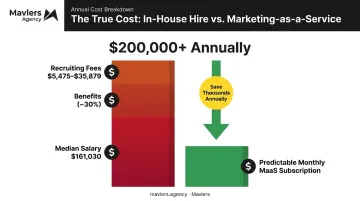
Cost efficiency. A single marketing manager carries a median salary of $161,030 in the US, according to the Bureau of Labor Statistics. That's before benefits, which typically add another 30% on top of wages, plus recruiting costs that SHRM estimates at $5,475 to $35,879 per hire depending on seniority.
Multiply that across five or six specialists, and one MaaS subscription starts looking a lot more efficient than a full internal build-out.
Scalability and speed. Capacity flexes for product launches, seasonal campaigns, or new market entry without waiting on a hiring cycle.
Access to specialized talent and technology. You get automation experts, analysts, and AI-enabled workflows on demand, plus a marketing tech stack you didn't have to research and buy yourself.
Common Misconceptions About MaaS
"You lose control of your marketing." Not accurate. MaaS is collaborative by design: you set goals and approve strategy while the provider handles execution and reports back on a set cadence.
"It's only for big companies." Also false. Scalable subscription tiers make MaaS accessible to small businesses and startups, often at a lower cost than hiring even one full-time marketer.
For Agencies: Expanding Your MaaS Offering Without Hiring
Agencies are experiencing the same shift their clients are. Many marketing and creative agencies are becoming MaaS providers themselves, bundling strategy, content, and web development into one unified retainer instead of selling services piecemeal.
The bottleneck shows up fast: adding multi-platform web development (WordPress, Shopify, Webflow, HubSpot) usually means hiring specialized developers. That slows delivery, squeezes margins, and ties up capital in salaries the agency may not need year-round.
This is where white-label web development partners come in. Mavlers Agency, for example, has delivered more than 1,800 Shopify projects for 500+ agency partners, alongside white-label WordPress development, all under strict brand invisibility. The agency's clients never know a third party touched the work.
What agencies gain from this arrangement:
- Faster project turnaround without recruiting delays
- Consistent quality across every project, regardless of volume
- No hard capacity ceiling during busy quarters
- Improved profit margins compared to hiring full-time developers
- Internal teams freed up to focus on strategy and client growth instead of production bottlenecks
Rick Murray, Founder and CEO of JXT Global, has worked with Mavlers Agency for six-plus years. He points to "consistent quality, strong communication, and reliable delivery" across hundreds of website projects. That's the kind of track record that lets an agency say yes to more work without saying yes to more hires.

Frequently Asked Questions
What are marketing-as-a-service agencies?
They're outsourced providers delivering a full team of marketing specialists (strategy, content, digital, and more) through an ongoing subscription rather than one-off projects.
How much does Marketing-as-a-Service typically cost?
Costs vary by scope and provider, but consider the alternative: a single marketing manager's loaded cost (salary plus benefits) often exceeds $200,000 annually before recruiting fees, versus a predictable monthly MaaS subscription.
Is MaaS suitable for small businesses and startups?
Yes. Scalable subscription tiers make MaaS accessible to smaller businesses, frequently at a lower cost than building an internal team from scratch.
What's the difference between MaaS and a traditional retainer agency?
Traditional agencies typically focus on specific channels with fixed-scope retainers. MaaS offers integrated, full-funnel execution with embedded collaboration and flexible scaling.
Can a MaaS provider include web development and design services?
Many MaaS models bundle web and design work, often delivered through white-label partners like Mavlers Agency to maintain speed and quality without over-hiring.
How do you choose the right MaaS provider for your business?
Look for proven expertise across the functions you need, transparent and regular reporting, and a scalable structure that can grow alongside your business.