
That growth is exactly why web development businesses are having a moment. Startup costs are low, the work is location-independent, and demand doesn't dry up. Every business needs a web presence, and platforms like WordPress, Shopify, and Webflow still can't replace custom functionality, integrations, or troubleshooting.
This interest is coming from every direction: bootcamp graduates looking for their first paycheck, freelance developers ready to formalize scattered client work, career switchers, and marketers who want to bolt dev services onto what they already sell. This guide walks through what actually goes into starting one, from validating your idea to scaling it.
Key Takeaways
- Web development businesses build and maintain client sites, whether solo, team-based, or productized.
- Once past initial projects, pricing discipline, contracts, and client management matter more than skill.
- Validate demand and pricing before committing full-time; don't skip straight to building.
- Capacity, not talent, usually caps growth first, so plan for it early.
- There's no verified "months to profit" number; ramp-up depends on niche, pricing, and outreach consistency.
What Is a Web Development Business?
A web development business builds, customizes, and maintains websites or web applications for clients in exchange for payment. That's the core transaction.
The value you're delivering is a functional, well-built digital product, not branding or "vision." That distinction separates development from design:
- Web design focuses on visuals, layout, and user experience.
- Web development focuses on the code and functionality that make a site actually work.
Many businesses do both, but they're different skill sets and different value propositions to a client.
Common Business Structures
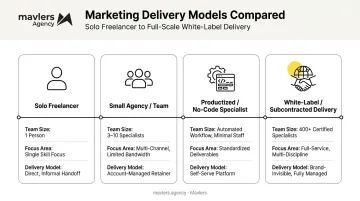
You don't have to pick one model forever, but most web development businesses start as one of these:
- Solo freelancer: one person handling everything from sales to delivery
- Small agency or team: a few specialists splitting design, development, and project management
- Productized/no-code specialist: focused on one platform, such as WordPress or Shopify builds
- White-label/subcontracted delivery: building sites for other agencies under their brand, often through partners like Mavlers Agency that manage delivery behind the scenes
What to Know Before You Start a Web Development Business
Most beginners underestimate what the job actually involves. Setting realistic expectations before you quit your day job matters more than worrying about your skill level.
That reality shows up first in how you spend your time. Coding is rarely the bottleneck. In the early stages, client acquisition, scoping calls, revisions, and admin work often eat more hours than actual development. Most solo founders handle everything themselves at first: sales, quality assurance, invoicing, support tickets.
How Long Until Steady Income?
There's no verified, published timeline for how long a new web development business takes to become profitable. What we do have:
- Upwork's Future Workforce Index found freelancers earning exclusively through freelance work reported a median income of $85,000, but that's across all skilled freelance categories, not web developers specifically.
- BLS reports a median annual wage of $90,930 for employed web developers (a wage benchmark, not a business profit figure).
Treat any specific "you'll be profitable in X months" claim with skepticism. Your timeline depends on niche, pricing, and how consistently you market yourself.
The Real Bottleneck Isn't Technical Skill
Success hinges more on pricing, contracts, and client management than on how clean your code is. Overlooked risks worth planning for:
- True startup and operating costs (tools, subscriptions, insurance)
- Realistic breakeven timelines
- Competitive pricing pressure from low-cost freelance marketplaces
- Legal and compliance setup
- Over-dependence on you as the sole delivery mechanism
Why Start a Web Development Business? (When It Makes Sense)
Starting makes sense under certain conditions, but it's not a guaranteed win just because demand exists.
The customer need is real and recurring. Nearly every business, regardless of industry, eventually needs a website built, redesigned, or maintained. That's a durable demand pattern compared to many other service businesses, and barriers to entry are comparatively low.
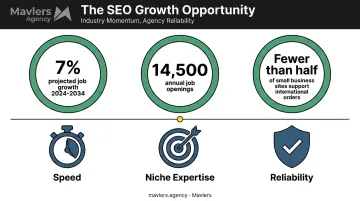
Employment for web developers and digital designers is projected to grow 7% from 2024 to 2034, with about 14,500 openings projected annually. That's solid evidence the underlying skill set stays in demand, though it doesn't directly forecast agency revenue.
Where the Opportunity Actually Is
A 2023 federal report found that fewer than half of surveyed small-business websites could process international orders. The report cited cost, limited expertise, and lack of time as the main barriers to digital adoption. That's a real service gap, not a hypothetical one.
You can differentiate on:
- Speed: faster turnaround than bigger agencies
- Niche expertise: deep Shopify or HubSpot specialization instead of generalist work
- Reliability: showing up and delivering, which sounds basic but is rarer than you'd think
These differentiators win the work. Recurring revenue, think maintenance retainers, hosting, and ongoing support, is what turns a one-off project into a long-term asset.
How to Start a Web Development Business – Step by Step
Here's where the theory becomes execution. The most common mistakes at this stage: skipping validation, underpricing to win the first few clients, and scaling before your systems can handle it.
Step 1 – Identify the Problem, Customer, and Opportunity
Pick a specific problem to solve, such as outdated sites, no e-commerce capability, or a poor mobile experience, and an initial niche or customer type. Then identify who actually has budget authority to pay for a fix.
Common miss: targeting businesses that need a website but haven't prioritized or budgeted for one yet. Interest without budget isn't a lead.
Step 2 – Validate Demand, Pricing, and Viability
Validate through direct conversations, small paid pilot projects, or test listings on freelance platforms before committing fully. Propose real pricing early: polite interest isn't the same as willingness to pay.
Common miss: confirming demand exists, then discovering months later that your pricing doesn't cover your actual time and costs.
Step 3 – Define the Business Model and Pricing Structure
Decide your pricing model based on your niche and service scope: hourly, fixed-project, retainer, or productized packages. For reference, here's what the market actually looks like:
| Provider Type | Hourly Rate |
|---|---|
| Freelancers on Upwork | $15–$50/hour |
| Web development companies (Clutch, general) | $25–$49/hour |
| U.S.-based web development companies (Clutch) | $100–$149/hour |
Project-based pricing varies widely too: a landing page might run $500–$2,000, while a custom web application can run $10,000–$50,000, depending on scope and complexity.
Factor in fixed costs (tools, subscriptions), variable costs (contractors), and cash-flow timing like deposits versus final payments.
Common miss: underpricing to "win" early clients, then struggling to raise rates once you've set expectations.
Step 4 – Set Up the Basics (Legal, Compliance, and Risk)
Register your business entity (sole proprietorship or LLC) and get an EIN if applicable. Registration costs are typically under $300, though this varies by state.
- Sole proprietorship: default status if you don't register another entity type; no separation between personal and business liability
- LLC: generally protects personal assets in most instances, formation rules vary by state
Set up contracts, NDAs, and basic business insurance to limit liability before you need them.
Common miss: skipping contracts or insurance until a client dispute or scope issue forces the issue.
Step 5 – Build the Offering and Operating Process
Clearly define what's included, such as design, development, hosting setup, and launch support, versus what isn't. Create a simple, repeatable workflow: discovery, design, build, review, launch, so delivery doesn't depend on your memory alone.
Common miss: vague scope definitions that lead to scope creep and unpaid rework.
Step 6 – Plan Capacity, Hiring, and Support
Decide early whether work gets handled solo, via contractors, in-house hires, or outsourced delivery partners. Many growing web development businesses hit a capacity ceiling fast: client demand can outpace one person's bandwidth long before it justifies a full-time hire.
Rather than navigating recruiting, training, and payroll overhead, some founders and agencies partner with white-label web development providers to handle back-end delivery. Mavlers Agency, for example, works behind the scenes across WordPress, Shopify, and other platforms so agencies can take on more client work without expanding headcount. Clients never know a third party is involved.

Common miss: hiring too early, before revenue supports it, or waiting too long and burning out.
Step 7 – Go to Market and Build Trust
Decide how customers find and evaluate you: a portfolio site, referrals, LinkedIn outreach, or agency partnerships. Credibility signals matter more than volume:
- Case studies with measurable outcomes
- Testimonials from real clients
- A clear, specific service offering (not "we do everything")
Common miss: relying on a single lead channel with no visibility into what's actually driving inquiries.
Step 8 – Monitor, Improve, and Stabilize
Track project profitability, client feedback, and financial health on a regular cadence. Fix delivery gaps, pricing issues, or inefficiencies before attempting to grow further.
Common miss: trying to scale (more clients, more hires) before pricing and delivery systems are stable.
Conclusion
Starting a web development business comes down to fundamentals: validating demand, pricing correctly, and delivering consistently. None of that happens instantly.
Clarity and execution matter more than speed. Expect a ramp-up period rather than instant traction, and treat early months as a data-gathering exercise for pricing and process refinement.
As demand grows, capacity often becomes the next hurdle. When that happens, rushed hiring isn't the only path forward. Scalable options, including white-label delivery partners like Mavlers Agency, let you take on more work without the overhead of building a full internal team overnight.
Frequently Asked Questions
What is a web development business?
It's a business that builds, customizes, and maintains websites or web apps for paying clients. Unlike web design, which focuses on visuals and user experience, development centers on functionality and code.
How much does it cost to start a web development business?
Starting costs are typically low: a laptop, software subscriptions, a domain, and business registration (usually under $300). Costs grow as you add insurance, contractors, or marketing spend.
Do I need a coding degree to start a web development business?
No. Certifications, bootcamps, and a strong portfolio can substitute for a formal degree. Many successful developers build credibility through client work and a solid project history instead of a CS credential.
How long does it take for a web development business to become profitable?
It varies by niche, pricing, and marketing consistency, with no single verified benchmark. Most founders should expect several months to a year before reaching steady, predictable income.
What's the difference between a web design business and a web development business?
Design focuses on visuals, layout, and user experience. Development focuses on the code and functionality that make a site work. Many businesses offer both under one roof.
Can I run a web development business alone, or do I need to hire immediately?
Most founders start solo, handling sales, delivery, and support themselves. As demand grows, many turn to white-label partners like Mavlers Agency to handle overflow web development work without hiring in-house staff.