That structural difference changes everything, from messaging to sales cycle length. And it creates a real problem for marketers and agencies alike: strategy is easy to sketch out, but execution at scale is hard. Landing pages, gated assets, campaign sites, and content all need to ship fast and consistently, or the strategy just sits on a slide deck.
This guide breaks down what B2B marketing actually means, the 4 C's framework replacing the old marketing mix, a five-step strategy blueprint, and the channels and best practices driving results in 2026.
Key Takeaways
- B2B marketing targets buying committees, not individual shoppers, through consultative, ROI-driven messaging
- The 4 C's (Customer, Cost, Convenience, Communication) reshape the marketing mix for B2B buying decisions
- A strategy follows five steps: vision, audience, channels, execution, and optimization
- Content, SEO/GEO, LinkedIn, email, and account-based marketing drive top B2B results
- Execution speed, especially web and content production, is the real bottleneck to scaling results
What Is B2B Marketing?
B2B marketing is the process of promoting products or services to other businesses and organizations, rather than individual consumers. Instead of one shopper deciding on impulse, you're persuading a group of stakeholders who each evaluate the purchase through a different lens: cost, risk, technical fit, or long-term ROI.
That's why B2B decisions move at a different pace entirely. According to 6sense's 2025 B2B Buyer Experience Report, the average B2B buying journey now runs 10.1 months, down slightly from 11.3 months in 2024. This figure covers the entire buyer journey, not just the portion where a sales rep is actively involved.
It's a Logic-First, Multi-Stakeholder Process
Business buyers aren't shopping for themselves. They're building a case they can defend to their own bosses. That means:
- Decisions lean on data, case studies, and total cost of ownership
- Multiple departments (finance, IT, operations) weigh in before signing
- Vendor selection often requires internal approval workflows, not a checkout button
Real-World Examples Across Industries
The definition plays out differently depending on the industry:
- SaaS companies use gated whitepapers, product demos, and free trials to move prospects through evaluation
- Manufacturers lean on detailed spec sheets, trade show presence, and distributor relationships
- Professional services firms (legal, consulting, accounting) build trust through thought leadership and referral networks
Every one of these examples involves more than one decision-maker. Gartner's research puts modern B2B buying groups at 5 to 16 people spanning up to four functions, based on a 2025 survey of 632 B2B buyers. That's a lot of people to convince with a single generic landing page.
The 4 C's of B2B Marketing
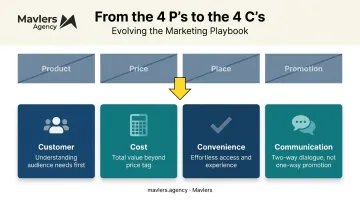
The traditional 4 P's (Product, Price, Place, Promotion) were built for shelves and storefronts. B2B buyers don't browse aisles; they research, compare, and build consensus. The 4 C's framework reframes the mix around the buyer's actual experience.
- Customer: Understand organizational pain points and map messaging to each member of the buying committee, not a single persona
- Cost: Frame pricing around total ROI, payback period, and business impact rather than a sticker price
- Convenience: Strip friction from research and evaluation. Buyers are busy; make comparison, demos, and procurement painless
- Communication: Replace one-way promotion with consultative, two-way dialogue that continues across the entire buyer journey
Here's the shift in practice: a B2C ad might say "Buy now, 20% off." A B2B equivalent looks more like a calculator showing projected cost savings over three years, backed by a case study from a similar-sized company. Same goal, completely different approach.
B2B Marketing vs. B2C Marketing
Confusing the two models is one of the fastest ways to waste a marketing budget. A flash sale email that works for a retail brand will fall flat with a procurement director evaluating a six-figure software contract.
| Dimension | B2B Marketing | B2C Marketing |
|---|---|---|
| Audience | Buying committees, multiple roles | Individual consumers or households |
| Purchase cycle | Long, iterative, multi-stage evaluation | Short, often immediate |
| Key drivers | ROI, risk reduction, compliance, trust | Emotion, convenience, personal value |
| Primary channels | LinkedIn, email, SEO, events, ABM | Social ads, marketplaces, direct response |
Some companies run both models at once. A manufacturer might sell bulk components to retailers through a dedicated B2B sales team, while also marketing a consumer product line through Instagram ads. The messaging shifts entirely between the two: one leans on volume pricing and reliability guarantees, the other on lifestyle appeal.
Understanding this distinction matters: consumer-style tactics tend to underperform with business buyers. A flashy social campaign might generate impressions, but it won't move a buying committee comparing vendors against a procurement checklist.
How to Build a B2B Marketing Strategy
A strategy that works on paper but can't be executed consistently isn't really a strategy. These five steps move from planning through to measurable output.
Step 1: Define Your Vision and Goals
Before any content or campaign gets built, set specific, measurable business objectives. "Increase brand awareness" isn't a goal. "Generate 40 qualified opportunities in the manufacturing vertical by Q3" is. Vague goals produce vague campaigns.
Step 2: Identify Your Target Audience and Buyer Personas
Build detailed personas for each stakeholder in the buying committee, not just the champion who signs the check. Research firmographic data (company size, industry, revenue) alongside role-based data (job title, priorities, objections). A CFO and a VP of Operations need entirely different messaging, even when they're evaluating the same purchase.
Step 3: Choose Your Channels and Tactics
Let audience research, not habit, guide channel selection. Key decision points include:
- Search: Where are buyers actively looking for solutions?
- Social: Is your audience active on LinkedIn, industry forums, or niche communities?
- Email: Can you nurture stakeholders over a multi-month cycle?
- Events: Do trade shows or webinars carry weight in this industry?
Step 4: Build Assets and Launch Campaigns
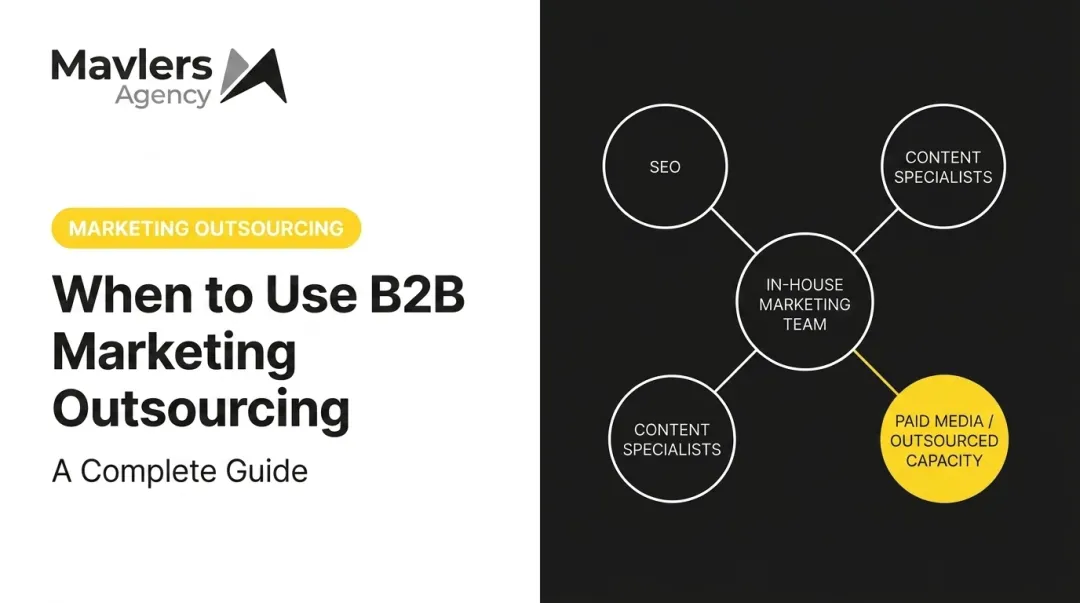
This is where most strategies stall. Landing pages, gated content, campaign microsites: someone has to actually build them, and fast. For agencies managing multiple client accounts simultaneously, execution capacity often becomes the real bottleneck, not creative thinking.
That's why many growing agencies partner with white-label execution providers instead of hiring for every skill set in-house.
Mavlers Agency, for example, builds and launches these assets across WordPress, Shopify, Webflow, and HubSpot on behalf of agency partners. The work ships under the agency's own brand, so client relationships stay intact while output scales without adding headcount.

Step 5: Measure, Optimize, and Scale
Track pipeline velocity, customer acquisition cost, and conversion rates at each funnel stage. Then iterate. A campaign that generates leads but stalls at the proposal stage needs different fixes than one that never gets past initial awareness.
B2B Marketing Channels, Tactics, and Best Practices
Not every channel deserves equal investment. Here's where B2B marketers are actually seeing results in 2026.
Top-performing channels and tactics:
- Content marketing: Case studies, research reports, and video consistently outperform generic blog posts for conversion
- SEO and GEO: Traditional search still drives intent-based traffic, while generative engine optimization increasingly determines whether AI tools cite your brand at all
- LinkedIn and social: LinkedIn remains the dominant professional network for B2B distribution
- Email nurturing: Still one of the highest-ROI channels for moving stakeholders through a long buying journey
- Webinars: Strong for both lead generation and thought leadership positioning
- Account-based marketing (ABM): A 1-to-1 strategy that targets specific high-value accounts with personalized campaigns
Why ABM Keeps Growing
ABM works because it concentrates resources where they matter most. In Forrester's 2024 ABM research, roughly a third of respondents reported an 11%-20% increase in average deal size, and nearly a third reported a 21%-50% increase. For teams selling into enterprise accounts, that's a meaningful revenue lever.
Best Practices Worth Adopting
- Be human. LinkedIn's B2B Institute (2022) studied 600 B2B ads and found 71% were unlikely to drive sales or growth, mostly due to formulaic, text-heavy execution. Stronger storytelling and earlier brand visibility fix this.
- Align sales and marketing on account selection and lead handoff. Duplicate outreach to the same stakeholder confuses buyers and wastes budget.
- Invest in thought leadership. Senior decision-makers read expert content weekly, making this a durable channel for building long-term trust.
- Adopt first-party data strategies. As third-party tracking becomes less reliable, personalization increasingly depends on data buyers give you directly.
Emerging B2B Marketing Trends to Watch
Three shifts are reshaping how B2B teams plan for the next few years.
- AI-driven targeting and personalization: With third-party cookie reliance declining, marketers are relying more on first-party and zero-party data to power relevant, connected experiences across channels.
- Composable martech stacks: Instead of one monolithic platform, more B2B teams are assembling interoperable tools they can swap in and out as needs change, reducing lock-in and increasing flexibility.
- Revenue accountability over lead volume: Marketing teams are increasingly measured on pipeline contribution and deal velocity, not raw lead counts.
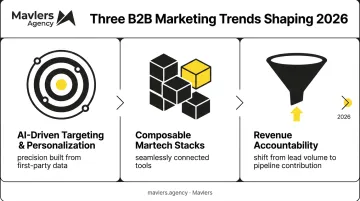
Together, these shifts make B2B marketing faster, more data-driven, and more directly accountable to revenue. Agencies already adapting their content and technical SEO for first-party data and AI-driven discovery, often through white-label partners like Mavlers Agency, are positioned to capture this shift early.
Frequently Asked Questions
What does B2B marketing mean?
B2B marketing is the process of promoting products or services from one business to another, rather than to individual consumers. It typically involves longer sales cycles and multiple decision-makers evaluating the purchase together.
What are the 4 C's of B2B marketing?
The 4 C's are Customer, Cost, Convenience, and Communication. They replace the traditional 4 P's with a buyer-centric model built for complex, committee-driven purchasing decisions.
What is the difference between B2B and B2C marketing?
B2B marketing targets buying committees over longer cycles using ROI-driven messaging, while B2C marketing targets individual consumers making faster, often emotionally-driven purchases. The channels and content used for each differ as well.
What are the key stages of the B2B marketing process?
The core funnel stages are awareness, consideration, decision, and retention. Each stage requires different content and messaging tailored to where the buying committee sits in its evaluation.
What is account-based marketing (ABM)?
ABM is a focused, 1-to-1 strategy that targets specific high-value accounts rather than casting a wide net. It aligns sales and marketing around a shared list of target companies and stakeholders.
Which channel works best for B2B marketing?
LinkedIn consistently ranks as the top-performing social platform for B2B, but email, SEO, and ABM remain strong complementary channels depending on your audience and sales cycle length.