Outsourcing SEO is how many agencies solve this without expanding payroll. But it isn't plug-and-play. Results vary widely depending on the model you choose, how carefully you vet partners, and whether you've built real communication structure around the arrangement.
This guide walks through the exact steps to outsource SEO, what separates a reliable partner from a risky one, the mistakes that trip up agencies most often, and how the major outsourcing models stack up against each other.
Key Takeaways
- Outsourcing lets agencies scale SEO delivery and protect margins without hiring specialists in-house
- Success hinges on clear scope, structured vetting, and matching the model to your client volume
- Look for white-label reporting, signed NDAs, and multi-platform technical depth in any partner
- Price-only decisions and skipped trial projects are the fastest ways to damage client trust
- The agency SEO services market will hit $87.82 billion by 2026 — a 16.8% growth rate from 2025, per The Business Research Company
How to Outsource SEO Services: A Step-by-Step Process for Agencies
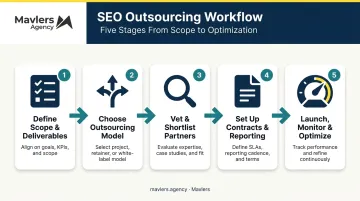
Outsourcing works best when you treat it as a structured process, not a one-off vendor search. Here's how agencies that scale successfully approach it.
Step 1: Define the Scope and Deliverables
Start by identifying exactly where your internal team falls short. Are you missing bandwidth for full-service strategy execution, or do you just need overflow help with specific tasks like link building, audits, or content?
Set outcome-based goals instead of vague task lists:
- Ranking movement for target keyword clusters within a defined window
- Organic traffic growth percentage over 90 days
- Turnaround time for audits, content drafts, or technical fixes
- Content output volume, such as published assets per month
Vague deliverables make any partner impossible to measure objectively. Specific goals make accountability easy.
Step 2: Choose the Right Outsourcing Model
Compare freelancers, contractors, boutique task-based firms, and full-service white-label partners against your monthly retainer volume and margin targets.
An agency handling occasional overflow work suits an on-demand reseller or freelancer. An agency scaling multiple ongoing client retainers needs a dedicated white-label partner built for consistent, invisible integration. Mismatching the model to your risk tolerance is where most outsourcing relationships break down early. Ask each candidate how quickly they can scale up if a client requests double the output next quarter.
Step 3: Vet and Shortlist Potential Partners
Request sample audits, case studies, and retention data before signing anything. Confirm white-label maturity by asking directly:
- Do they sign NDAs on day one, or only if you ask?
- Are reports branded under your agency's name, with zero mention of the provider?
- Can they show a client dashboard mockup before you commit?
Run a paid trial project or a skills-based test task first. A single audit or content sprint reveals more about execution quality than any sales call. Score each trial against the same rubric you'll use for ongoing performance reviews.
Step 4: Set Up Contracts, Reporting, and Communication Systems
Establish SLAs covering turnaround time, revision policy, escalation paths, and reporting frequency, whether weekly or monthly. Define who owns client-facing communication in writing.
In nearly every well-structured agency arrangement, the agency retains 100% of client contact while the partner works entirely behind the scenes. Mavlers Agency, for instance, operates inside the agency's own project management tools like Asana or Trello rather than opening any separate channel a client might stumble across.
Step 5: Launch, Monitor, and Optimize the Partnership
Treat the first 30 to 60 days as a live validation phase. Track ranking movement, traffic, and deliverable quality against the benchmarks you set in Step 1.
Build a feedback loop from day one:
- Review weekly during the first month to catch friction early
- Reallocate tasks if certain deliverables are consistently late or below quality
- Renegotiate scope as client volume grows or shrinks
Don't wait until quarter-end to notice a partnership isn't working.
When Should Your Agency Outsource SEO?
Outsourcing makes sense in a few clear scenarios:
- Client demand exceeds internal bandwidth and hiring would take months you don't have
- Specialized skills are missing internally — technical SEO, multilingual link building, or emerging areas like AI search optimization
- Hiring would erode margins faster than outsourcing a proven partner would
Agencies already outsourcing other delivery functions, such as white-label web development, often extend the same invisible-partner model to SEO. It's the same logic applied to a different service line: scale output without adding headcount or management overhead.
That said, outsourcing works less well for highly bespoke strategic consulting, where the client pays specifically for your team's judgment.
It also fails when an agency lacks the internal process to manage an external partner. Even the best outsourcing relationship needs someone on your side reviewing deliverables and relaying context.
What to Look for in an SEO Outsourcing Partner
Not every provider that claims "white-label SEO" delivers it well. Here's what separates the ones worth trusting.
Proven Results and Transparent Reporting
Ask for case studies, ranking and traffic data, and sample client dashboards before signing. Pricing varies by provider type: Ahrefs' survey of 439 SEO providers found average monthly retainers of $1,348 for freelancers, $3,250 for consultants, and $3,209 for agencies, with agency project fees averaging $9,507.84.
Higher pricing doesn't automatically mean better results. Use these figures to sanity-check quotes, not as a quality guarantee.
White-Label Maturity and Confidentiality
Confirm the partner offers:
- Signed NDAs as a standard, non-negotiable first step
- Fully branded reports, dashboards, and audits carrying only your agency's name
- Zero direct client contact under any circumstances
If a provider hesitates on any of these three, treat it as a warning sign.
Technical and Platform Expertise
Verify hands-on experience across the CMS and eCommerce platforms your clients actually run — WordPress, Shopify, Webflow, HubSpot, WooCommerce, Magento, or BigCommerce. A partner strong in technical audits but unfamiliar with your client's platform quirks will cost you more time than it saves.
Scalability and Communication Structure
Evaluate whether the partner can flex capacity up or down as your retainer volume shifts. Also check whether they assign a dedicated point of contact rather than routing you through a support queue. Agencies managing multiple client accounts need one reliable contact person to avoid constant hand-offs.
Common Mistakes Agencies Make When Outsourcing SEO
Even experienced agencies stumble on the same handful of errors:
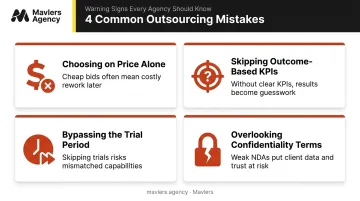
- Choosing on price alone: the cheapest provider often causes quality issues that damage client trust long before you save meaningful margin
- Skipping outcome-based KPIs: vague deliverables like "improve rankings" are impossible to measure or hold anyone accountable for
- Bypassing the trial period: signing a long-term contract before validating real execution quality invites expensive surprises
- Overlooking confidentiality terms: a partner without strict white-label protocols risks a client discovering the arrangement, which can unravel an agency relationship overnight
Each of these mistakes is preventable with the vetting steps outlined above. None of them require exotic due diligence, just discipline in following through.
Outsourcing Models Compared: Which Fits Your Agency?
| Model | Best For | Key Trade-Off |
|---|---|---|
| Freelancers / independent contractors | Occasional overflow or narrow one-off tasks | Inconsistent availability, limited accountability at scale |
| Boutique / task-based SEO firms | Specific deliverables (audits, link building) without a full strategic partnership | Less strategic ownership across a full campaign |
| Full-service white-label partners | Agencies scaling multiple retainers needing consistent quality | Higher retainer minimums, but stronger long-term reliability |
Freelancers work well when you need a single audit done or a short-term content sprint covered. They're the cheapest entry point, averaging $1,348 a month per the Ahrefs data above, but reliability drops as your client count grows.
Boutique firms suit agencies that need discrete deliverables handled well without handing over full campaign strategy. You retain more control, but you're also coordinating more pieces yourself.
Full-service white-label partners fit agencies scaling multiple ongoing retainers who need one consistent engine running in the background. Mavlers Agency delivers this model to agencies, providing:
- Fully branded reporting with the agency's name on every page
- Invisible communication so end clients never know a partner is involved
- Consistent quality across 7,000+ client engagements, backed by 400+ certified specialists
For agencies juggling more than a handful of active SEO clients, this model tends to reduce management overhead the most.
Frequently Asked Questions
What is SEO outsourcing?
SEO outsourcing means hiring a third-party specialist or agency to plan and execute SEO tasks, from technical audits to link building. In agency contexts, it's typically delivered under the hiring agency's own brand rather than the provider's.
How much does it cost to hire someone to do SEO?
Average monthly retainers run $1,348 for freelancers, $3,250 for consultants, and $3,209 for agencies, based on Ahrefs' survey of 439 providers. Project-based fees range from roughly $2,349 for freelance work up to $9,508 for agency projects.
What is the 80/20 rule of SEO?
It's the Pareto principle applied to search: a small share of efforts, like key technical fixes or top keyword clusters, tends to drive most ranking and traffic gains. Treat it as a prioritization lens, not a guaranteed traffic split.
Is outsourcing SEO worth it for a small or mid-sized agency?
For most small-to-mid agencies, yes — it adds capacity and specialized skill without payroll risk. The trade-off is quality control, which is why vetting and trial projects matter more than price comparisons.
How do agencies keep an outsourced SEO partner invisible to their clients?
Through signed NDAs on day one, reports and dashboards branded entirely under the agency's name, and a strict rule that the outsourcing partner never contacts the client directly.
How long does it take to see results after outsourcing SEO?
Google states businesses typically need four months to one year after starting SEO changes to see meaningful benefits. Be cautious of any provider promising faster, guaranteed rankings.