Introduction
Most people picture web design as picking colors and fonts. That's a fraction of the job.
Businesses regularly underestimate what a professional web design engagement actually covers, and that gap causes real problems: budgets balloon mid-project, deliverables get missed, and scope creep turns a six-week build into a six-month scramble.
A real web design project spans strategy, user research, interface design, development, content, SEO, and quality testing. Skip any one of these, and the finished site underperforms no matter how polished it looks.
This guide breaks down every service category included in a full web design engagement, from the first discovery call to post-launch maintenance, so you know exactly what you're paying for.
Key Takeaways
- Web design covers strategy, UX/UI, development, content, and testing, not just visuals
- Five elements shape site effectiveness: content, layout, navigation, style, and function
- Full-service engagements often bundle hosting, maintenance, and SEO beyond launch
- Costs and scope shift across DIY, freelance, agency, and white-label delivery models
What Is Web Design?
Web design is the process of planning, structuring, and visually crafting how users experience a website. It combines three disciplines:
- UX design — how the site works and feels to navigate
- UI design — the visual interface elements users click and interact with
- Visual design — the overall aesthetic, from color to imagery
Design and development are often used interchangeably, but they're not the same thing. Design covers the look, feel, and usability of a site.
Development is the technical engineering that makes it function, using languages like HTML, CSS, and JavaScript on the front end, with PHP, Python, or similar languages powering the back end (Upwork, 2024).
For example, a designer decides where the "Buy Now" button goes and what it looks like. A developer writes the code that makes it actually process the purchase.
Professional engagements rarely separate these cleanly, though. Most agencies bundle design with strategy, content, SEO fundamentals, and testing as one package. That's exactly why first-time buyers are often surprised at how long the full service list turns out to be.
The Core Services Included in a Web Design Project
Professional web design typically unfolds across five phases, each with its own deliverables. Skipping a phase doesn't save money. It just shifts the cost to post-launch fixes.
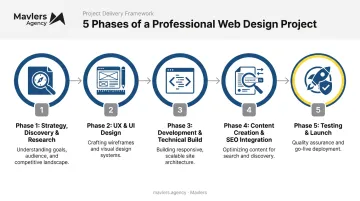
Strategy, Discovery & Research
Before anyone opens a design tool, there's a discovery phase. This includes stakeholder interviews, user research, and workshops to define goals, audience, and success metrics (Nielsen Norman Group, 2020).
HubSpot's own website redesign questionnaire runs to 119 questions, covering everything from the reason for the redesign to budget and accessibility needs (HubSpot).
Discovery also includes competitor and marketplace research. Outputs typically identify:
- Market gaps and unmet user needs
- Competitor strengths and weaknesses
- Performance benchmarks to beat at launch
- Technical constraints specific to the industry or platform
UX & UI Design
Design deliverables move through two stages. First, wireframes: black-and-white structural layouts with no branding, used to lock in content hierarchy and page structure. Then mockups: fully branded, near-final visuals that clients review before a single line of code gets written.
UI design work covers:
- Color palettes and typography systems
- Button styles and interactive states
- Visual hierarchy that guides the eye to key actions
Development & Technical Build
Once mockups are approved, developers translate them into a working site using HTML, CSS, and JavaScript, often built on a CMS platform. WordPress powers 41.2% of all websites, with Shopify at 5.3% and Webflow at 0.8% (W3Techs, 2026).
This phase also includes responsive development, building the site so it adapts correctly across desktop, tablet, and mobile using CSS media queries and mobile-first styling (MDN Web Docs, 2026).
Content Creation & SEO Integration
Someone has to write the copy, source the images, and produce any video or multimedia. This work happens alongside design, not after it, so pages are built around real content rather than placeholder text.
On-page SEO gets integrated here too:
- Page titles and meta descriptions written per Google's guidelines
- Alt text on images for accessibility and search context
- Logical site structure with descriptive URLs and internal links
Testing & Launch
Before go-live, a proper QA process checks:
- Cross-browser and cross-device compatibility
- Form validation and broken links
- Page load speed
That last one matters more than most clients realize. Deloitte analyzed 30 million mobile sessions across retail, travel, and lead-generation brands and found that a 0.1-second speed improvement drove an 8.4% increase in retail conversions (Deloitte, 2020). Launching without speed testing means launching blind.
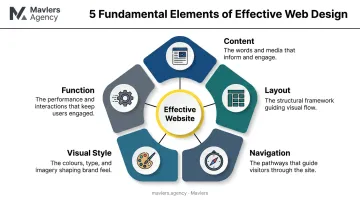
The 5 Fundamental Elements of Every Web Design
Every effective site, regardless of industry or platform, relies on the same five building blocks working together.
Content. Headers, copy, images, and calls-to-action need to be planned around what users actually came to find, not what looks good in a mockup. Content decisions should happen before visual design locks in.
Layout. Wireframes and grid systems arrange these elements so the page reads in a logical, accessible order. A cluttered layout buries the content no matter how good that content is.
Navigation. Menus, breadcrumbs, and search tools help users find what they need without hunting. Nielsen Norman Group's research on information scent shows users abandon pages quickly when navigation cues feel ambiguous or unfamiliar (NN/g, 2020).
Visual Style. A consistent color scheme, typography, and imagery, all guided by a brand style guide, build hierarchy and make the site instantly recognizable as yours.
Function. None of the above matters if the site is slow or breaks on mobile. Portent analyzed 5.6 million sessions across 20 B2B and B2C sites and found a B2B site loading in one second converted 3x better than one loading in five seconds, and 5x better than one loading in ten (Portent, 2022).
A slow-loading site costs conversions no matter how polished the design looks.
Beyond the Build: Ongoing Web Design Services & Deliverables
Launch day isn't the finish line. Several deliverables continue long after the site goes live.
Domain and SSL setup. Registering a domain and installing an SSL certificate affect both credibility and search visibility. Google has treated HTTPS as a ranking signal since 2014, and Chrome has flagged non-HTTPS sites as "not secure" since 2018, according to the Google Security Blog.
Hosting and maintenance. Once the site is secure and live, keeping it running smoothly becomes the next priority—this is where retainer agreements come in. Ongoing work typically includes:
- Update core software, plugins, and themes
- Apply security patches and run compatibility checks
- Back up databases and files regularly, storing copies in multiple locations
Digital marketing bundling. Many engagements pair the site build with a broader marketing plan, since a well-designed site with no content strategy or traffic plan rarely performs. Content calendars, email flows, and social integration frequently show up as add-ons to the core design retainer.
Choosing the Right Web Design Service: Cost & Delivery Models
Pricing varies enormously depending on who's building your site and what's actually included.
| Model | Typical Cost | What You Get |
|---|---|---|
| DIY builder | $4–$29/month | Templates, hosting; you do the design work |
| Freelancer | $15–$75+/hour | Custom design, limited strategy or QA depth |
| Agency (project) | $2,000–$100,000+ | Full strategy-to-launch, most under $10,000 |
Most reviewed agency projects take around 7 months start to finish, though scope and platform complexity can shift that timeline by months (Clutch, 2026).
Agencies face this same cost equation from the other side of the table. Rather than hiring in-house developers for every platform, many now partner with white-label web development providers like Mavlers Agency to deliver strategy-to-launch services under their own brand.
This model lets an agency scale project output and profit margins across WordPress, Shopify, Webflow, and HubSpot without adding headcount. The end client never knows a third party was involved.

Whichever route you choose, get specific before signing anything. Confirm in writing whether your quote covers:
- Strategy and discovery
- UX/UI design
- Development and responsive build
- Content and SEO integration
- Testing and QA
- Post-launch maintenance
Missing even one of these from a contract is how "surprise invoices" happen three months after launch.
Frequently Asked Questions
What are the 5 basic elements of web design?
Content, layout, navigation, visual style, and function. All five need to work together: strong visuals with poor navigation still produce a weak site.
What services do web designers offer?
Strategy, UX/UI design, development, content creation, and post-launch support are the core offerings. Providers deliver these individually or bundled as a full package.
What is the difference between web design and web development?
Design focuses on look, feel, and user experience. Development handles the technical coding, front-end and back-end, which makes the design actually function on the web.
Do web design services include SEO?
On-page SEO fundamentals, like metadata, alt text, and site structure, are usually built into the design process. Ongoing SEO campaigns are typically a separate, recurring service.
How much do web design services typically cost?
DIY builders run $4–$29/month, freelancers charge $15–$75+ an hour, and agency projects range $2,000–$100,000+, with scope and platform driving the final number.
Is website maintenance included in web design packages?
Usually not as a one-time deliverable. Maintenance, including updates, backups, and security patches, typically sells as a separate ongoing retainer, though some providers bundle it in.