Reaching that buyer has gotten harder. Inboxes are crowded, LinkedIn DMs get ignored, and generic "just checking in" emails land straight in the trash. Yet outbound hasn't disappeared. For many B2B and SaaS companies with longer, higher-value sales cycles, proactive outreach still fuels a meaningful share of qualified pipeline — it just looks completely different than it did five years ago.
This guide walks through the outbound strategies actually working in 2026, how to pick the right combination for your business, and what happens operationally once those strategies start winning you clients.
Key Takeaways
- AI personalization and intent data now separate high-performing outbound from ignored outbound
- Multi-channel sequencing (email, LinkedIn, phone) consistently beats single-channel outreach
- ABM delivers the strongest documented ROI, but only when targeting high-value accounts
- Match strategy to deal size and sales cycle length, not trends
- Outbound wins create delivery pressure — agencies need a plan for absorbing new project volume
What Is B2B Outbound Marketing and Why It Still Matters in 2026
B2B outbound marketing is proactive, company-initiated outreach aimed at prospects who haven't yet raised their hand: cold email, cold calls, targeted ads, event invitations, and direct mail. It's the opposite of inbound, which waits for buyers to find you through content, SEO, or search.
Most B2B teams think about their go-to-market mix in four buckets:
- Outbound marketing: direct, seller-initiated outreach
- Inbound marketing: content and search that pulls buyers in
- Account-based marketing (ABM): concentrated, multi-stakeholder campaigns on named accounts
- Relationship and referral marketing: growth through existing networks and customer advocacy
There's no single industry-wide figure for what share of B2B budgets or pipeline outbound owns; that data simply isn't standardized across sources. What is clear from talking to sales and marketing teams: outbound remains a primary lever for companies with complex, higher-ACV sales cycles, where waiting for inbound demand alone isn't fast enough.
The defining shift for 2026 is precision, not outbound's disappearance. Teams that once measured success by volume (more dials, more sends) now measure it by relevance: reaching the right account with a well-timed, well-crafted message.
Top B2B Outbound Marketing Strategies for 2026
These strategies made the list based on real 2026 adoption patterns, what AI tools can now realistically do, and their track record for booking qualified meetings, not because they're trendy.
AI-Personalized Cold Email at Scale
Generic templates are dying. AI tools now research a prospect's company, role, and recent activity, then draft individually tailored email copy at volume, a task that used to take an SDR 20 minutes per prospect.
That said, benchmark data hasn't fully caught up. Gong's analysis of 28 million cold emails found top performers book 8.1x more meetings and get 4.2x more replies than average senders, but that study didn't isolate AI-written copy specifically. Treat AI personalization as a strong operational upgrade, not a guaranteed statistical win.
The risk: over-automated emails that technically mention the prospect's name and company but still read like a robot wrote them. Human review before sending remains non-negotiable. A rep should skim every AI draft for tone, accuracy, and whether it actually sounds like something a person would send.
Multi-Channel Sequencing (Email + LinkedIn + Phone)
Single-channel outreach is easy to ignore. A prospect can delete an email in two seconds. Missing a call is even easier. Combining channels into one coordinated cadence forces repeated, varied exposure, which connects to the old "rule of 7" idea that buyers typically need several touchpoints before engaging.
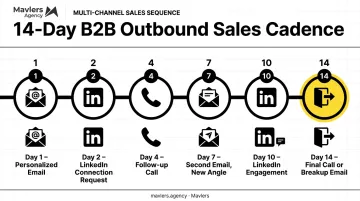
A common 2026 SDR cadence looks like this:
- Day 1: Personalized email introducing the value proposition
- Day 2: LinkedIn connection request referencing the email
- Day 4: Follow-up call, brief and value-led (not a script read)
- Day 7: Second email with a different angle or resource
- Day 10: LinkedIn comment or engagement on prospect's content
- Day 14: Final follow-up call or breakup email
No study proves seven is the magic number. It's a planning heuristic rather than a law. But the logic behind stacking channels holds up: different people respond to different formats.
Account-Based Marketing (ABM) for High-Value Target Accounts
ABM flips the funnel. Instead of casting wide and qualifying down, teams pick a curated list of high-fit accounts first, then build personalized, multi-stakeholder campaigns around each one, often coordinating marketing, sales, and even executive outreach simultaneously.
Demandbase's 2024 ABM Benchmark survey of 300+ global marketers found leading ABM programs generated 81% higher ROI than less mature programs. That's the strongest ROI signal in outbound right now.
ABM works best when:
- Sales cycles run 6+ months
- Contract values justify the extra research and coordination time
- Multiple stakeholders need to sign off on a purchase
It's a poor fit for high-volume, low-ACV motions, where the effort-to-account ratio doesn't pencil out.
Intent Data and Signal-Based Outreach
Intent tools track buying signals: website visits, tech stack changes, funding announcements, hiring surges, job changes at target accounts. Reps get a nudge the moment a prospect shows real activity, rather than relying on guesswork.
This shifts outreach from cold to warm. A prospect who just visited your pricing page three times, or whose company just raised a Series B, is a fundamentally different conversation than a cold list dial.
Common signal types SDR teams act on:
- New executive hires (especially in a relevant function)
- Technology or vendor changes
- Funding or expansion announcements
- Job postings that suggest a new initiative
Forrester notes that while most B2B organizations now invest in intent data, many still struggle to prove its direct pipeline impact. Use it to prioritize and time outreach, not as a standalone silver bullet.
Cold Calling Reinvented with Conversation Intelligence
Cold calling never actually died, but it's gotten smarter. AI call analytics now transcribe conversations, flag objections in real time, and help reps refine scripts based on real call performance.
Cognism's 2025 report, built on nearly 42,000 connected calls, found a 4.82% conversation-to-meeting rate. That's a useful benchmark for any team measuring calling ROI against conversations, not raw dial counts.
Calling remains high-effort. It's also one of the only channels that gets a real-time, unfiltered reaction from a decision-maker, a dynamic no email thread can replicate.
Video Prospecting and Personalized Async Video Messages
A 30-second video, recorded specifically for one prospect, stands out in an inbox full of text. Tools like Vidyard and Loom make this fast to produce at scale.
Salesloft reported that sales emails containing video saw 16% higher open rates and 26% higher reply rates than plain-text emails. That data is a few years old and comes from a single vendor platform, so treat it as a strong hypothesis worth testing rather than a locked-in 2026 guarantee.
Video works best for:
- Re-engaging cold or stalled prospects
- Executive outreach where a personal touch matters more
- Following up after a missed call or unanswered email
Strategic Direct Mail and Executive Gifting
For a small list of top-tier enterprise accounts, a well-timed physical package can cut through digital fatigue in a way no email ever will. Companies like Snapdocs and Cradlepoint have used targeted direct mail alongside account intelligence to reach C-level buyers who ignore everything digital.
This isn't a mass tactic. It works because it's rare:
- Reserve it for named, high-value accounts, not broad lists
- Pair it with digital sequences already underway, not as a standalone play
- Time it around a specific trigger (a funding round, a new hire, an event)
Direct mail is expensive per touch. That's exactly why it works when everything else is free and automated.
How to Choose and Combine the Right Outbound Strategies for Your Business
Not every tactic belongs in every playbook. The right mix depends on your deal size, sales cycle, and who you're actually trying to reach.
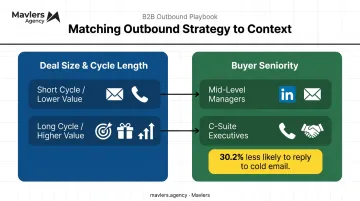
Match strategy to deal size and cycle length:
- Short cycles, lower contract value → high-volume email and calling
- Long cycles, higher contract value → ABM, executive gifting, multi-touch sequences
Match channel to buyer seniority:
- Mid-level managers respond well to LinkedIn and email
- C-suite buyers need shorter messages, fewer asks, and often a phone call, referral, or event invite
- Executives are 30.2% less likely to reply to cold email than non-executives, according to Gong's analysis of over 1 million executive sales cycles
Budget it out before you scale anything:
- Calculate cost-per-meeting: total program cost divided by qualified meetings held
- Benchmarkit's 2025 SaaS data puts median CAC payback around 18 months, though it ranges from 13 months for sub-$5K deals to 24 months for $50K-$100K deals
- Don't scale a channel until you know what a meeting actually costs you
The rule of 7: Treat it as a planning prompt, not gospel. There's no verified study proving seven touches is the exact right number, but it's a reasonable floor for how much persistence multi-channel outreach usually needs before someone engages.
Common mistakes to avoid:
- Blasting an unqualified list because the tool makes it easy
- Skipping lead scoring and treating every contact the same
- Scaling a channel before testing messaging on a small sample first
- One channel alone rarely carries the whole cadence
From Outbound Wins to Reliable Delivery: Scaling Without the Bottleneck
Here's what nobody warns agencies about: outbound success creates its own problem. Once cold email, ABM, and LinkedIn sequencing start converting, agencies often land more new clients in a quarter than their internal team can comfortably deliver.
A healthy growth engine pairs outbound acquisition with inbound content for durable long-term pipeline. But delivery capacity determines whether those new wins turn into profit, or into missed deadlines and burned-out teams.
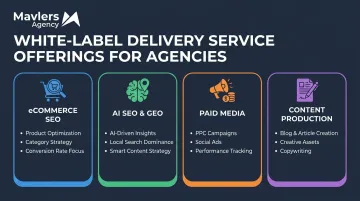
Mavlers Agency fits into that gap as a white-label delivery partner. It absorbs the SEO, AI SEO and GEO, paid media, and content production work that agencies win through their own outbound campaigns, so those agencies never need to hire.
- eCommerce SEO delivery across Shopify, WooCommerce, Magento, and BigCommerce for agencies picking up retail and DTC clients
- AI SEO and GEO services, including entity optimization and AI visibility monitoring, for agencies fielding requests they haven't built in-house expertise for yet
- White-label content retainers with 24-48 hour turnaround, so a surge in new project volume doesn't stall existing client work
- Full brand invisibility, backed by an NDA signed on day one, so clients only ever see the agency's name
Agencies keep closing deals through outbound. Mavlers Agency handles the execution behind the scenes.
Conclusion
Effective B2B outbound in 2026 comes down to precision: personalized messaging, coordinated multi-channel touchpoints, and timing that reflects buyer intent rather than a quota deadline.
Test each strategy against your own sales cycle and audience before committing real budget to it. What works for a $5,000 ACV SaaS product won't work for a $200,000 enterprise contract, and vice versa.
And if outbound starts winning more clients than your team can comfortably deliver for, that's a good problem — as long as you have a plan for it. Agencies scaling their client base through outbound can lean on Mavlers Agency to handle delivery, freeing them up to focus on what's actually growing the business: prospecting and closing.
Frequently Asked Questions
What is B2B outbound marketing?
B2B outbound marketing is proactive, company-initiated outreach, such as cold email, calls, targeted ads, and direct mail, used to generate leads rather than wait for prospects to come to you. It's the direct counterpart to inbound's pull-based approach.
What are the 4 types of B2B marketing?
Most teams group B2B marketing into outbound, inbound, account-based marketing (ABM), and relationship or referral marketing. Each serves a different stage or type of buyer relationship.
What is the rule of 7 in B2B?
The rule of 7 suggests prospects typically need around seven touchpoints across channels before they engage or convert. It's a useful planning heuristic, though no formal study has verified seven as an exact number.
Is outbound marketing still effective in 2026?
Yes, especially when paired with AI personalization and intent data that make outreach timely and relevant. Outbound continues to drive a meaningful share of qualified pipeline for B2B and SaaS companies with complex sales cycles.
How much of a B2B marketing budget should go to outbound versus inbound?
There's no universal industry split. It depends heavily on deal size and sales cycle. Most successful B2B and SaaS companies blend both, with outbound often carrying more weight for higher-value, longer-cycle sales.
What tools do B2B teams need to run outbound campaigns in 2026?
Core essentials include a sales intelligence platform, a CRM, sales engagement or automation software, an intent data provider, and conversation intelligence tools for calls. Most teams layer these rather than relying on just one.