




Table of contents
Get in touch
Expect response in 4 hours.

For agencies, explaining to clients that “your traffic is down but SEO is working” has become even more stressful than trying to parallel park a massive SUV on a tight city street while a crowd of strangers stops to watch.
You cannot spin a traffic decline as a win. And saying, “Traffic does not tell the full story anymore,” or vaguely blaming AI search, will not reassure a client who sees fewer visitors in their dashboard.
For agencies managing SEO accounts, that realization is now essential for retention.
Clients do not pay agencies for their impeccable skills of explaining the latest search trends. They pay for commercial outcomes: qualified demand, sales opportunities, revenue, and stronger visibility where buyers research and evaluate solutions.
So, when your client’s organic traffic is down, rankings healthier, and the AEO/GEO report shows more citations, it is reasonable on their part to ask this: “If visibility is improving, why are fewer people reaching our website?”
With AI seeping deeply into discovery journeys, correlating SEO efforts with meaningful outcomes is giving agencies some serious emphysema. As fewer searches translate into website visits, traditional SEO metrics are now harder to measure and easier to misdiagnose.
In no way that implies that SEO has stopped working because traffic is falling. But agencies that use AI as a catch-all explanation, without proving what is happening to visibility, lead quality, and pipeline, risk losing the account.
The agencies most likely to retain clients will do three things: diagnose whether the traffic decline is a genuine visibility problem or a click-through problem; prove where and how the client is appearing in AI-assisted discovery; and report SEO against qualified leads, opportunities, and revenue.
Curious how we report our SEO performance to our agency clients? Here’s a framework to use before the next renewal conversation.
Tell your clients that traffic decline can still mean value
Shrinking organic traffic doesn’t always weaken its commercial impact. Because, the amount of traffic a website loses to AI search results depends on the type of queries and whether users can find direct answers to those queries in AI-generated response.
Semrush reported that top-of-the-funnel, informational searches have the highest share in AI overviews. That is because AI search increasingly absorbs informational activity with users asking follow-up questions and making comparisons within the same interface. The brand website, on the other hand, becomes the final destination for verification and action.
In nutshell, traffic loss can not be confidently correlated to equivalent loss in sales. Its commercial impact depends on which pages, queries, and buying stages were affected - and whether leads, opportunities, and pipeline changed.
However, there is a more complicated reality that Brainlab’s analysis points towards.
Brainlabs analyzed GA4 data from 54 clients across 19 industries and found this:
- The organic sessions fell 10.5% in 8 months after AI Overviews became commonplace.
- 46 of the 54 clients experienced a decline.
- AI referral traffic grew by more than 163% over the same period, but it offset only around 5% of the lost organic sessions.
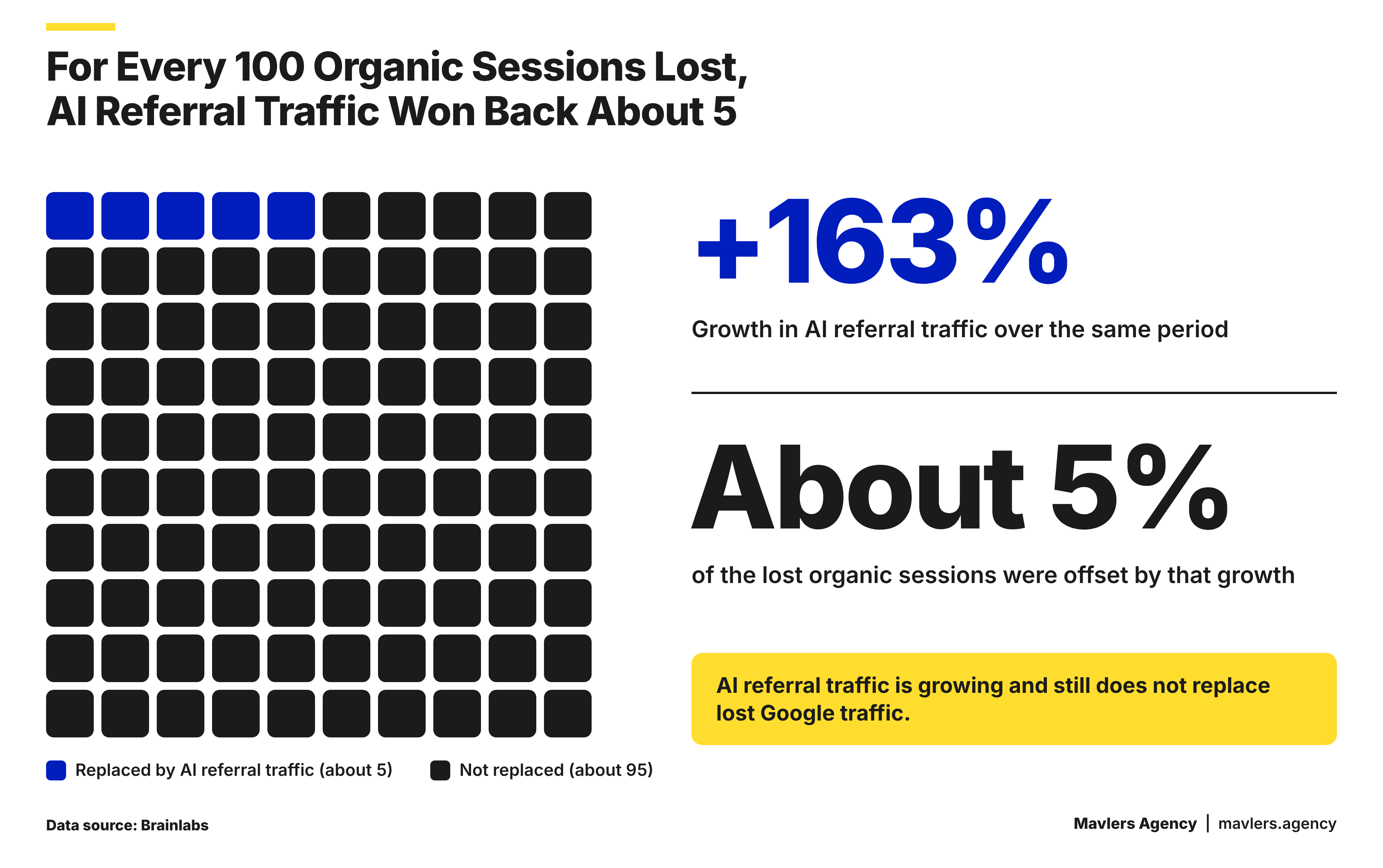
That tells agencies two things:
- While AI referral traffic is growing, it doesn’t replace the lost Google traffic. Not one for one, and not yet.
- Marketers lose the ability to track every single impression, question, or comparison. With AI search engines, you are influencing the consumer, but you could be doing it in the "dark."
That's why, the better approach to understand your search performance is to find out what kind of traffic fell and whether the decline is affecting the part of the website that creates commercial value.
Before you explain anything to the client, understand that a traffic decline can reflect at least five different conditions:
Last-click attribution now hides part of SEO’s value
A buyer may first encounter a brand in an AI Overview, ChatGPT, Gemini, Copilot, or Perplexity response. They may then open a new tab, Google the company name, return through direct traffic, click a retargeting ad, or submit an enquiry days later from another device.
In all of those cases, the original AI- or SEO-driven discovery may not receive credit. The eventual conversion can be recorded as branded organic, direct, paid, or another channel even when SEO content helped create the initial discovery.
This is why agencies must stop treating last-click organic conversions as the complete measure of SEO performance.
If your team needs a practical way to start measuring this shift, see our GEO Measurement Guide.
How should agencies diagnose a traffic decline?
1. Find out what traffic you lost
Do not begin with the total organic-traffic number. It hides too much.
Instead, open Google Search Console and identify the pages that lost the most clicks over the last 30, 60, or 90 days. Then split those pages into two groups: research pages and buyer pages.
Research pages
These are pages people use to learn:
- Blog posts
- Definitions
- How-to guides
- General industry explainers
- Broad educational resources
- Early-stage checklists
Buyer pages
These are pages people use when they are closer to choosing a provider:
- Service pages
- Product pages
- Pricing pages
- Consultation and demo pages
- Comparison pages
- Industry-specific pages
- Location pages
- Customer stories and case studies
- Contact pages
The bifurcation is important as a person researching a broad topic and a person searching for an agency’s pricing may both count as one visit in analytics, but they are nowhere near the same stage of the buying journey.
So, what should you look for?
If research pages lost traffic but buyer pages are stable, you have a more manageable situation. You are likely losing some early-stage clicks while still holding the traffic most likely to produce enquiries.
Explain it to the client like this:
“We are losing some visits from people looking for broad answers. We are not ignoring that. But the pages that bring in enquiries - our service, pricing, and comparison pages - are holding steady. We are now focused on two things: keeping the brand visible during early research, including in AI answers, and protecting the pages buyers visit when they are ready to compare providers.”
But if buyer pages are losing impressions, rankings, traffic, and leads, be upfront about it. That is more than a change in click behaviour. You may be losing visibility on pages that directly influence the pipeline.
Explain it to the client like this:
“This is more than an AI click-through issue. We are losing visibility on pages that influence the pipeline. We have identified it early, and we are treating it as a commercial-priority recovery project.”
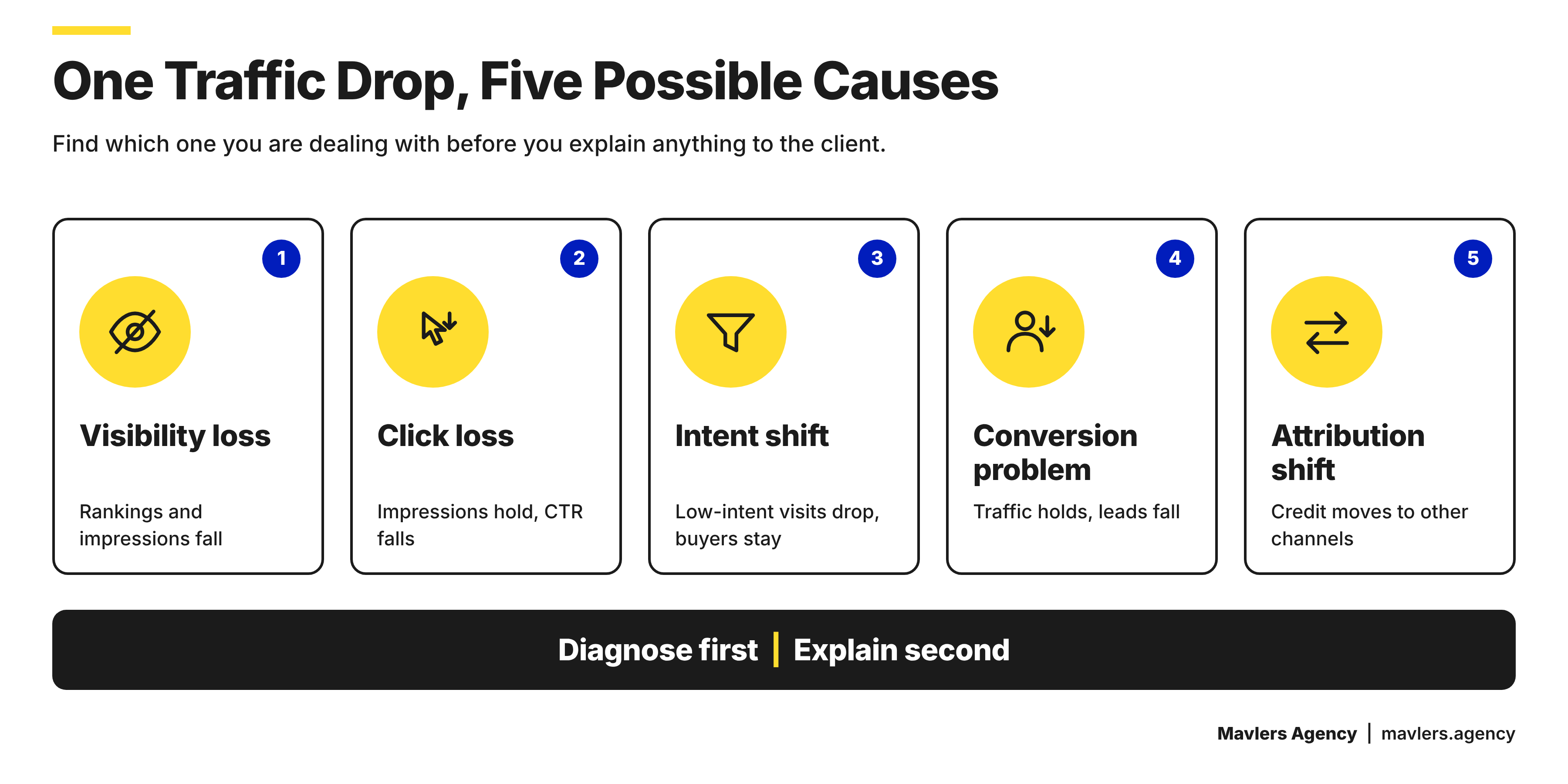
2. Check whether AI is actually the cause
“AI is causing the SEO traffic decline” is a hypothesis that needs evidence.
So, what evidence should agencies look for?
If AI is causing the dip, Search Console impressions remain stable or rise, while clicks and click-through rates fall. We’ve seen this trend across several accounts: better rankings, rising impressions, declining clicks, and conversions remaining steady or growing.
The likely explanation is that Google AI Overviews are increasingly answering questions directly in the results page, reducing the need to visit a website.
If the client’s data looks like this:
- Impressions are steady or increasing.
- Rankings are steady or improving.
- Clicks are declining.
- CTR is declining.
- The drop is concentrated in broad, informational searches.
Then AI Overviews and other SERP changes are a credible explanation.
But if impressions and rankings are falling too, don’t blame AI yet. The problem may involve:
- Competitors overtaking the client.
- Lost or weaker backlinks.
- Content that doesn’t answer the query as well.
- Technical SEO problems.
- Important pages being deindexed or poorly crawled.
- Internal-linking gaps.
- Search demand falling in the category.
- Cannibalization, where multiple client pages compete for the same query.
3. Test the website before blaming search
Quite often, traffic or lead decline is self-inflicted and begins after a website change, not a search algorithm update.
During a migration for RTR Sports Marketing, Mavlers had to move 9,000+ pages across 12+ languages and preserve the SEO equity built over three decades. Redirects, canonical tags, metadata, duplicate content, internal linking, and multilingual relationships all had to be checked before the new site went live. The migration recorded zero critical downtime, with organic rankings preserved across markets.
The lesson for agencies is: before attributing a decline to search, check what changed on the client’s website.
Before you talk about AI, manually test every meaningful conversion path on the client’s site. Do it on desktop and mobile. Use more than one browser. Submit test leads and check that they reach the CRM or the right inbox.
Check:
- Contact forms
- Demo and consultation forms
- Quote-request forms
- Calendar-booking tools
- Phone-click tracking on mobile
- Primary CTAs on buyer pages
- Thank-you-page tracking
- CRM lead creation
- Lead-routing rules
- Cookie-consent and analytics changes
- Form-abandonment rates
This does not take days. It can take a few hours. Yet it can save an account.
What should agencies report when organic traffic is falling?
Traffic still matters. It tells you whether people are reaching the site. It helps identify which topics and pages are gaining or losing attention. It can reveal a serious visibility problem before the pipeline feels the impact.
But it should not be the verdict of an SEO programme.
So, what exactly goes in your search performance report when the organic traffic is declining?
Your first page of reporting should answer the client’s actual business questions:
- Did qualified leads from organic search rise or fall?
- Did sales opportunities influenced by organic search rise or fall?
- Are the pages closest to conversion gaining or losing visibility?
- Are people still finding the client for high-intent searches?
- Is the client appearing when buyers ask AI tools which providers to consider?
- What did the agency do this month?
- What will the agency do next, and why?
Here is a more useful reporting structure for agencies:
More on: What a genuinely useful AI visibility report looks like, and why few agencies build one
SEO and AEO/GEO are not competing services
Clients may assume the answer to declining SEO traffic is to replace SEO with AEO or GEO. Agencies should resist that framing.
Google has been vocal about the fact that there are no special requirements or special schema needed to appear in AI Overviews or AI Mode. Eligibility still depends on the page being indexed, eligible to appear in Google Search, technically accessible, and built on helpful, reliable, people-first content.
Google also warns against supposed shortcuts, such as special AI text files, excessive “chunking,” rewriting content solely for AI, or seeking inauthentic mentions.
That is good news for agencies. You do not need to discard SEO and chase a new trick. You need to do the fundamentals well, and extend them to the places where buyers now look for answers. That discovery system combines:
- Technical SEO that allows crawlers and users to access important content.
- Clear site architecture and internal linking.
- Accurate entity information and on-page business details.
- Structured data that matches visible content.
- Expert-led content with original evidence, examples, and points of view.
- Commercial pages that answer buyer questions and create an appropriate next step.
- Credible third-party coverage, reviews, and citations.
- Prompt-level monitoring across priority answer engines.
- Measurement that connects visibility to leads and revenue.
If you need additional execution capacity, white-label SEO support built for agencies can sit underneath that strategy.
Dig deeper: How to bundle AEO, GEO, and SEO into one offer
How does AI search visibility work alongside SEO? A B2B case study
Mavlers Agency’s work with a confidential Perth-based B2B AV integrator provides a practical example of why agencies should manage AI visibility and SEO as one programme.
At the start of the engagement, the client was cited in none of the nine tracked buyer prompts in either Google AI Overviews or ChatGPT. It also did not rank organically for its flagship category query, “Teams Rooms installers.” For a considered B2B purchase, that absence mattered: facilities and IT buyers were using AI to create vendor shortlists before making contact.
We did not treat this as a content-volume problem. The team worked across the full path from discovery to conversion:
- Fixed the technical foundation so search engines and AI systems could crawl, render, and understand important pages
- Strengthened the client’s business and service information with relevant structured data.
- Built direct, useful answers around the questions buyers asked.
- Improved third-party trust signals through citations and reviews.
- Measured mentions, citations, competitor presence, and AI referrals.
- Sent users to landing pages that matched the purpose behind their search.
Over six months -
- The client moved from zero citations to being cited in all nine tracked buyer prompts in both Google AI Overviews and ChatGPT.
- Organic sessions increased by 50%, and organic key conversions increased by 54%.
- Crucially, the client achieved AI visibility despite not ranking organically for its flagship category query.
The takeaway is not that every client will reach 9/9 prompt coverage or grow traffic and conversions at the same rate. It is that AI visibility is most valuable when it is built on a functioning SEO foundation, tied to high-intent buyer questions, and routed to pages that support conversion.
What to do in the next 30 days if a client’s SEO traffic is falling
Week 1: Diagnose the decline
- Compare Search Console clicks, impressions, CTR, and rankings against a meaningful baseline.
- Identify the pages with the largest losses.
- Separate research pages from buyer pages.
- Check whether the loss is branded, non-branded, informational, commercial, or transactional.
- Review whether competitors gained visibility on important terms.
- For priority commercial queries, track the ranking URL as well as position.
- If Google alternates between a service page and a blog post, investigate cannibalization, internal linking, intent mismatch, and page purpose - even if average rankings appear stable.
Week 2: Audit the conversion path
- Test every form, CTA, booking tool, and phone link.
- Check desktop and mobile experiences.
- Verify that leads reach the CRM.
- Compare conversion rates before and after the decline.
- Review whether recent site, tracking, consent, or CRM changes caused a problem.
Week 3: Protect the pages that create pipeline
Create a list of the 10 to 20 pages that have historically produced the most organic leads, sales opportunities, or revenue. This will usually include service, product, pricing, comparison, location, case-study, and contact pages.
Track those pages weekly for:
- Search impressions
- Rankings
- Clicks
- Conversion rate
- Leads
- Technical health
- Competitor movement
These are your client’s money pages. Do not let the performance of broad informational content distract you from them.
Week 4: Build an AI-search baseline
Choose 15 to 20 buyer questions. Test where the client appears, where competitors appear, and what sources answer engines cite.
Then identify the gaps:
- Questions where the client should appear but does not
- Services the client offers but does not explain clearly
- Pages that exist but do not answer the buyer’s question directly
- Missing proof, reviews, case studies, or third-party references
- Pages that attract interest but do not give visitors a relevant next step
At the end of the month, give the client a diagnosis and a focused 90-day action plan.
Key takeaways
SEO traffic may continue to decline for some query classes as AI answers absorb more early-stage research. But clients need an agency that can distinguish genuine performance loss from changing click behaviour, preserve commercial visibility, create AI-era discoverability, and prove contribution to revenue.
That is the role of modern SEO, AEO, and GEO: not to chase every click that disappears, but to ensure the client is visible, credible, and chosen when buyers are ready to act.
FAQs agencies will hear from clients
“My organic traffic is down. Is SEO still working?”
Not necessarily, but traffic alone cannot tell you.
Check whether the decline is on broad research pages or on service, pricing, comparison, and contact pages. If buyer pages, leads, and opportunities are stable, SEO may still be creating commercial value. If high-intent pages are losing visibility and leads, treat it as a priority recovery issue.
“If AI is answering more questions, why keep investing in SEO?”
Because SEO determines whether clients can be found, understood, and trusted during search.
Google says appearing in AI Overviews and AI Mode still depends on core SEO fundamentals: crawlable, indexable, technically accessible pages and helpful, people-first content. SEO is not only about clicks. It is about visibility across search results and AI answers.
“Why are rankings improving but traffic falling?”
Often, the client is still visible, but AI Overviews or other SERP features answer the question before a click.
Compare impressions, clicks, and CTR. Stable or rising impressions with falling CTR suggests a click-through issue. Falling impressions and rankings suggest a real visibility problem.
“Should we stop creating blog content?”
No, but stop treating every blog post as a direct lead source. Use educational content to answer early-stage questions, build authority, earn citations, and link readers to service, pricing, comparison, and case-study pages.
“Can we replace SEO with AEO and GEO?”
No. AEO and GEO should extend SEO, not replace it.
AI tools cannot recommend a client if its site is hard to crawl, its services are unclear, or its commercial pages do not answer buyer questions. Treat them as one discovery programme.
“How do we know if AI tools are recommending us?”
Test 15–20 buyer questions monthly across the answer engines your client’s buyers use.
Record whether the client is mentioned, cited or linked, described accurately, and which competitors appear. Then connect those findings to leads, opportunities, and revenue.
“If traffic is down but leads are stable, should we celebrate?”
You can highlight it, but do not celebrate too early.
It may mean remaining visitors are more qualified, but validate it in the CRM. Check lead quality, opportunities, and revenue before presenting it as a success.