







Table of contents
Get in touch
Expect response in 4 hours.

This guide covers what a modern AI visibility report includes, the metrics that matter across visibility, influence, and revenue, how to measure across AI engines, what you honestly cannot measure yet, and how to turn the output into decisions a client will pay to keep receiving.
It draws on the GEO Visibility Index and the GEO measurement framework Mavlers Agency uses in live engagements.
The real question an AI visibility report has to answer
A useful AI visibility report answers one question most clients have: when a buyer asks an AI engine about our category, do we show up, are we described correctly, and are we winning or losing ground against competitors.
If a report cannot answer those three questions with a repeatable method, it is not measuring AI visibility. That deficit is why so few agencies produce a good AI visibility report.
The measurement problem in AI SEO is genuinely harder than SEO, and many teams have quietly ported their old rank-tracking model onto a channel where ranks do not exist.
Why agencies are adding AI visibility reporting
The question has already changed in the client meeting.
Alongside rankings and paid performance, brands now ask questions most agencies were not prepared for: why doesn't ChatGPT recommend us.
It is not an early-adopter concern anymore. More than half of B2B and B2C buyers consult AI assistants during purchase research, and when a brand is missing from those answers, the client notices before the agency does.
As buyers vet vendors and lock in their shortlists directly inside AI chat boxes before clicking through to a company website, it drives significant market volume, as shown by the numbers below:
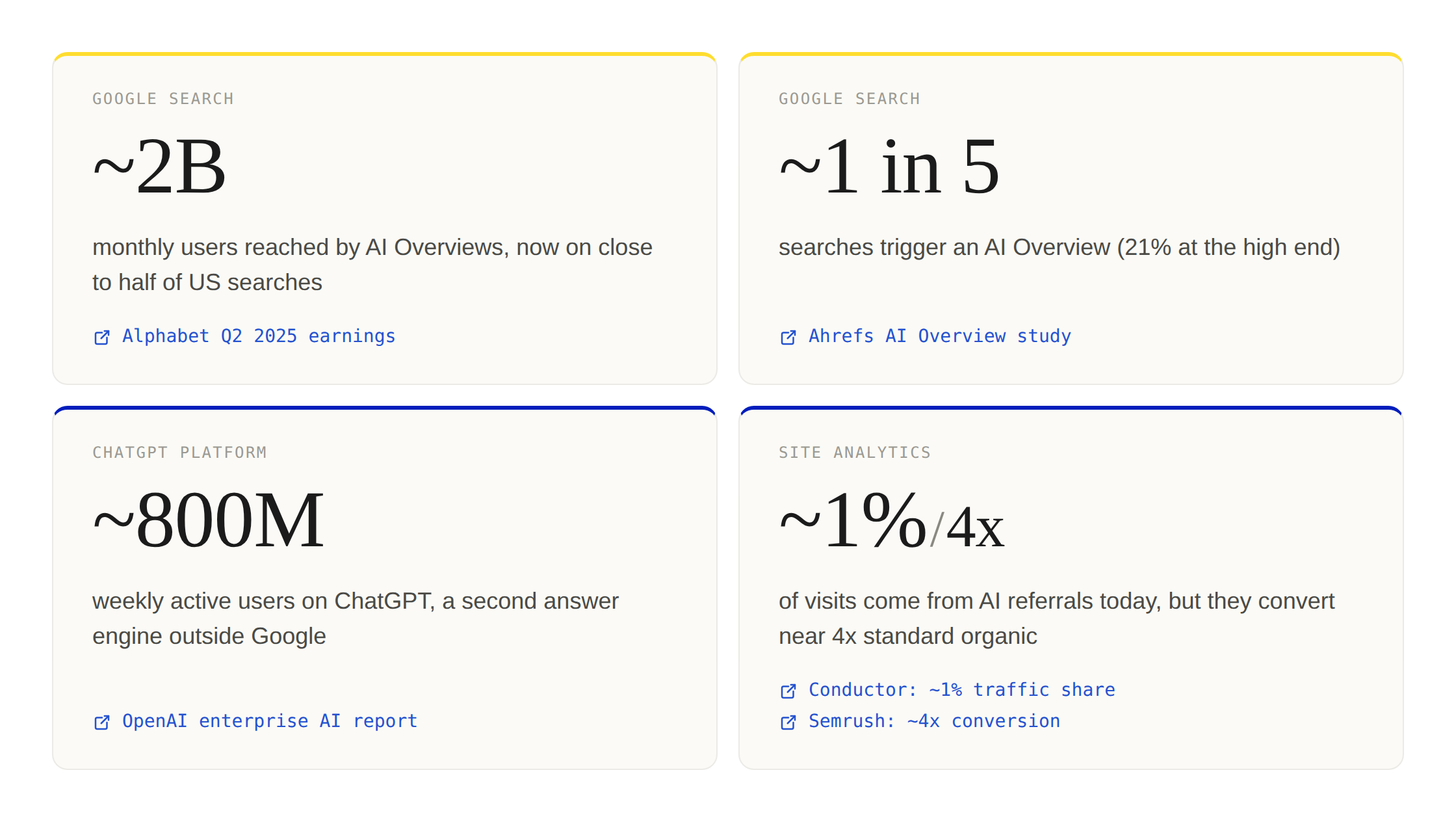
In nutshell, being absent from the AI answer is a consideration lost before a prospect reaches a search engine.
For the agency, an AI visibility report does three jobs:
- It proves value where inclusion or omission shapes trust. A rank report cannot show whether AI describes the client accurately, hedges on them, or names a competitor instead.
- It exposes the levers. By surfacing which prompts, topics, and sources shape AI answers, it turns a vague "we are invisible in AI" into a concrete roadmap.
- It reads competitively. AI visibility reports help show which competitors appear in the same AI answers, giving you competitive intelligence.
Moreover, an AI visibility report also gives agencies a new service line with real margin.
How?
The AEO/GEO audit and AI visibility report make a strong, billable first engagement. The client gets a structured report covering key findings, source mapping, accuracy issues, and a prioritized action plan - something concrete you can present in a strategy meeting and charge a standard consulting fee for.
From there, it naturally leads into an ongoing reporting retainer. The client continues paying to track how their AI visibility changes over time, turning the trend line into a clear reason to renew.
In short, the audit and reporting get the foot in the door, and the retainer turns a one-time engagement into a compounding advisory relationship.
The old SEO report is measuring the wrong outcome for AI search
Traditional SEO metrics were built for a click economy, where the value only shows up once someone clicks a result.
AI search runs on a decision economy.
In decision economy, the recommendation lands inside the answer and shapes the buying decision before any click happens. So a report that counts clicks is measuring a smaller and smaller slice of what actually moves the client's business.
.jpg)
Here is the part that trips people up -
SEO metrics tell you what happened after a click, but an AI answer usually resolves the question before there is a click at all.
- You can read the product description in a ChatGPT reply, like it, and never start a session - so traffic stays flat even as brand awareness rises.
- Attribution gets messier too, because Google mixes AI Overview and AI Mode visits into regular organic traffic, making it hard to isolate AI-driven performance.
- And there is no referrer tag that tells your stack a user found you in an AI answer.
The fix?
Don't judge AI success by traffic alone. Track mentions, citations, and which pages are cited separately from organic numbers. As citations grow, watch for rising branded search and direct traffic. Measurement has to come first, though. While the question has moved from "how do we show up in AI" to "is AI already driving customers," answering the second without measuring it is impossible.
AI search reporting vs Traditional SEO reporting
What a modern AI visibility report should include
A useful AI visibility report answers five questions, and it helps to take them in order of depth.
- Do you show up in AI search at all?
- Where in the AI answer do you land?
- Are you described accurately?
- Is the AI engine pulling from your pages?
- And how do you look next to the competition?
What a real AI report actually measures
- Presence. Do you show up, and how often? Report it as a rate. "Named in 7 of 20 ChatGPT answers" tells a story; "7 mentions" tells you nothing you can act on. And measure each engine on its own, because the brands ChatGPT likes are often not the ones Gemini reaches for.
- Prominence. Where your brand appears in the answer. Being named first is very different from being mentioned at the end, so treating both as the same can give a false impression.
- Accuracy and sentiment. Are you described correctly, and in a good light? An engine that recommends you but botches your pricing, or misreads what you actually sell, is handing prospects a reason to look elsewhere.
- Citations. Is a page from your own site the source the answer leans on? That is a deeper signal than a mention. It means the engine trusts your content enough to rely on it in the answer.
It helps to check three things about your citations:
- Citation quality. Are you the authority, a supporting link, or a footnote?
- Pages. Which of your URLs get pulled.
- Sources. Which outside domains the engines trust for your category. That list is your outreach list.
- Competitive share. Who turns up beside you, or in your place, on the same prompts? This is usually the first thing a client reacts to, because it shows who the model treats as a genuine peer and which rivals are quietly winning the prompts that matter.
Read the citation data with a skeptical eye as it can go wrong in two ways:
- The AI may keep using the same few pages, so the citation rate looks good even though most of your site is never used.
- A citation does not mean the AI supports you. It can quote your page and still recommend a competitor.
The positive part is this: if the AI keeps pulling an old blog post instead of the commercial page you expected, that tells you your site structure or content needs fixing.
The fixed test surface: the Prompt Universe
None of those five metrics mean much without a fixed baseline to measure it against.
That means keeping the same prompts and engines in place so you can compare results over time. Mavlers Agency calls this the Prompt Universe: a set of real buyer prompts grouped by intent.
The five buyer-intent prompt types are:
- Category discovery - the broad questions people ask while they are still scoping the space.
- Comparison - head-to-head and "best of" queries.
- Problem-first - what buyers ask before they even know vendors exist.
- Brand-direct - prompts that name you outright.
- Bottom-funnel - pricing, alternatives, the late-stage stuff.
.jpg)
That grouping shows where you win in the buyer journey.
The tracked score: the GEO Visibility Index
Mavlers Agency tracks it as the GEO Visibility Index, or GVI, laid out in our GEO measurement guide If You Can't Measure It, You Can't Sell It.
The GEO Visibility Index is one number that combines citation frequency, mention quality, prompt coverage, and referral outcomes.
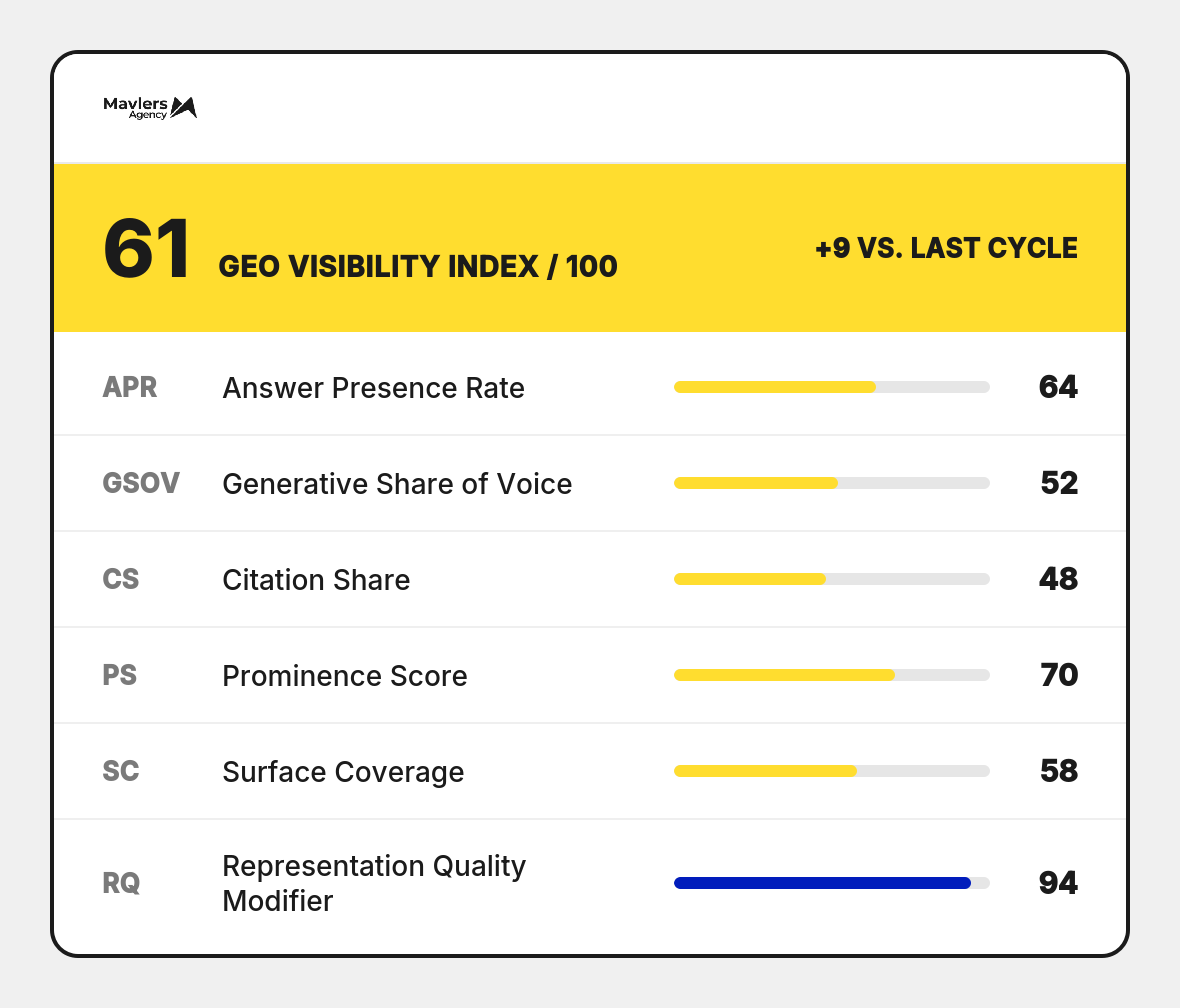
This scorecard converts several GEO signals into one overall visibility index out of 100.
A higher index means the brand appears more often, gets cited more, and is represented more strongly in AI answers.
The point is not the exact score, but that it is measured the same way every month.
One caveat before the table. These five layers are only the visibility half of the story.
A complete AI search visibility report goes on to measure influence, whether AI is actually changing how buyers behave, and commercial impact, what it does to revenue, and both come later in this guide.
However the numbers land, a report should end on a short, ranked list of what to do next. That is what turns measurement into progress.
At a glance: what a modern AI visibility report includes
Why most agencies never conduct a proper AI visibility audit
Most agencies never conduct a proper AI visibility audit because a real one is operationally expensive, technically unfamiliar, and exposes uncomfortable gaps. So the incentive is to ship a lighter substitute that looks similar.
There’s no API for a single “AI rank” like SERP rank trackers.
A proper AEO/GEO audit uses fixed prompts, repeated tests across AI engines, and checks mentions, competitors, accuracy, and business impact.
That is process work most teams have not built yet. The result is a rebranded rank tracker.
Here is a diagnostic you can use whether you are building the offering or receiving one from an agency.
Five signs an AI visibility report is fake
- It reports one number with no methodology. A single "AI visibility score" with no visible prompt set, no engine list, and no sampling rule is a black box. You cannot verify it, reproduce it, or challenge it.
- It measured each prompt once. AI outputs vary run to run. One study of Google's AI Mode found only 9.2 percent result overlap when the same query was run three times, versus 85 to 90 percent consistency in traditional search. A single run can be a screenshot but not a metric.
- It ignores competitors. If the report tells you that you appear in AI answers but not who else appears alongside you, it has hidden the only context that makes presence meaningful.
- It has no sentiment or accuracy layer. Presence is treated as a binary win, with no check on whether the engine described you correctly. Being mentioned inaccurately is worse than being absent.
- It never connects to revenue. The report stops at visibility and never isolates AI referral traffic, assisted conversions, or close rates, so the client cannot tie the work to a business outcome.
There is a discipline that fixes the deepest version of this problem, and almost no agency applies it: tag every finding by evidence level.
Mavlers Agency marks each claim in a report as one of four levels, so the client always knows what is proven and what still needs testing.
The four evidence levels:
- Fact - confirmed live.
- Observation - seen directly on the site or in the answer.
- Inference - reasoned, not yet confirmed.
- Validation required - must be tested before you rely on it.
This is important in white-label work because an unverifiable number becomes your liability.
The Mavlers Agency AEO and GEO audit follows this kind of process:
- Prompt-level testing across ChatGPT, Perplexity, Gemini, Copilot, and Google AI Overviews.
- Entity and citation gap analysis.
- A technical and schema readiness check, and
- A 180-day roadmap.
The AI visibility metrics that matter
Layer one, visibility and representation
Layer two, influence and revenue
What to stop putting in the AI visibility report
- Sessions reward volume over influence.
- Bounce rate penalizes the exact behavior AI creates, a buyer who arrives from a recommendation, reads one page, and calls you directly.
- Average position measures a ranking system that AI operates outside of.
- Impressions and time on page are similarly click-era artifacts.
How to measure AI visibility across ChatGPT, Gemini, and AI Overviews
.jpg)
To measure AI visibility across ChatGPT, Gemini, and AI Overviews, run a fixed prompt set through each engine multiple times per cycle, record the frequency and quality of brand appearances, and isolate the resulting referral traffic in analytics.
1. Build the prompt library, not a keyword list
Create 50 to 200 buying-intent prompts across the AI engines your buyers use most, such as Google AI Overviews, ChatGPT, Perplexity, Gemini, and Copilot.
Use specific prompts like “best project management tool for a remote agency” instead of broad ones like “project management software,” so you can see whether you show up at the decision stage.
Mix two types of prompts:
- Synthetic prompts: Built from keyword and competitor research for consistent benchmarking.
- Real prompts: Taken from sales calls, customer interviews, support tickets, and site search logs to reflect real buyer language.
Keep updating the prompt list as customer language changes.
2. Cluster the prompts
Group prompts into clusters by category, industry, and feature, because one prompt alone is not very useful.
A brand may rank well for one topic but miss more valuable, high-intent topics where a competitor is stronger.
Use these clustered prompts across each AI engine and score the answers to build a useful dataset.
3. Sample, and measure multi-turn
Run each prompt 3 to 5 times per engine and track how often the brand appears.
Also measure the full conversation, not just the first prompt, because buyers often narrow their search over multiple turns and a brand may show up later in the exchange.
4. Isolate the traffic
In GA4, build a dedicated AI channel or referral segment filtering the AI engine domains, so AI-referred sessions stop hiding inside "direct" and generic referral.
GA4 added a native AI Assistant channel in May 2026, which helps, but it appears to cover only supported AI sources. A custom segment still provides more flexible per-engine analysis where the underlying source data exists.
You do not need an enterprise attribution stack to start tracking whether AI is driving actual pipeline:
- Add an AI option to your "how did you hear about us" lead form.
- Tag AI-referral landing pages with UTMs and give those visits a label you can track in analytics.
- Flag AI-sourced leads in the CRM with a field like “AI influenced: yes/no” or “source: ChatGPT/Perplexity.”
What an AI visibility report honestly cannot tell you (yet)
- No tool captures every AI conversation, so reports should be based on samples and say that.
- AI answers change between runs, which is why we sample instead of screenshot. Much AI-driven demand isn’t credited to AI - it often shows up as “direct” or as a later Google search - so some credit leaks away.
Two more things remain unmeasured:
- Prompt volume - With web search you had monthly search counts to guide priorities. In AI search you can tell if you appear for a prompt, but not how many buyers ask it, so prioritization is partly guesswork.
- Why the model chose you - You can see citations, not the model’s reasoning. Hence, optimization becomes a loop: change a page, retest prompts, watch results, infer what worked, repeat.
The importance of tracking AI visibility over time
Tracking AI visibility over time matters because single snapshots are noisy. AI answers fluctuate week to week, so only a consistently measured trend shows real gains or losses.
Here is what that tracking gives you:
1. It separates real movement from model noise.
In a Semrush study of 230,000 prompts, ChatGPT's citation of Reddit as a source dropped from 60 % of responses to around 10 % in a matter of weeks. Against drift like that, one reading proves nothing.
.jpg)
2. It is the only way to prove your work caused the win.
A Perth AV integrator we tracked had zero citations across nine buyer prompts in Dec 2025 and didn’t rank for its main category.
By tracking the same nine prompts each month, it reached nine-of-nine citations on both Google AI Overviews and ChatGPT by May 2026, and organic key conversions rose 54%.
Without a fixed prompt set measured over time, you wouldn't be able to show that progress.
3. Annotation turns the trend into a story leadership believes.
A spike alone is meaningless. Tag campaigns, launches, and content updates on the timeline so you can link changes to outcomes (for example, AI share rising two weeks after a content push). Also mark competitors’ moves so you can spot when a rival’s update causes their share to jump.
4. It sets the clock so the program survives long enough to pay off.
Results compound on a schedule, and saying so up front is what keeps the work funded.
Two rules keep the trend honest.
- Run the same prompts, engines, and sampling rule each cycle. If you change the prompt set, reset the baseline and flag it.
- Match cadence to the metric: check prompt-level citations weekly; brand-level AI share monthly or quarterly.
Building an AI search visibility report clients can understand
Building an AI search visibility report clients can understand means:
Leading with the answer to their actual question, showing the trend before the detail, and translating every metric into a decision.
Structure your AI visibility report in this order:
- The one-line verdict. Are we winning or losing ground in AI answers this cycle, and by how much. Lead with it.
- The trend line. A single tracked number over time, so the client sees direction at a glance. The number matters less than the consistency of the method behind it.
- The competitive view. Share of AI voice versus named competitors, because clients understand market share intuitively.
- The movers. Which prompts or engines improved or declined, and the likely reason.
- The action list. Two or three specific next steps tied to what the data showed.
Put raw prompt-level data in an appendix. Speak the audience’s language - translate citations into business outcomes (for example, “recommended in nearly half of category comparisons” instead of “appears in 42% of responses”).
Here is what a single clean reportable row looks like from a live Mavlers Agency engagement. An eco-focused California home builder, measured across five AI platforms and 830 category answers, holds:
- 63.1 percent share of AI voice against every named competitor.
- Ranks first of five in its category for AI visibility.
- Carries 100 percent positive brand sentiment with zero negative mentions.
How to turn AI visibility reporting into strategic insights
.jpg)
Turn AI visibility into strategy by linking observations to specific actions. A metric alone won’t change anything, a report must map gaps to fixes.
Three signals turn observation into a to-do list:
- Prompt-level citation gaps. Like keyword gap analysis; each gap becomes a content brief.
- Source opportunities. Sites that cite competitors but not you are PR/outreach targets.
- Content decay and displacement. Track URLs losing citations or being replaced by competitors.
Each signal maps to an intervention, which is what turns a dashboard into a roadmap:
- Low category presence → build authoritative, buyer-focused pages.
- Low citation frequency → make content more quotable and keep it fresh.
- Losing share to competitors → publish targeted, prompt-specific content.
- Inaccurate representation → update your site and key third-party listings.
- More AI mentions but no traffic → measure assisted/brand impact, not just clicks.
Quick note: AirOps found pages not updated quarterly are roughly 3 times more likely to lose AI citations, and tracking displacement at the prompt level turns passive monitoring into an early-warning system. so schedule regular reviews.
Key takeaways
- A genuinely useful AI visibility report spans three layers: visibility (do we appear), influence (is AI changing behavior), and commercial (the revenue impact).
- Most agency reports are rebranded rank trackers. The five tells are: one number with no methodology, single-run measurement, no competitors, no sentiment, and no link to revenue.
- Tag every finding by evidence level, so the client always knows what is proven. This is the fastest way to tell a real report from a tracker.
- Ranks do not predict AI visibility. A brand ranked #14 was cited in every relevant AI answer after six months, and research finds engines citing pages ranked 21 or lower.
- Sample every prompt multiple times, across multiple conversation turns, and track over time, because AI answers are volatile enough that a single source's citation share can swing from 60 percent to 10 percent in weeks.
- Be honest about limits. No tool sees every AI conversation, so the goal is a consistent baseline and a reliable trend, and any session should end with a list of actions, not numbers to explain.
Frequently asked questions
What is an AI visibility report?
An AI visibility report is a recurring report that measures how a brand appears inside AI-generated answers across engines like ChatGPT, Gemini, and Google AI Overviews.
How do you measure AI visibility?
You measure AI visibility by:
- Building a fixed library of buying-intent prompts.
- Running each prompt several times through each relevant engine per cycle.
- Recording how often, how prominently, and how accurately the brand appears, including across multi-turn conversations.
- You then isolate the resulting referral traffic in analytics so visibility connects to assisted conversions, close rate, and revenue.
What is the difference between an AI visibility audit and AI search reporting?
An AI visibility audit is the initial deep assessment that establishes the prompt set, engine list, competitive baseline, and current gaps. AI search reporting is the ongoing, repeatable cycle that tracks those same metrics over time to show movement and inform strategy.
Which AI visibility metrics actually matter?
AI Visibility metrics like Answer Presence Rate, Prompt Coverage, Model Coverage, Citation and Mention Frequency, Share of AI Voice, Accuracy and Framing, and Response Position, plus influence and revenue metrics like assisted conversions, close rate by source, sales velocity, and branded search lift.
Can you track every AI mention of your brand?
No. No tool has access to every AI conversation, because the engines do not expose that data, so measurement relies on representative sampling of a fixed prompt set rather than complete observation. If a vendor claims to see every AI mention of your brand, treat that claim as a warning sign and ask how they collect it.
How often should you track AI visibility?
Review prompt-level citation gaps and content decay weekly, since AI retrieval changes continuously, and review brand-level share of AI voice monthly or quarterly, since it needs time to accumulate meaning.
How do you measure a competitor's share of AI answers?
Run your fixed prompt set through each engine and record who gets named alongside you, then express it as a share of AI voice: the percentage of relevant answers each brand appears in. Frequency alone is not enough, so note the context too, whether a rival shows up as the lead recommendation or a fallback alternative. Tracked on the same prompts over time, that share is your clearest read on whether you are gaining or losing ground.
Should a report count brand mentions that never link back to your site?
Yes. In AI answers the engine reads the text reference and its context, not the hyperlink, so an unlinked mention on a trusted source still shapes how a model associates your brand with a category.
Further reading:

.webp)
.png)