







Table of contents
Get in touch
Expect response in 4 hours.

White label partner onboarding at Mavlers Agency runs through 7 steps, and the first one has nothing to do with deliverables. Before we scope anything, we learn what your end client is trying to achieve and where your team is stretched. A subject matter expert (SME) then assesses the requirement; we agree on the engagement model that fits, and the SME walks you through a proposal you can take to your client under your own brand, with your margin added.
The NDA and SOW formalize what both sides have already agreed. Kickoff introduces you to the people doing the work, and your Account Manager coordinates delivery from there. You keep full ownership of the client relationship at every step.
This detailed article covers what happens at each step.
What does the onboarding journey look like end to end?
Each step settles one question before the next one starts. Nothing gets priced before it is understood, and nothing gets signed before it is agreed.
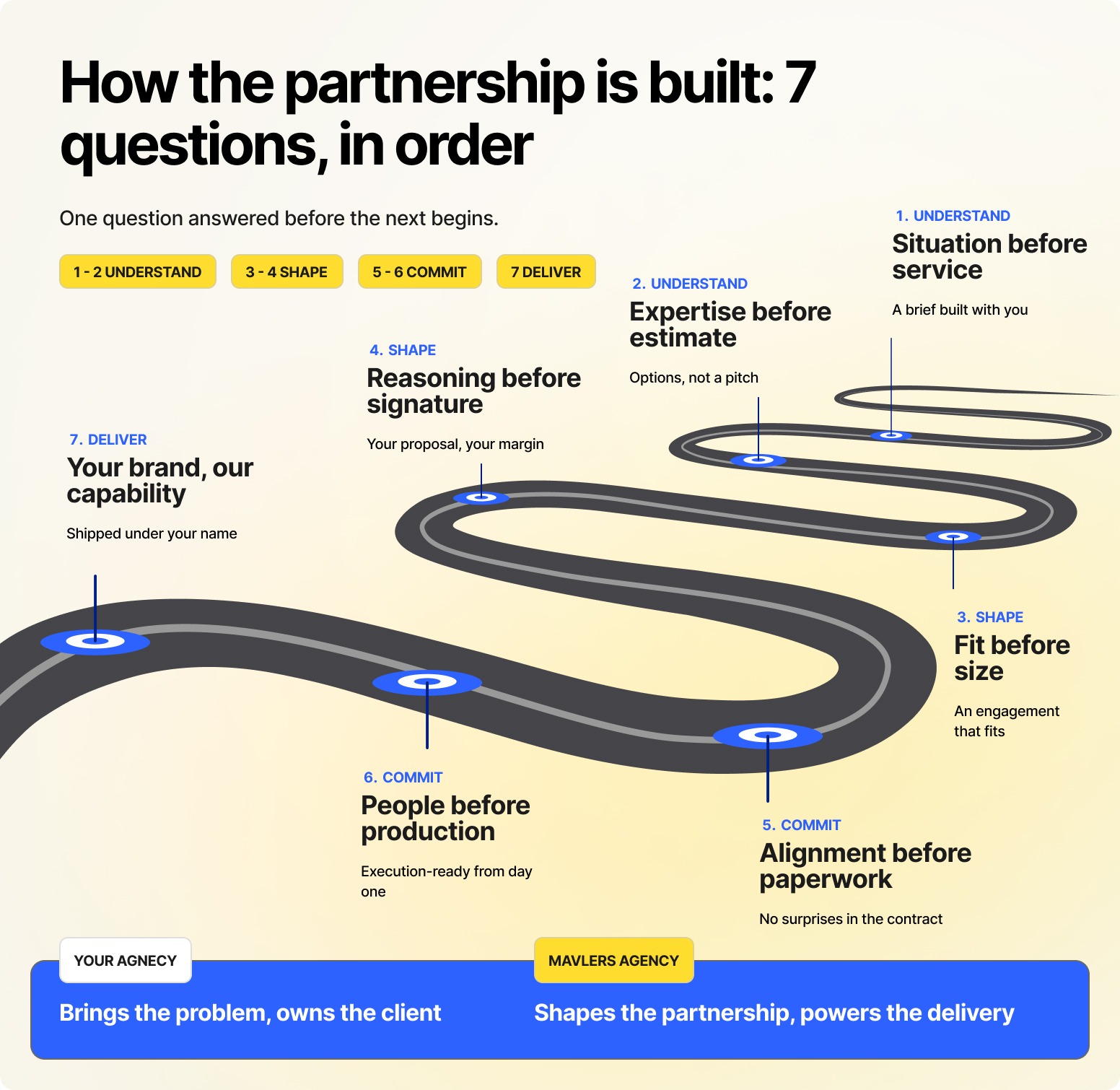
Step 1: Situation before service
Your inquiry reaches our business development team, whether it comes through a form on Mavlers Agency, an email, or a referral.
The first call goes further than "What do you need us to execute?" We want to understand the situation the request sits in, because that decides what we recommend. If you would rather not name your end client yet, say so when you book. Agencies ask for this often, and we plan the conversation around it.
What we will explore with you
- What the end client is trying to achieve, which industry they operate in, and how sensitive the relationship is
- What success looks like for your agency at 30 and 90 days, which may differ from what success looks like for the client
- Where your current team is stretched, and whether this is a temporary gap or a new capability you want to offer
- Whether the work is one-off, likely to recur, or capacity you want available on demand
- Your current stack: CMS, ad platforms, analytics, ESP or CRM, and your project management tool
- How your client should experience the work: fully invisible, or our team communicating through your agency's email alias
- Your approval flow, both inside your agency and on the client side, and which deadlines are fixed
- What did not work with a previous partner, if you have had one, as knowing where a previous partnership broke down tells us which parts of the process to reinforce.
Step 2: Expertise before estimate
Once the situation is clear, a subject matter expert evaluates the requirement; whether it is feasible, how it would actually be delivered on the platform or channel involved, and what business outcome it needs to produce. When the person scoping the work understands the build, the estimate reflects real effort and the assumptions reflect real risk.
For a website rebuild, the SME reviews the current site against your reference, maps the UI, UX, and development tasks, and sizes the effort from there. For an SEO engagement, the recommendation is shaped by the site's technical health and competitive landscape.
Step 3: Fit before size
With the assessment done, we shape the solution with you in four moves, namely, strategy, scope, engagement model, and roadmap. The engagement model is where most agencies benefit from a second opinion, because the wrong model creates friction later even when the work itself is good.
Step 4: Reasoning before signature
Your proposal is written with the SME who assessed the work, and it sets out the following:
- Recommended scope and strategic approach
- Deliverables, milestones, and timelines
- Roles and responsibilities on both sides
- Pricing and commercial assumptions
- Inclusions and exclusions
- Communication, reporting, and escalation
It is built for you to take to your client under your own brand, with your margin added. That saves you the step of rewriting a white label partner agency document before you can pitch it, and it keeps your pricing yours. If margin is the main concern, our agency margin benchmarks from 200+ agency owners are a useful reference.
How to pressure-test any proposal, including ours
Step 5: Alignment before paperwork
Contracts come after agreement, so the paperwork records decisions both sides have already made. Once you are comfortable with the approach, we formalize the engagement with the relevant NDA and contractual arrangements, followed by the agreed SOW and service agreement.
The NDA does not have to wait for this step. If you need to name your client or share their data before the first call, ask for it when you book, and we will sign it on day one.
What gets locked before signing
- The final in-scope and out-of-scope lists
- The phased roadmap, including what ships first and why
- Revision rounds per deliverable
- How change requests are raised, estimated, and approved
- Reporting format and cadence, delivered under your brand
- Communication channels and expected response times
Questions worth asking any white label partner about confidentiality
- Is the NDA mutual, and does it cover your client's data as well as your agency's?
- Will any of the partner's branding appear in files, metadata, staging URLs, or email headers?
- How is client access revoked when the engagement ends?
- Can the partner show you how confidentiality works in practice, beyond the paperwork?
Step 6: People before production
Kickoff is where you meet the people delivering the work. It is a working session, and together we:
- Reconfirm scope and priorities
- Introduce the execution team and key stakeholders
- Establish communication and reporting rhythms
- Collect assets, information, and platform access
- Confirm ownership, dependencies, and escalation points
- Agree on the start date and immediate next steps
We work inside your existing tools and communication channels, so part of kickoff is agreeing where tasks, files, and approvals will live.
The access checklist, by service line
Access is where most start dates slip. Prepare this before kickoff so the team can begin the same week.
Step 7: Your brand, our capability
Work starts against the agreed roadmap, and your Account Manager becomes your ongoing point of contact. The AM coordinates delivery, communication, updates, and adjustments as your needs change. The SME stays involved wherever specialist judgment is needed, so you keep access to expertise without managing the specialists yourself.
The division of roles is simple. You retain full ownership of the client relationship. Mavlers Agency operates as the capability behind it. In practice, that means:
- Reports, dashboards, and decks carry your agency's branding
- We do not contact your client directly unless you ask us to, and then only under your agency's name
- Communication can run through your agency's email alias if you agreed that at discovery
- Capacity scales up or down with your pipeline, within the engagement model you chose
Frequently asked questions
Do I need a detailed scope before contacting Mavlers Agency?
No. A short note on the service, the client type, and your timeline is enough. The first conversation and the SME assessment are there to work out the right scope with you.
How quickly will Mavlers Agency respond to my inquiry?
Our service pages commit to a reply within 24 hours to two days. The first reply comes from the business development team and moves you toward the first call.
How long does onboarding take?
It depends on how defined the work is. When a brief is already clear, our service pages commit to a specialist working on it within 48 hours. Engagements that need an SME assessment, a proposal, and a walkthrough take longer, and the biggest factors you control are access and approvers.
Can I sign an NDA before the first call?
Yes. If you need to name your client or share data early, ask for the NDA when you book, and it will be signed on day one.
Will my client know I am working with Mavlers Agency?
No. Deliverables, reports, and communication carry your brand. We do not contact your client unless you ask us to, and then only under your agency's name.
Who writes my proposal?
The subject matter expert who assessed the work, with support from business development. The SME also leads the walkthrough, so you can question the scope with the person who built it.
What happens if our scope changes after the SOW is signed?
We agree on how changes are raised, estimated, and approved during alignment, before signing. We write that process into the SOW.
When do I meet my Account Manager?
When delivery begins. Your AM then becomes your day-to-day point of contact, with the SME staying involved for specialist decisions.