





Table of contents
Get in touch
Expect response in 4 hours.
.webp)
Knowing which clients are ready for GEO boils down to one measurable gap: the distance between where a brand already ranks organically and how often it appears in AI-generated answers for those same queries.
Readiness isn't a function of industry, company size, or how modern a client's marketing team feels. A regional HVAC contractor with a tight organic footprint can be more GEO-ready than a national SaaS brand with a bloated content library.
A client already ranking well organically is a stronger GEO candidate, not a weaker one, because organic rank is the raw material AI engines pull from when deciding who to cite. Here is how to check for that gap before you build a proposal around it.
What does "ready for GEO" actually mean?
The phrase “ready for GEO” implies a condition where a client’s brand knowledge exists at a scale large language models can extract, structure, and cite, but that extraction isn't happening yet at the rate the client's organic performance would predict.
The myth that catches agencies early is that any client with a website qualifies. A client with a five-page site and no topical depth has nothing for an AI engine to cite, no matter how badly they want to show up in ChatGPT.
Pitching GEO before a client has organic substance is like optimizing crawl budget for a site that hasn't been indexed.
Does the client already have an SEO foundation to build on?
It’s important to know that AI engines are retrieval systems before they are generative ones. They lean on indexed content, backlink signals, and topical clustering to decide which sources are trustworthy enough to summarize.
A client with years of consistent publishing and a relevant backlink profile has already built the trust signals citation requires. A thin, scattered history has not.
Foundation essentially means 3 things in practice: enough indexed pages in the target topic to give an AI engine multiple entry points, a backlink profile that signals topical relevance rather than raw volume, and content that clusters around a defined set of questions instead of scattering across unrelated subjects. Therefore, it is recommended to check these first.
How do you check for a visibility gap in AI answers today?
The first thing you need to do is pull the client's top 15 to 20 queries from Search Console or a rank tracker. Run each through ChatGPT, Perplexity, and Google's AI Overviews, and note whether the brand shows up, how, and where.
Three outcomes matter, and treating them as the same thing misses the signal.
- A citation names the brand with a clickable source link.
- A mention names the brand with no link.
- An absence means the brand does not appear at all, even when a weaker-ranking competitor does.
A client who ranks on page one organically but sits at absence across all three engines has the widest gap, and that gap is exactly what a GEO engagement closes.
The three-signal readiness check
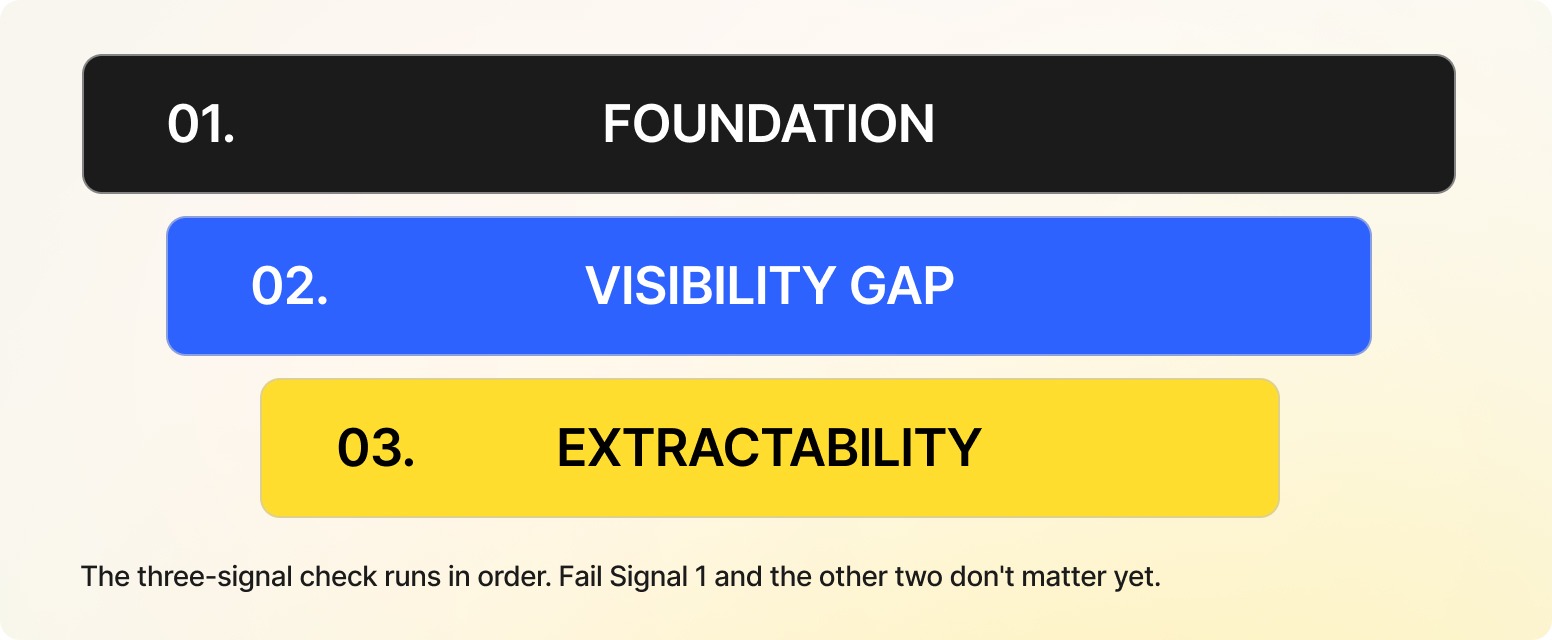
Before Mavlers Agency quotes a GEO engagement, the account team runs the client through three signals, in order.
Signal 1: Understanding the organic foundation
Does the client have indexed depth and backlink relevance in the target topic cluster? This is a pass-or-fail gate. Fail it, and the conversation moves toward an SEO engagement, not a GEO one.
Signal 2: Decoding the query-level visibility gap
Across the top 15 to 20 queries, what percentage sit at absence or mention despite page one organic rank? A gap above 40% is a strong buy signal. Below 15%, the client is likely cited adequately already.
Signal 3: Measuring content extractability
Is existing content structured for extraction, meaning direct answer paragraphs and clear headers, or long narrative copy that buries the answer? This decides how fast results show up, not whether the client qualifies.
A full GEO Visibility Index audit comes after this check, not before it. The three-signal check decides whether a GVI audit is worth running at all.
Here is the tell that catches agencies most often. A mid-market client ranked page one for its core commercial terms with a genuinely strong backlink profile, so signals one and two passed easily. Signal three failed. Every page opened with three paragraphs of brand narrative before answering the query, and AI engines skipped past all of it to cite a smaller competitor whose blog answered the question in the first sentence. The client looked ready on paper but needed a content restructure before a GEO push would show any movement.
Which client profiles tend to see results fastest?
The clients who move fastest after qualification share one trait above all; their content already answers questions in the first sentence, even if nobody built it that way on purpose. FAQ heavy service pages, comparison content, and how-to guides written by subject experts tend to outperform generic authority.
This is where account managers get surprised most.
A regional professional services client with modest domain authority but tightly scoped, direct-answer FAQ pages outpaced an enterprise client with far more content volume, because AI engines rewarded precision over sheer size. So don't rule out a client on domain authority alone.
Engagements move fastest when signal three passes on day one. A client needing only the topical gap closed showed measurable citation movement within 30 to 45 days; one needing a structural rebuild first typically needs 90 days or more. The difference is not effort. It is how much foundation already existed before the engagement started.
When should you hold off on pitching GEO?
Consider holding off when a client fails signal one outright: thin content, no backlink relevance, no topical cluster. This is a sequencing problem, not a permanent no. GEO amplifies authority that already exists, so the right move is to build that authority first and layer GEO on top of it so the investment compounds instead of starting from zero.
Give the client a concrete trigger to come back on, not a vague check-in later, such as publishing 8 to 10 structured, direct-answer pieces in the target cluster, or moving into the top 20 organic positions for priority queries. Once either happens, run the three-signal check again. That turns a stalled pitch into a scheduled one.
Frequently asked questions
Does a client need to already rank number one to be GEO ready?
No. Page one visibility, even at positions five through ten, is enough to run the three signal check. What matters is the gap between rank and AI citation, not the exact position.
How long does it take to know if a client is ready?
The three signal check takes a single working session, typically under a week once query and content data are pulled. A full GEO Visibility Index audit happens after readiness is confirmed and takes longer.
Can a brand new client with no SEO history still qualify?
Rarely, and usually not yet. Without indexed content or backlink relevance, there is nothing for an AI engine to retrieve or cite. These clients tend to be stronger candidates for a combined SEO plus GEO roadmap than a standalone GEO engagement from day one.


.webp)