





Table of contents
Get in touch
Expect response in 4 hours.
.webp)
A first-pass GEO opportunity audit takes under 30 minutes and needs no paid software. The method is simple: you pull a client's current organic rankings, run the same target queries through the major AI answer engines, then compare the two results side by side.
The gap between ranking well and getting mentioned by AI is the single most useful data point in the exercise.
However, a caveat is due here, a 30-minute audit is a qualifying tool instead of a finished deliverable. Treating the two as the same thing is where most account teams lose credibility with a prospect who expects either speed or depth, not a mismatched version of both.
What can you actually check in 30 minutes or less?
A first-pass audit covers three things;
- whether the brand shows up at all across a handful of AI platforms for its own target queries,
- how that mention rate compares to organic rank for the same queries,
- and which competitor gets cited instead when the brand does not appear.
It deliberately skips full citation source mapping, sentiment inside AI answers, and a queries-at-scale sample large enough to report on with confidence.
Those belong in a paid diagnostic, where the sample size supports a number a client can act on. The 30-minute version exists to answer one question for the account team; is there a real gap here worth a conversation?
How do you test AI visibility for a client's target queries?
We recommend that you pull queries from three sources, namely:
- the client's existing top organic rankings,
- competitor gap terms where a rival outranks them,
- and category questions a buyer would ask before naming any brand.
Roughly 8 to 12 queries in total, split roughly evenly across the 3 sources, is enough for a first pass.
Check ChatGPT, Google AI Overviews, Perplexity, and Gemini every time. Microsoft Copilot gets added when time allows, since B2B buyers on Microsoft-heavy stacks still route research through it.
Run each query in a fresh, logged-out session per platform, since personalization and chat history skew results, and screenshot every answer as evidence.
How do you compare that against their existing organic rankings?
Pull current rank for the same query set from Google Search Console or whatever rank tracker the client already runs. Lay the results side by side in one table; query, organic position, AI mention by platform, and the competitor cited instead where the answer was a miss.
The most important combination is a strong organic rank next to an AI absence.
It means the content and the authority both exist, and the brand is still invisible on the channel where a growing share of buyers now start their research. That single finding is what makes a GEO pitch land with a marketing lead who already believes their SEO is fine.
Which tools are required, and which are just nice to have?
The required stack costs nothing; all that you need is the client's own logged-out AI sessions across the four core platforms, Google Search Console, and a spreadsheet. That should cover the entire first pass.
A paid tool earns its keep once the work moves past qualifying into ongoing tracking with dozens of queries on a recurring schedule, citation sources monitored over time, or share of voice reported against several competitors every month.
Entry-level monitoring platforms start around $29 a month, and mid-market tools built for tracking several brands at once run roughly $95 to $500 a month depending on query volume and platform coverage. We now recommend reading ~ 12 best AEO tools in 2026.
Below that threshold, a person with four browser tabs and a spreadsheet outperforms a subscription.
What does the internal 30-minute SOP at Mavlers Agency actually look like?
The fast GEO opportunity audit is not a separate methodology from Mavlers Agency's Four Gates process. It is the quick-scan version of the first gate, Qualify, built to confirm a gap exists before anyone commits a client to a paid diagnostic. Here is the sequence an account manager can run start to finish.
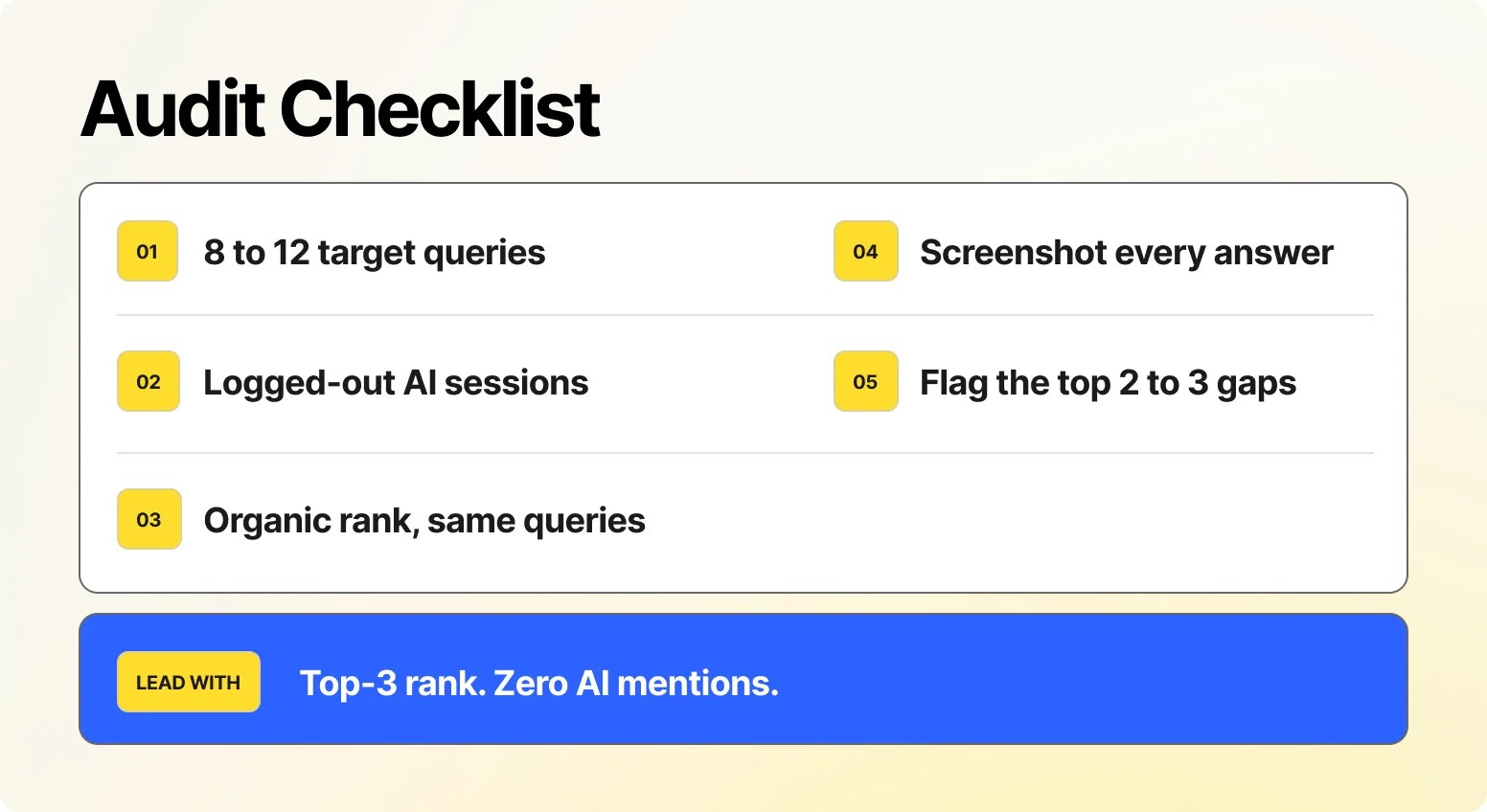
- Pull 8 to 12 queries: 4 to 5 from the client's top organic rankings, 3 to 4 from a competitor gap, 2 to 3 category questions a buyer asks before naming a brand.
- Open a fresh, logged-out session in ChatGPT, Perplexity, Gemini, and Google AI Overviews.
- Run every query in every platform. Screenshot each answer, noting whether the brand is mentioned, cited, or absent, and which competitor shows up instead if it is not.
- Pull the client's current organic rank for the same queries from Search Console.
- Build one table: query, organic rank, AI mention by platform, competitor cited instead.
- Sort by gap size, prioritizing rows where organic rank sits in the top five and AI mention reads zero across every platform checked.
- Flag the top two or three gap rows as the headline finding, and stop there. The audit's job ends at the finding. The pitch starts next.
Screenshot this checklist and run it yourself:
If your team would rather hand off the scan, our white-label AEO and GEO delivery team runs it under your brand, NDA-first, with no contact with your client.
How do you turn audit findings into a pitch, not just a report?
A spreadsheet of gaps is not a pitch. The bridge is turning “here is your gap” into “here is what closing it costs and what you get.” Take the top two or three gap rows, the queries with a strong organic rank and zero AI mentions, and frame them as visibility the client is already losing on searches they win everywhere else.
Scope should follow the size of the gap, not a fixed package. A narrow gap across one or two platforms supports a smaller content and structured-data engagement. A wide gap across most queries and every platform checked supports a full Four Gates diagnostic and a retained GEO program. Either way, the proposed number should map back to the rows in the audit table, because that is the math a prospect can check for themselves.
The finding that closes deals most reliably is a query the client ranks top three for organically, that returns zero mentions across every AI platform checked, while a named competitor gets cited in its place.
That combination removes the two objections that stall most GEO pitches; our SEO is already good, and does this even matter? Lead the deck with that row.
On that note, we recommend reading the free GEO measurement guide.
FAQs
Do you need a paid tool to run this audit?
No. A first-pass audit runs on logged-out AI sessions, Google Search Console, and a spreadsheet. A paid tool becomes worth its cost once tracking moves from a one-time qualifying check to ongoing monitoring across dozens of queries.
How many queries should you test per client?
8 to 12 for a first pass with a handful from existing top rankings, a few from competitor gaps, and a couple of category questions a buyer would ask before naming any brand.
What if the client shows up in some AI platforms but not others?
That is still a usable finding. Record it as a platform-specific gap rather than a total absence, since a brand missing on one engine needs a narrower fix than one missing everywhere, and the scope should reflect that difference.