







Table of contents
Get in touch
Expect response in 4 hours.
.png)
A client asked us a question last quarter that most agencies still cannot answer: when a buyer asks ChatGPT for the best option in our category, do we show up, and how often? The agencies that can answer that question keep the account. The ones who deflect to a sessions chart lose it, usually at renewal, usually to a competitor who walked in with a screenshot of the client’s brand missing from an AI answer while three rivals were named.
That is the state of AI visibility for agencies in 2026. The measurement gap has quietly become a retention risk. And this piece explains why agencies that cannot measure brand visibility in AI search will lose clients who can, and it shows the exact reporting system we use to stay on the right side of that line.
What does “measuring AI visibility” actually mean?
Definition: AI visibility is the rate at which a brand is named, recommended, or cited inside AI engine answers (ChatGPT, Gemini, Perplexity, Claude, and Google AI Overviews) for the questions its buyers actually ask.
Now, this is not the same as an "AI visibility score" ticking up on a vendor dashboard. Real AI search metrics for agencies are specific: brand mention rate, share of AI voice, citation frequency, source mix, sentiment, and citation persistence. Each answers a different question, and each moves independently across engines.
The reason measurement is a discipline, not a screenshot, is volatility. Go ahead and ask the same engine the same question 100 times, and the brand list rarely repeats.
Only about 30% of brands remain visible from one prompt regeneration to the next. Across the major engines, the four leading models agree on which brand to cite for only about 34% of head-term queries. And once a citation is won, it drifts after roughly 41 days.
Therefore, a single-day snapshot will always mislead. Measurement means tracking a fixed set of buyer questions across engines, over time.
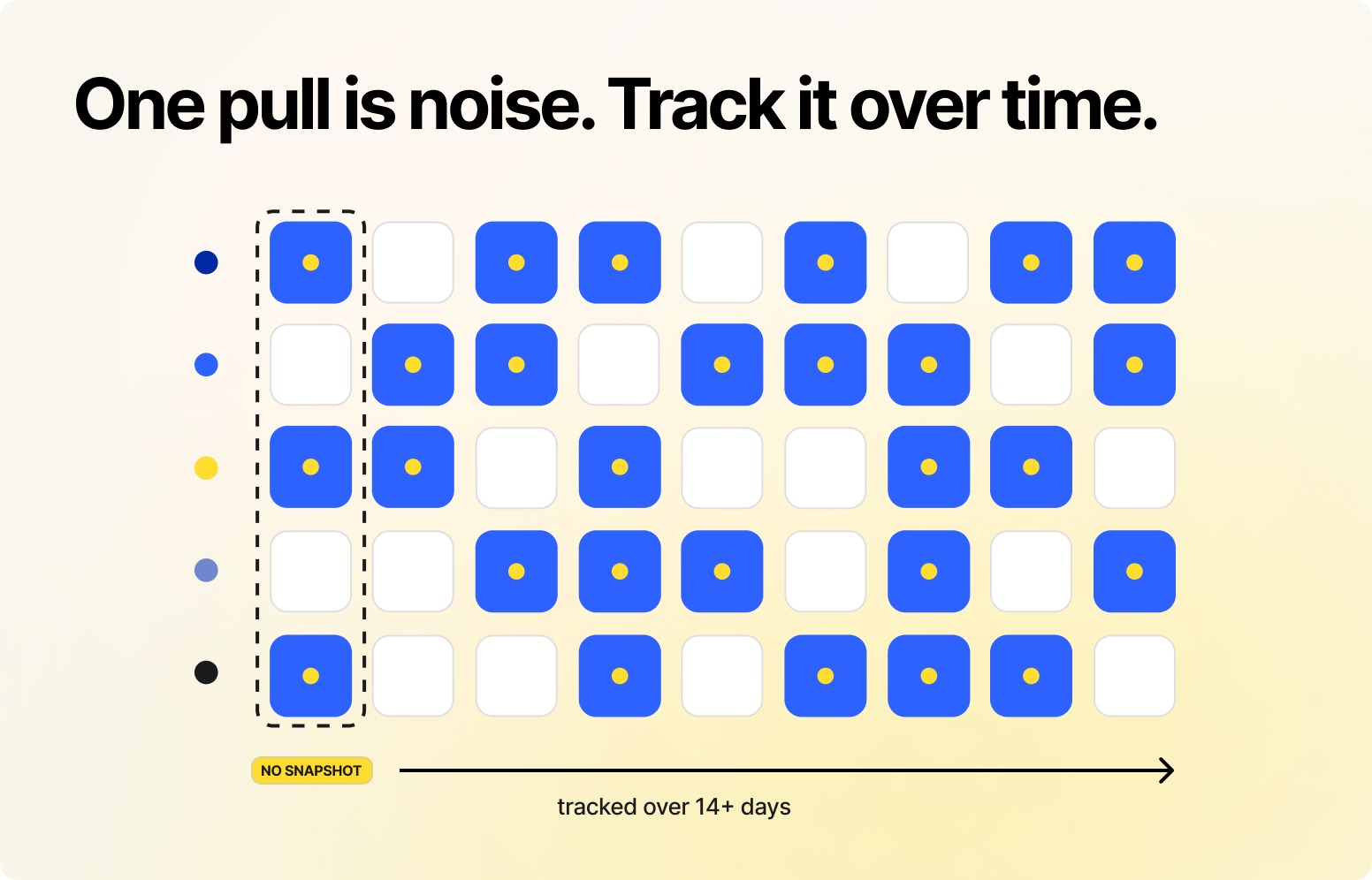
Key takeaway: If your "AI report" is a single screenshot from a single engine on a single day, you are not measuring visibility. You are photographing noise.
Why is this a client-retention problem rather than a reporting upgrade?
Because the buying journey moved into the answer, and the answer forms before the click. Gartner projects a roughly 25% drop in traditional search volume by the end of 2026 as buyers shift their queries to AI assistants. The traffic that does arrive from AI converts at around twice the rate of organic search because the buyer has already done their research during the conversation.
Here is the part that clients feel in their pipeline. One in three buyers now report purchasing from a vendor they had never heard of before an AI chatbot surfaced, and 69% chose a different vendor than they originally planned after chatbot guidance. Meanwhile, 95% of winning vendors were already on the buyer’s day-one shortlist.
If that shortlist is assembled inside ChatGPT and your client is not named, the deal is lost before anyone types a search query. As Kevin Indig has argued, the metric that matters in this era is not AI traffic but mention and influence inside the models themselves.
So rankings hold steady, pipeline softens, and the client cannot explain why. The agency that can explain it with data keeps the trust. While, the agency that shrugs invites the pitch that replaces it.
Nital Shah, Co-Founder and COO at Mavlers Agency, sees this from behind the agencies we deliver for:
Key takeaway: Clients are not asking for a new chart; instead, they are asking why good rankings stopped producing pipeline. AI visibility is the answer, and only measurement makes it credible.
What happens to agencies that keep reporting the old way?
Simply said, they get out-pitched by a screenshot. When the monthly report is a GA4 session chart, the agency is not accountable to a business outcome, and every competitor knows it. The pitch that wins the account in 2026 is simple: a live dashboard showing the prospect’s brand absent from the AI answers their buyers are already reading, next to competitors who are named.
The market has priced this in. The GEO services market reached roughly $1.48 billion in 2026, and searches for "geo agency" are up around 2,300% year over year. That demand has produced a wave of rebranded SEO shops that added "GEO" to a service page without changing the methodology.
They do not survive the one question a serious buyer now asks: show me a live mention dashboard across ChatGPT, Perplexity, Gemini, Claude, and AI Overviews. If the only answer is Search Console data, the buyer is looking at SEO, not agency AI visibility.
Key takeaway: Measurement is the moat. The ability to demonstrate AI visibility is what separates the agencies that keep clients from those that rename their decks and hope.
How do we measure AI visibility for clients?
Since this is the part that most agencies tend to skip, we built a system for it. The GEO Visibility Index (GVI) turns scattered AI mentions into a single defensible, trackable measure of how strongly a brand owns its category in AI answers. The method is fixed and repeatable:
- Build the prompt map. Pull the real questions buyers ask from Search Console, sales calls, and category research. This becomes a tracking universe of 50 to 150 prompts, not keywords.
- Baseline across engines. Measure mention rate, share of AI voice, citation frequency, source mix, and sentiment across ChatGPT, Gemini, Perplexity, Claude, and AI Overviews.
- Run it over time. Multiple regenerations per prompt across a 14-day-plus window, because a single pull is noise.
- Index and report. Roll the signals into a single GVI score per client, tracked against a frozen prompt set to ensure the trend is honest.
What that produces is not theory. A Perth AV integrator went from being cited in zero prompts to nine. Similarly, a Perth dental group went from zero to six cited prompts. Those are the numbers that renew retainers, because the client can see the category shifting toward them inside the exact answers their buyers read.
Key takeaway: An original, frozen-prompt index like the GVI is what converts "AI visibility" from a buzzword into a line on a report the client trusts month over month.
What is the AI visibility ROI story you tell the client?
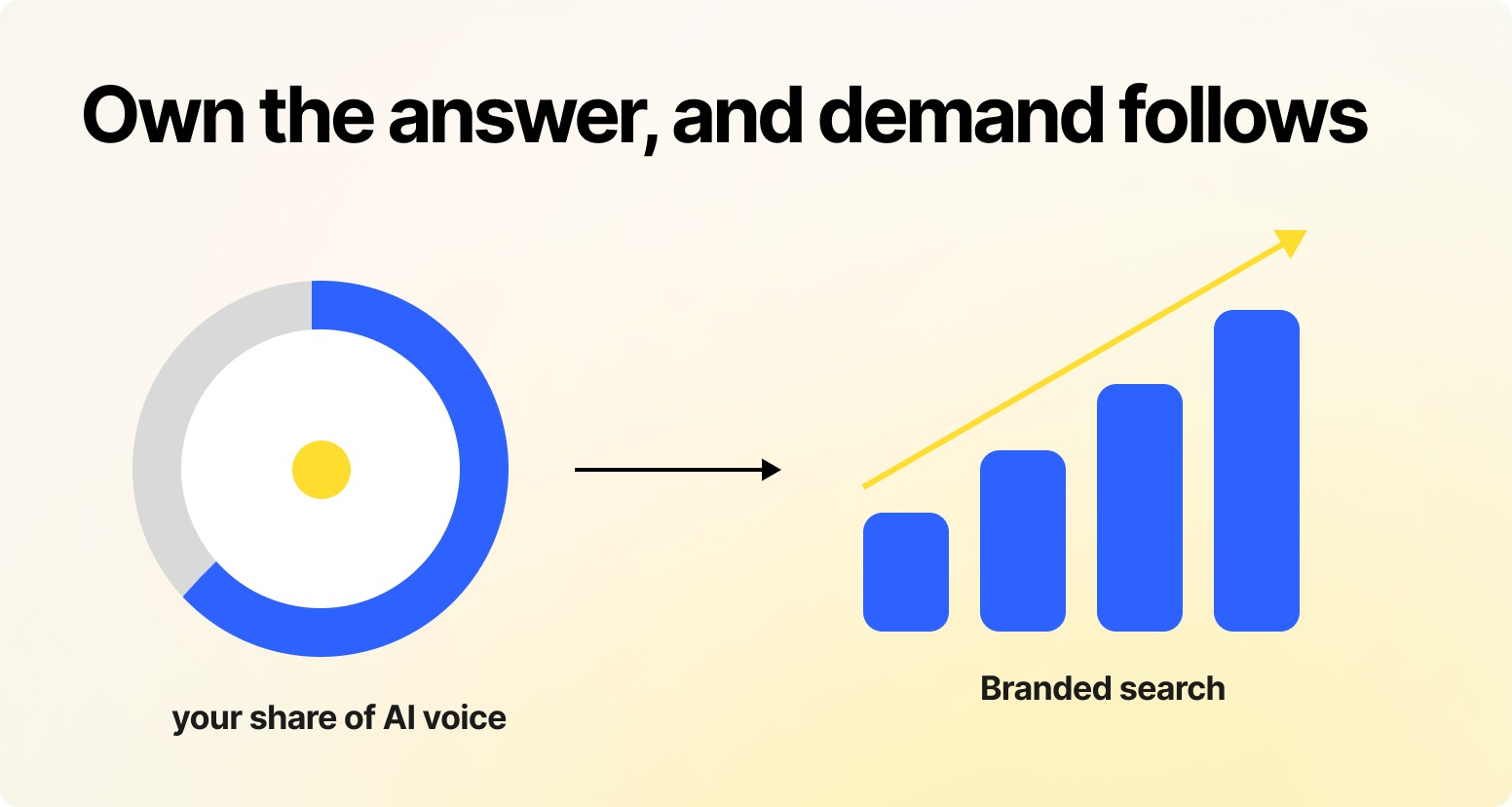
The key is never to sell sessions. AI referral traffic is still around 1% of total website traffic, so a sessions chart will always look small and lose the room. The AI visibility ROI story is about influence on demand, not clicks.
The strongest measurable link is branded search. Brands cited consistently in AI answers see roughly a 23% lift in branded search volume within 30 days. So the reporting stack looks like this: branded-query impressions as the primary KPI, citation-detected dates with before-and-after lift analysis as the proof, and AI referral traffic as a tertiary signal.
AI reporting for agencies works when it connects an owned share of AI voice to branded demand and then to the pipeline, in that order. That is the chain that survives a CFO’s questions and keeps the account.
Key takeaway: Report AI visibility as branded-demand influence, not traffic. "You now own 63% of AI voice in your category, and branded search is up" is the sentence that renews the contract.
FAQ
What is AI visibility for agencies?
It is the practice of measuring, improving, and reporting how often a client's brand is named or cited inside AI answers, then packaging that as a recurring, provable service. It answers the client's real question: are we in the AI answer, and can you prove it?
How is AI visibility different from SEO rankings?
SEO measures where a page ranks in a list of links. AI visibility measures whether the brand is named in the sentence the model says back to the buyer. A page can rank on Google and never be cited in ChatGPT, and vice versa. They are related but separately measured.
How many prompts should an agency track?
Between 50 and 150 per client, frozen at baseline. Below roughly 30, a single prompt swinging moves the whole score, and the trend stops being honest. Above 150, the cost of running enough regenerations to beat volatility outruns the value. Size the set to the buying journey rather than the keyword list: category questions, comparison questions, and vendor-selection questions. The set being frozen matters more than the set being large, because a prompt map that quietly changes month to month produces a chart nobody can defend.
What is a good AI visibility score?
There is no cross-industry benchmark, and any vendor quoting one is selling you a number they invented. A score is only meaningful against two things: the client's own baseline in a frozen prompt set, and the named competitors appearing in those same answers. Useful framing for the client conversation is even sharing. In a category where five credible players compete, an equal split is 20% share of AI voice, so anything above that is outperforming the field. The number worth reporting is the delta over 90 days, not the absolute.
How often should AI visibility reports be shared?
Monthly to the client, with collection running continuously underneath. Weekly reporting exposes the client to volatility rather than signal, since only about 30% of brands stay visible between regenerations of the same prompt. Quarterly is too slow, because won citations drift after roughly 41 days, and a quarterly cadence means finding out a citation was lost six weeks after the fact. Monthly reporting built on a rolling 14-day-plus sampling window is the cadence that matches how the engines actually behave. Campaign launches and competitive pushes are the exception and justify a mid-cycle pull.
Which AI platforms matter most for B2B?
ChatGPT, Google AI Overviews, and Perplexity carry the most weight for most B2B categories, with Gemini and Claude mattering more in specific ones. ChatGPT holds the assistant volume. AI Overviews matter because they intercept demand the client is already paying to capture through SEO, so invisibility there has a direct cost. Perplexity overindexes for research-stage B2B buyers who cite sources internally. Gemini follows the Google Workspace footprint into enterprise, and Claude shows up in technical and developer-led buying. The mix is category-specific, which is why the prompt map gets baselined across all five before deciding where to concentrate.
How do you measure AI visibility ROI for clients?
Tie it to branded demand and pipeline instead of sessions. Track share of AI voice and citation frequency as leading indicators, branded-search lift as the proof point, and qualified pipeline as the outcome. AI referral traffic is a supporting signal, not the headline.
Can agencies white-label AI visibility reporting?
Yes. Most measurement platforms allow fully branded dashboards and reports, so the agency stays the expert in front of the client. The differentiator is not the tool; it is the framework and interpretation layered on top, which is where the GVI sits.
Suggested further reads
We now recommend reading;


.png)