







Table of contents
Get in touch
Expect response in 4 hours.
.png)
GEO measurement tracks two things: how often generative engines cite a brand when buyers ask category questions, and how that brand is positioned when they do. It replaces the rank-and-clicks model of SEO reporting, which does not survive contact with AI answers, because generative engines do not rank a list. They retrieve passages from many sources, synthesize one answer, and cite a few of them. There is no position one to hold and usually no click to count.
The working unit is a rate, not a snapshot. You freeze a set of buyer questions, run each three to five times per engine in signed-out sessions, and record how often the brand appears. That citation frequency is the GEO equivalent of keyword rank.
Below is the framework Mavlers Agency runs across client accounts: the prompt universe, the four-layer metric stack, the GEO Visibility Index, and the diagnostic table that turns each weak metric into scoped work.
Why can't you measure GEO with your existing dashboards?
Because your dashboard tracks clicks, and a growing share of discovery now happens before a click exists. A buyer asks ChatGPT a question, sees the brand, remembers the name, and arrives days later through a branded search. GA4 records that visit as direct or branded organic. The AI answer that created the demand gets no credit.
The failure is specific: budget shifts toward whichever channel captured the final click, while the channel that introduced the brand disappears from the data. The traffic numbers underneath point in two directions at once, which is why the dashboard reads as a quiet month when it is not one.
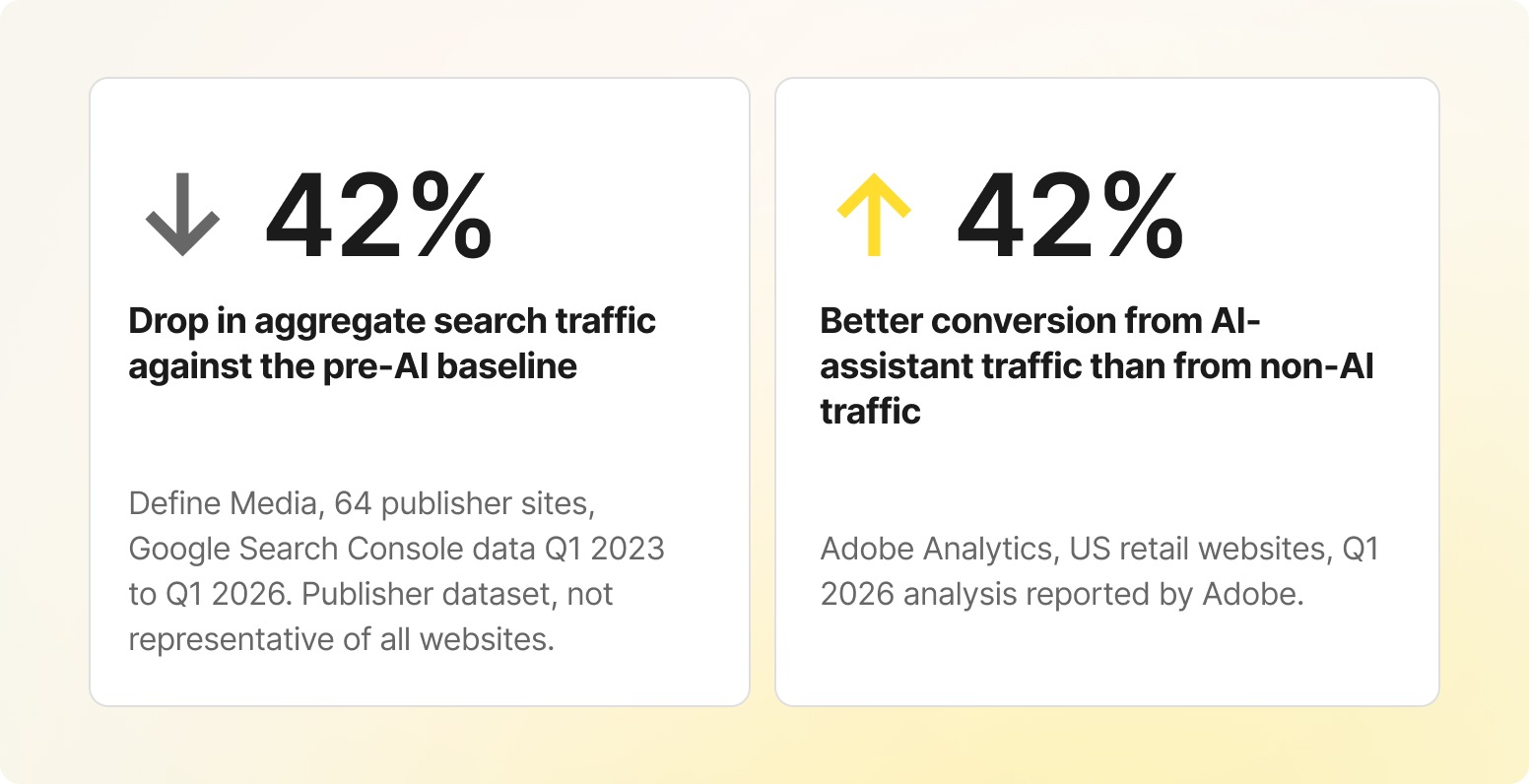
Fewer visitors from the open web, higher intent from the ones AI sends. Volume is down and value is up, and a click-based dashboard can only see the first half of that sentence.
Rank does not rescue you either. NP Digital found the share of ChatGPT citations from Google's top-ranking pages has fallen to 38%, down from 76%. Pages ranking first are mentioned 31.4% of the time. By position four, 2.6%. And 90% of ChatGPT citations come from pages ranking 21 or lower, because engines want the clearest answer rather than the highest-ranking one.
KEY TAKEAWAY
If you cannot measure the answer layer, you cannot price work against it or defend a retainer through it. Measurement is the precondition for the service line, not the reporting step at the end of it.
What is a prompt universe?
The prompt universe is the list of real questions a client's buyers ask AI tools. It is what you measure against, the same way an SEO program measures against a keyword list. You write it once, freeze it, and check the same questions every cycle so the numbers stay comparable.
Build 50 to 200 per client, then sort them by what the buyer is trying to do.
Read the mix, not just the total. If a brand only appears for brand questions, it is winning attention it already had. When it starts appearing for category and problem questions, it is capturing demand it did not own before. That shift is the point of the work.
Track six engines, weighted by where the client's buyers spend attention: ChatGPT, Perplexity, Gemini, Google AI Overviews, Google AI Mode, and Microsoft Copilot. A brand can appear in ChatGPT, go missing in Gemini, and sit third in Perplexity for the same question on the same day, so a single-platform check hides most of the picture.
How often you check
Generative engines are non-deterministic. An engine builds each reply one word at a time from a probability distribution, so a brand can read at 40% one week and 25% the next without anyone touching a page.
The sampling rule. Run every prompt three to five times per engine each cycle, in clean signed-out sessions so personalization does not bias the result, and record how often the brand is cited. That citation frequency is the number you report. Tools call this multi-sampling, and it is the credibility floor for the framework.
The scale of the variance is easy to underestimate. SparkToro founder Rand Fishkin, who ran a study on it, found that to get two answers naming the same brands in the same order, you would on average need to ask the same question around 1,500 times. His conclusion is the case for this whole approach: measure it the way you measure a poll, not the way you check a rank. The signal is real if you sample enough, and worthless if you check once.
Variance is selective, not random. Models are steady on factual questions and much less steady on open-ended recommendation prompts. Sample hardest where the space is widest, because that is where your client's visibility is actually decided.
What are the key metrics for measuring GEO success?
Six metrics, arranged as four layers read bottom to top. Each layer depends on the one below it. If a brand never appears it cannot be cited. If it is not cited it cannot compete for influence in the answer.
- Answer Presence Rate (APR). Out of all the times you ran your prompts, how often the brand showed up. Nothing else counts until the brand appears. Report it per engine, not just overall.
- Surface Coverage (SC). How widely that presence spreads across the five question types. It stops one strong pocket of visibility from flattering the whole picture.
- Citation Share (CS). When the answer mentions the brand, how often it also links to the brand's own site as the source. Cited brands earn far more clicks than brands that are only named, so this is the metric that predicts traffic.
- Generative Share of Voice (GSOV). The brand set next to its named rivals. Agree the competitor list up front and keep it fixed. This is the number clients react to most.
- Prominence Score (PS). Being the one tool an answer recommends beats being eighth in a list, though both count as showing up. Score each appearance from 0.2 for a passing mention to 1.0 for a sole recommendation.
- Representation Quality (RQ). Whether what the engine says is accurate. A brand can appear often and still be damaged if the answer states the wrong price. Errors go into a risk log.
Layer 4 is the one to be careful with. The influence happens before a visit rather than during one. Instead of claiming AI search drove X revenue, watch four proxy signals: AI referral sessions in GA4, branded search lift in Search Console, a “how did you hear about us?” field on lead forms, and the AI-referred conversion rate.
THE HONEST FRAMING FOR CLIENTS
Visibility and authority are what you control and report with confidence. Business impact is the trend you watch alongside them. Promising a clean revenue line from AI search today means selling a number nobody can yet stand behind.
What is the GEO Visibility Index?
The GEO Visibility Index (GVI) is a single number from 0 to 100 that rolls up presence, share of voice, and representation quality applied as a modifier. Rather than telling a client they were mentioned 18 times and cited 7 times, you convert those signals into one trendable score.
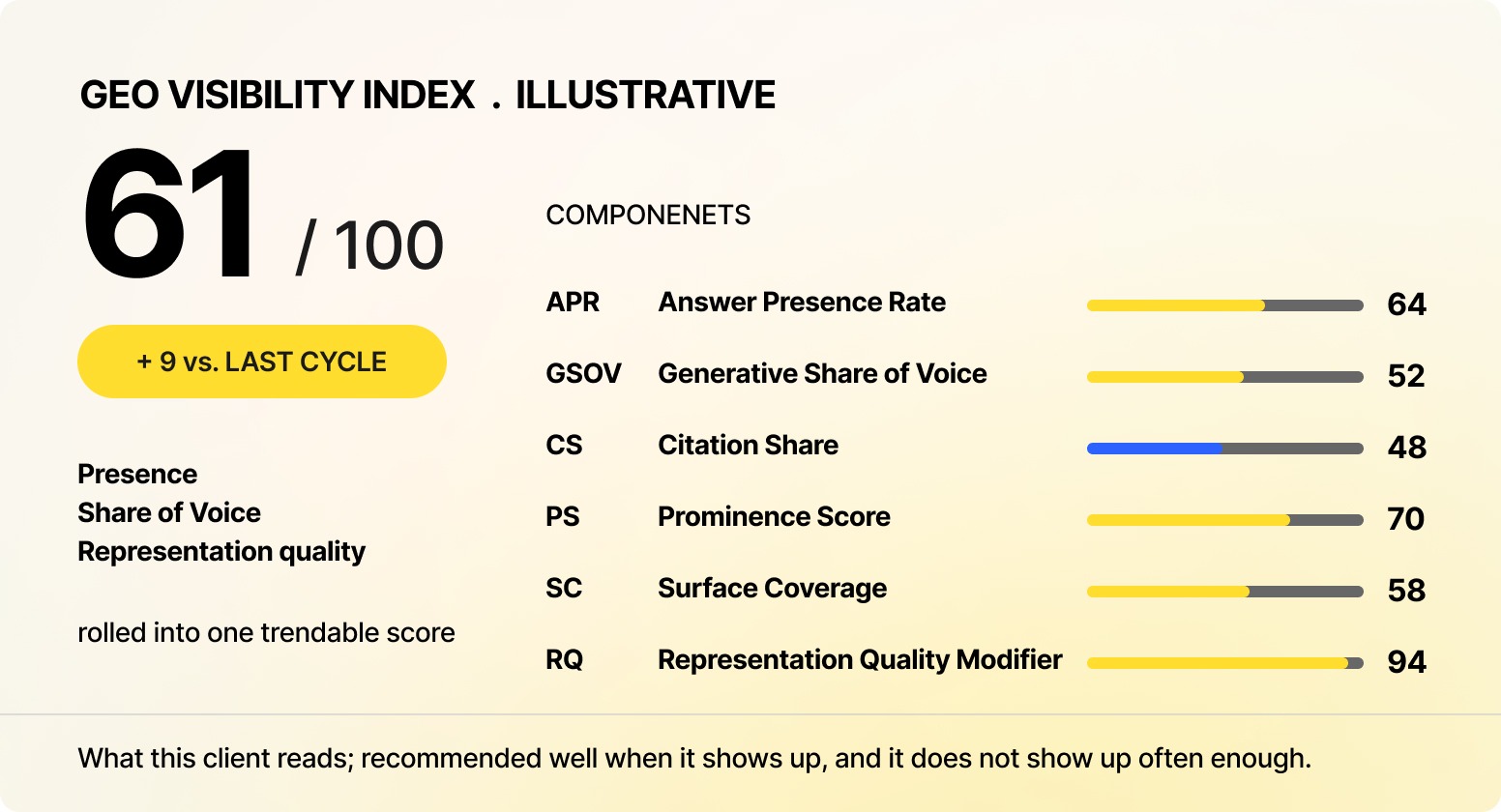
An illustrative GEO Visibility Index. Presence and citation are the ceiling here, so the work points at those rather than at prominence. What this client reads: recommended well when it shows up, and it does not show up often enough. Source: Mavlers Agency, The GEO Measurement Guide for Agencies, 2026.
One caveat: clients understand prompt movement faster than any composite score. The index works better as a summary than as a headline.
How does a GEO report turn into a retainer?
A score that does not tell you what to do next is a vanity metric. The bridge from report to retainer is a diagnostic table that reads each weak metric and names the work it scopes.
Each weak metric points at specific work
The distinction the middle column protects is the expensive one. A presence problem and an extractability problem look identical on a dashboard and cost completely different amounts to fix. One is an outreach project, the other is a content project.
Measure, diagnose, scope, execute, measure again. The loop gives the client a reason the work continues that is written in their own results, which is the most durable renewal argument an agency can hold. A monitoring tool cannot do this part: it confirms the gap, it does not explain it. For the platforms themselves, see our honest review of the 12 best AI SEO and AEO tools in 2026.
What this looks like on a real account
A Perth dental clinic is the clearest example we can point to. The clinic ranked fine in traditional search but was close to invisible in AI answers: when prospective patients asked ChatGPT and Google's AI Overviews for the best clinic in their area, competitors were named and the clinic was not. That is a presence problem on category prompts, the first row of the diagnostic above.
The fix followed the loop. We set a baseline across the buying prompts local patients actually use, restructured the clinic's content for clean extraction, tightened the entity and location signals the engines rely on, and tracked citation frequency month over month. The result reflects in the Perth dental clinic AEO and GEO case study.
The detail worth carrying over to any account: the win was not more content or a higher Google rank. It was being structured so the engines could parse, trust, and cite the clinic, then measuring that citation frequency so the progress was visible before the bookings moved.
Frequently asked questions
What is GEO measurement?
GEO measurement is the practice of tracking how often generative engines such as ChatGPT, Perplexity, and Google AI Overviews cite a brand in their answers, and how that brand is positioned when they do. It replaces rank and click-through as the yardstick for AI search visibility, because generative engines synthesize one answer from many sources rather than ranking a list of links.
Can you attribute revenue to AI search?
Not cleanly, and claiming otherwise damages client trust. Most AI answers resolve without a click, so the influence happens before a visit rather than during one. Report visibility and authority with confidence, and watch four proxy signals alongside them: AI referral sessions, branded search lift, self-reported “how did you hear about us” answers, and AI-referred conversion rate.

.webp)
.png)