







Table of contents
Get in touch
Expect response in 4 hours.
.webp)
If you want clarity on how many AI prompts to track for a client, we recommend tracking 5 per topic, with the number of topics determining the total.
For instance, a client with 6 priority topics needs 30 tracked prompts, and similarly, a client with 12 needs 60.
For an agency that adds GEO clients every month, the prompt count becomes a process decision, as it sets your tool spend, analyst hours, and how well your reports stand up to a skeptical client.
How to go about tracking AI prompts per client?
Start by counting topics; classic SEO maps keywords and entities. In AI search, the working unit is the topic an assistant associates with a brand, such as "payroll software for small businesses" for a SaaS client. For each topic, we track 5 prompts that cover the different ways a buyer would ask about it.
The topic list comes from the client's hero products, hero categories, or core service lines. That ties the tracked set to revenue and gives you a sizing rule to quote in the sales conversation.
Worked examples at 5 prompts per topic. Topic counts are illustrative.
Why doesn't a longer prompt list give you better data?
The fact is that a prompt does not return a fixed result.
In January 2026, Rand Fishkin of SparkToro and Patrick O'Donnell of Gumshoe.ai had volunteers run 12 prompts nearly 3,000 times through ChatGPT, Claude, and Google's AI. Search Engine Land reported that the odds of getting the same brand list twice were under 1 in 100. How often a brand appeared was far more stable than its ranking.
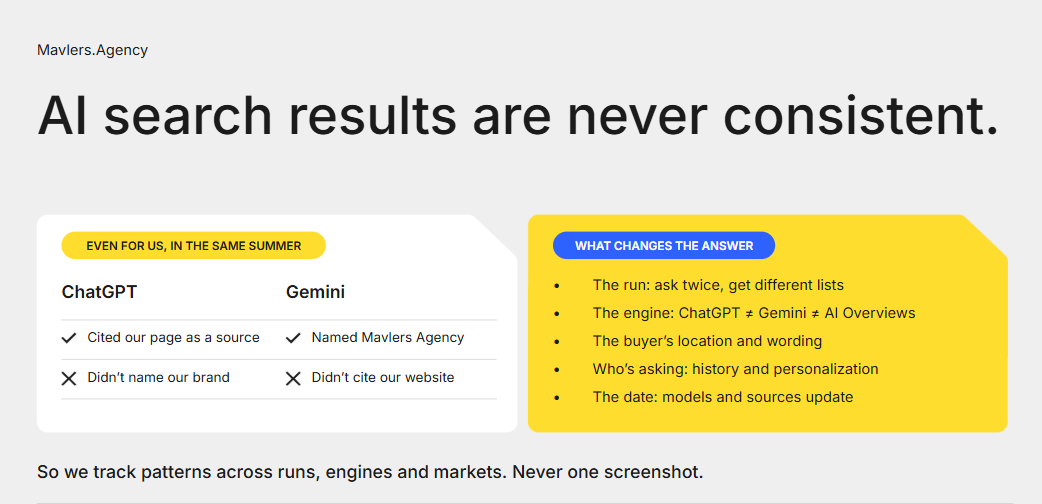
Our specialists describe the same thing on client calls. A brand shows up for a prompt in the morning and might go missing by evening. So we run every tracked prompt daily and report how often the brand was mentioned and how often it was missed.
5 prompts on 4 platforms, run daily, produce roughly 600 responses per topic each month. That volume turns a noisy answer into a usable rate. Prompts beyond it mostly add tool cost and review time.
Which prompts deserve a slot in the tracked set?
Split branded and non-branded prompts first. In a recent audit our team prepared for an agency's enterprise consumer brand, the brand appeared for almost every prompt that included its name. However, a direct competitor still had about twice as many AI mentions, roughly 16,400 against 8,000, because it showed up for category questions buyers ask before they have a brand in mind.
The agency's leadership raised a sharp question on that call: “How do you separate results from your work from the halo a famous brand already carries?” Separate prompt sets answer it. Branded prompts reflect the halo, while the non-branded set makes your work visible.
The same audit found more than 400 third-party pages cited in answers about the brand, including aggregator pages that list competitors beside it. Log the cited source for every tracked prompt along with the mention.
Within the non-branded set, we weight toward purchase-intent prompts because they sit closest to revenue. Awareness prompts stay for topics where the client is absent from early research.
How often should you review tracked prompts?
The review cadence Mavlers Agency runs on AEO and GEO accounts.
We connect the tracking platform to our reporting through its MCP (Model Context Protocol) server, so stalled prompts surface automatically. The manual layer stays because, as our subject matter expert told one agency, the leading tracking tools are not 100% accurate.
For a local retail client, our month-by-month grid showed "no" for every tracked prompt in the first two months. The client's developers were working on schema, metadata, robots rules, and canonical fixes. Once those shipped, two prompts turned to "yes" in month three, nearly all of them the month after, and every prompt by July 2026.
What should sit beside prompt data in a client report?
Prompt tracking simply shows visibility. However, it cannot yet be tied to an individual purchase, and we mention that clearly in our conversations with clients. Two first-party sources help.
- Search Console: Google launched Search Generative AI performance reports on June 3, 2026. They show impressions in AI Overviews and AI Mode, and Google is rolling them out to a subset of sites first.
- GA4: Google added a native AI Assistant channel to the Default Channel Group on May 13, 2026, according to Search Engine Journal. It groups referrals from recognized assistants such as ChatGPT.
We map mention rates against both, along with direct traffic, and set first-quarter visibility KPIs. Conversion targets come later.
How does Mavlers Agency set this up for agency partners?
Mavlers Agency runs this as white-label delivery under your brand. Around 100 of our 400+ specialists work on SEO and AEO/GEO for the 600+ agencies we partner with. The prompt model above is templated, so every new client is sized, tracked, and reported the same way.
That repeatability lets a scaling agency sell GEO with confidence. One agency partner started with a single AEO/GEO project. About a year later, it has roughly 35 running with us and adds 5 to 6 a month on the same template.
FAQs
Should branded prompts count toward the 5 per topic?
No. Track them as a small separate set so they do not inflate the visibility rate.
Which AI platforms should we track?
Our default set is ChatGPT, Perplexity, Gemini, and Google AI Overviews.
When should we replace a tracked prompt?
Review the content behind it after two months without traction. After a full quarter, re-audit entity and cluster gaps and rebuild the plan for that topic.