White label

Ending the data war between storefront and warehouse

Project Overview

Organization

Mid-market home and lifestyle retailer

Industry

Retail and eCommerce

Technology stack

Shopify Plus, NetSuite, integration middleware

Products / Services Used

  • Shopify Plus and NetSuite integration
  • Middleware development
  • Inventory synchronization
  • Order and fulfilment automation
  • Data reconciliation
  • API integration
  • Integration monitoring & error handling

The client was a home and lifestyle retailer generating around Β£2 million in annual revenue through a Shopify Plus store, wholesale, and marketplace channels.

‍

With plans to double order volume, launch a second brand, and open a third distribution centre, its disconnected Shopify–NetSuite workflows had become a bottleneck.

‍

Inventory, orders, fulfilment, and financial data relied on manual CSV uploads and duplicate data entry, creating frequent mismatches across teams.

‍

Mavlers Agency was brought in to establish a single, reliable source of truth across the business.

Performance Insights

Key results for the client

85%

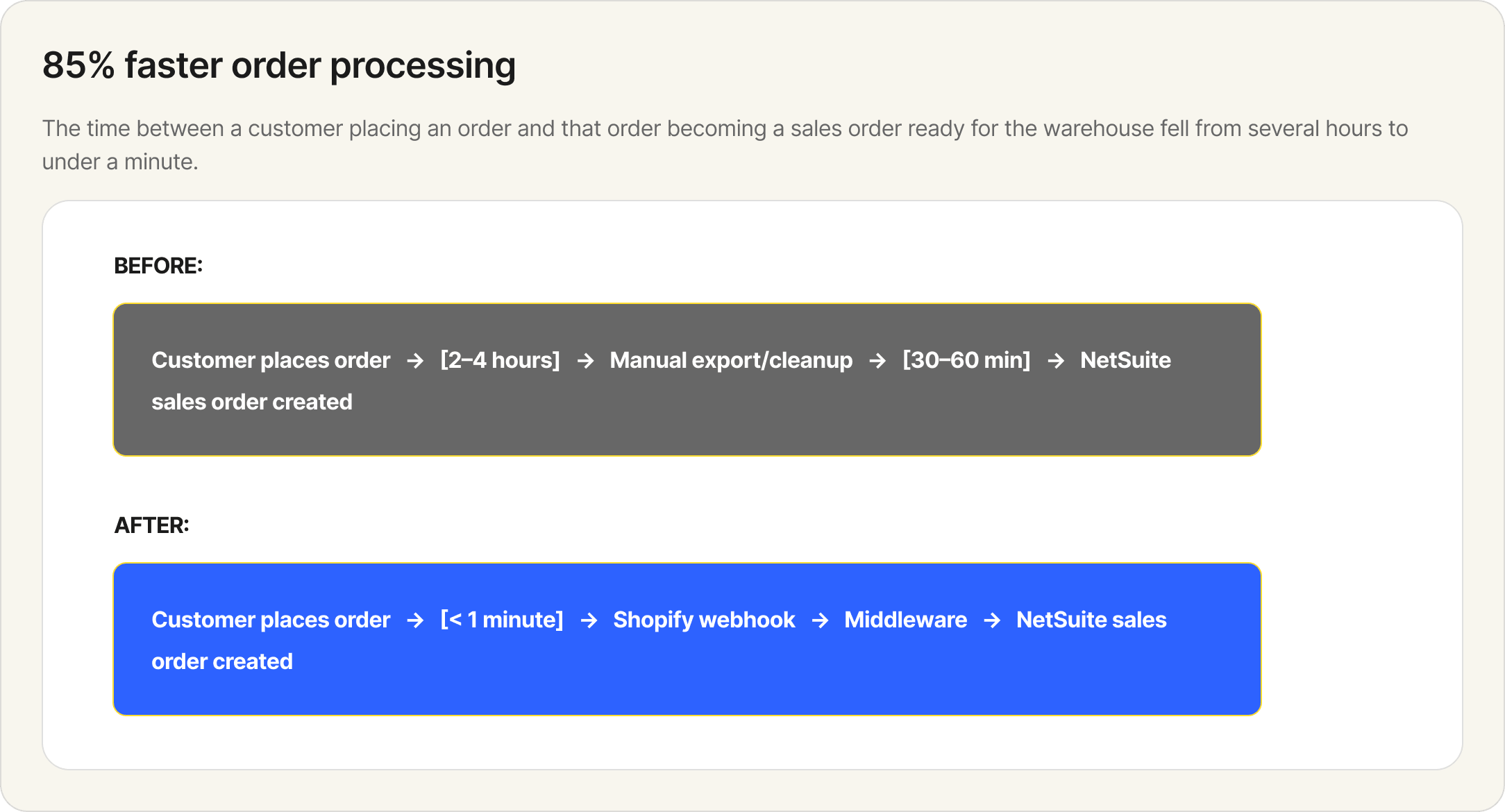
Faster order processing time

99%+

Cross-system inventory accuracy

~ 90%

Reduction in manual data entry

0

Oversells since go-live

Client Objectives

The challenges the client faced

1.
Inventory updates were too slow

NetSuite was the inventory system of record, but Shopify received updated stock figures only twice a day through scheduled CSV exports. This created a high risk of overselling during promotions, resulting in cancellations, refunds, and customer support issues.

2.
Orders required manual processing

Shopify orders had to be exported, cleaned, and imported into NetSuite. The process delayed fulfillment and created risks involving mismatched SKUs, incorrect tax codes, duplicate lines, and data-entry errors.

3.
Finance was spending too much time reconciling data

Orders, fulfilments, and payments reached NetSuite through different routes. Invoices were raised manually, while the finance team investigated discrepancies before records could be reconciled.

4.
Reporting was always behind

Sales, inventory, and margin reports were assembled manually from multiple exports. By the time they were ready, they often reflected the previous week rather than the current state of the business.

5.
Growth was increasing the operational burden

Doubling order volume on the existing setup would have increased manual work, errors, and the need for additional operational headcount.

Mavlers Strategy

Built backwards from the warehouse floor

1.
Mapped the business before designing the integration

We worked with operations, warehouse, finance, and eCommerce teams to map the client’s order-to-cash, procure-to-stock, and return-to-refund processes.

The audit identified manual data transfers, API limitations, webhook requirements, and three different SKU conventions. A canonical product registry was established before the integration was built.

2.
Defined a system of record for every data entity

The integration assigned ownership for each data type.

  • NetSuite owned products, pricing, inventory, invoices, and financial records
  • Shopify owned orders at the point of capture
  • Fulfilment originated in the warehouse and flowed through NetSuite
  • Tracking information flowed back to Shopify
3.
Built a middleware layer instead of a direct connection

Rather than connecting Shopify and NetSuite directly, Mavlers built a middleware layer to transform data, apply business rules, queue messages, record activity, and retry failed operations.

This protected the workflow from temporary outages and reduced the risk of lost data.

4.
Combined event-driven updates with scheduled polling

Shopify webhooks pushed order and fulfillment events in near real time. NetSuite saved-search polling identified inventory changes where event notifications were limited.

A nightly reconciliation process compared records across both systems and corrected any differences.

5.
Automated the key operational workflows

The integration automated the movement of

  • Products and pricing from NetSuite to Shopify
  • Inventory updates from NetSuite to Shopify
  • Orders from Shopify to NetSuite
  • Fulfilment and tracking information from NetSuite to Shopify
  • Invoice and financial data within NetSuite

Shopify orders were converted into NetSuite sales orders as soon as the relevant webhook was received.

6.
Added validation, retry logic, and monitoring

Before data was written to NetSuite, the integration checked SKU validity, tax codes, currencies, and quantities. Invalid records were quarantined instead of being pushed downstream. Idempotent operations prevented duplicate orders, while retry logic and dead-letter queues handled failed messages.

Structured logs, correlation IDs, queue monitoring, error tracking, and synchronization-latency alerts provided visibility across the entire workflow.

7.
Tested the integration under realistic conditions

The integration went through unit testing, user acceptance testing, anonymised real-order testing, and peak-volume performance testing.

It also ran in shadow mode for one week before launch. Production rollout then took place in stages, beginning with inventory and followed by orders, fulfilment, and finance.

‍

Results

What the client achieved

‍

‍

90% less manual data entry

The time previously spent exporting, cleaning, importing, and correcting data could be redirected towards merchandising, supplier relationships, and customer experience.

Faster month-end close

With cleaner order, fulfilment, and payment data flowing automatically into NetSuite, the finance team spent less time investigating discrepancies.

A better customer experience

Customers received more accurate stock information, faster dispatch, and more reliable tracking updates. The result was fewer cancellations and fulfillment issues.

Near-real-time business reporting

Leadership gained a more current view of sales, inventory, and margin across channels without waiting for manually assembled reports.

A scalable operating model

The same automated pipeline could support higher order volumes, additional warehouses, new sales channels, and the launch of a second brand without creating a proportional increase in manual work.


Before and After


Before After
Inventory updated twice dailyt Near-real-time inventory updates
Orders exported and imported manually Orders created automatically in NetSuite
Frequent overselling during promotions 99%+ inventory accuracy
Manual reconciliation across systems Automated data flow and nightly reconciliation
Month-end close slowed by discrepancies Faster close with cleaner financial data
Reporting assembled from multiple exports Near-real-time visibility across channels
More volume meant more manual work Additional volume flows through the same automated pipeline

‍

Sandra Field

Related Case Studies

Results that speak
for them selves.

Migrating 9,000+ pages across 12 languages

Successful migration of 9,000+ pages across 12+ languages, with no critical downtime.

80% CPR reduction and 3x ROI over 6 years

Multi-channel strategy driving 50%+ monthly registration growth.

35% cost reduction while scaling SEO delivery globally

Ogilvy needed to scale SEO delivery across multiple markets without expanding headcount. Mavlers stepped in as their invisible production partner.