Web Development

How Mavlers turned one Framer template into a scalable, CMS-driven case study platform

Project Overview

Organization

Confidential (portfolio website client)

Platform

Framer + Framer CMS

Deliverable

A single dynamic case study template powered entirely by a structured CMS

Objective

Every project page is uniquely presented and published by the client's team without developers

Products / Services Used

  • Framer Development
  • CMS Architecture
  • Dynamic Components
  • Conditional Rendering
  • Responsive Grid Systems
  • Media Integration

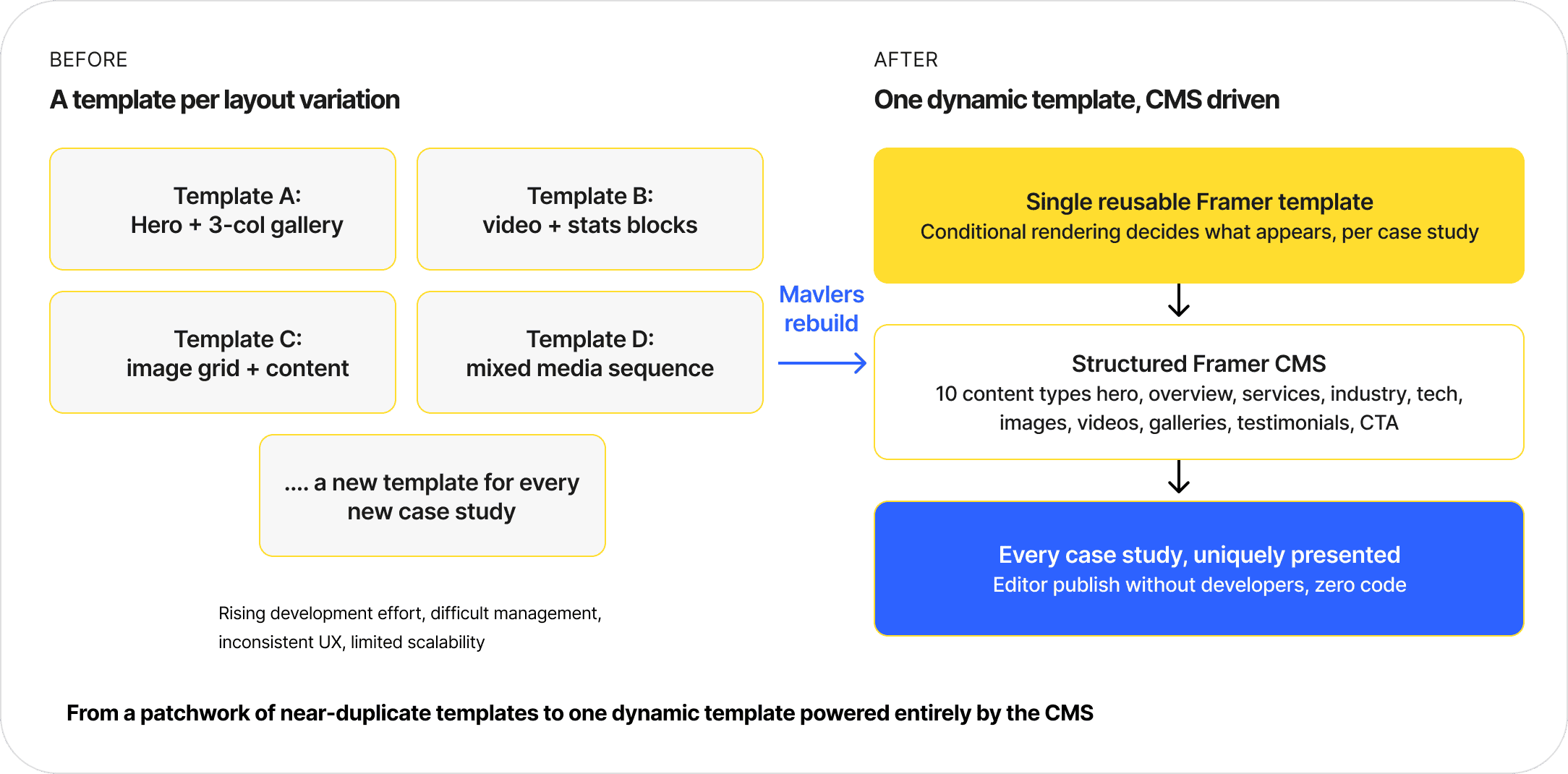
The client wanted a modern portfolio website built in Framer that would showcase their projects through visually engaging case studies. A base Framer template was provided, but the client needed a far more flexible content management system: one where their team could create and publish new case studies without relying on developers, and where every project page could have its own unique presentation while running on a single reusable template. At first glance, the requirement looked straightforward. The complexity surfaced in the design files: each case study featured a different combination of media layouts, ranging from full-width heroes with three-column galleries to pages that mix videos, image grids, statistics, and content blocks in completely different sequences.

Performance Insights

Key results for the client

1

Reusable template powering every case study

10

CMS content types, managed without code

7

Dynamic components wired to CMS fields

0

Developer involvement needed to publish
Client Objectives

The challenges the client faced

1.
Every case study demanded a different layout

Pages combined heroes, videos, image grids, statistics, and content blocks in completely different sequences, with no single fixed structure to template against.

2.
Separate templates meant runaway effort

Building a template per variation would have multiplied development and maintenance work with every new case study added.

3.
Content management would stay developer-bound

Without a flexible system, the client's team could not create or publish new case studies on their own.

4.
Inconsistent user experience

A growing pile of near-duplicate templates would inevitably drift apart in spacing, behavior, and design quality.

5.
Limited scalability

Every future case study would compound the problem, making the portfolio harder to grow rather than easier.

Mavlers Strategy

How we built one template that behaves like dozens

1.
Designed a content-first CMS structure

Rather than mirroring the visual layout, the CMS organizes information logically across ten content types (hero, project overview, services, industry, technologies, images, videos, gallery sections, testimonials, and CTA content), so every project is managed entirely from the Framer CMS.

2.
Built a reusable component library

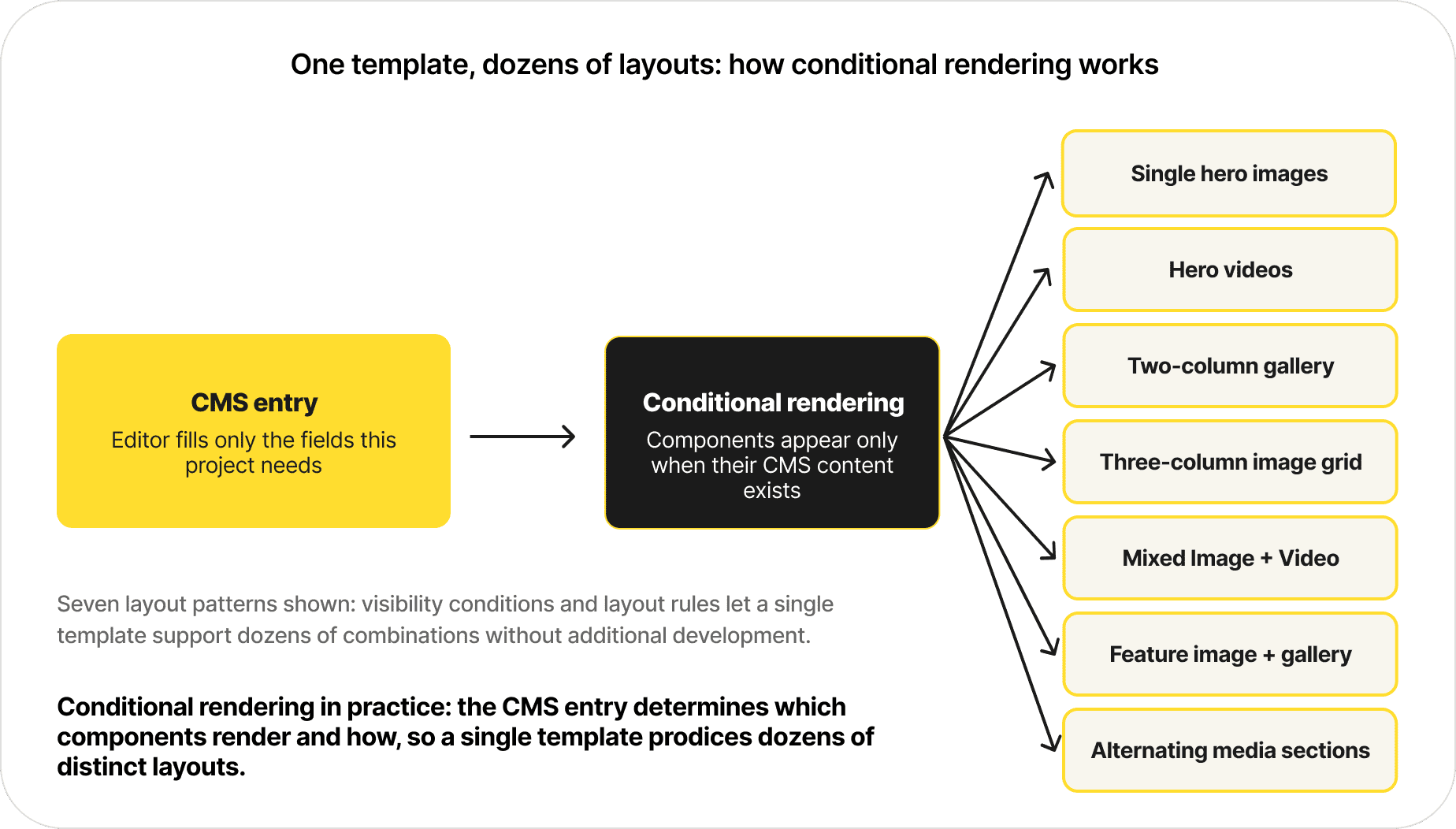
Seven dynamic Framer components (hero sections, project information, image galleries, video sections, statistics, content blocks, and CTA sections), each connected directly to CMS fields.

3.
Implemented intelligent conditional rendering

Custom visibility conditions and layout rules mean components appear only when their corresponding CMS content exists, so one template supports dozens of layout combinations, from a single hero image to alternating mixed-media sections, without additional development.

4.
Integrated media dynamically

Images and videos are supported directly from the CMS, so editors upload or replace assets without touching page structure or writing code.

5.
Tested across every configuration

The template was validated across different case study setups for responsive layouts, correct media rendering, consistent spacing, fast loading, and a smooth editing experience.

Results

What the platform now enables

Workflow Before After
Page creation Developer builds or clones a template per variation Created entirely through the CMS
Layout flexibility Fixed per template; new layout means new build Dozens of combinations from one template
Media management Structural edits required for image/video changes Upload or replace directly in the CMS, no code
Publishing time Dependent on developer availability Significantly shorter, editor-driven
Scalability Each new case study compounds maintenance Unlimited variations, future-ready foundation

From template-based page creation to a scalable, CMS-driven publishing experience.

The insights

Why it worked

  1. Content-first, not layout-first - Structuring the CMS around information rather than visuals meant the front end could adapt to the content instead of the content bending to the template.
  2. Presence-based rendering - tying component visibility to whether CMS content exists eliminated duplicate templates while preserving complete design flexibility.
  3. Editor autonomy by design - Every publishing action lives in the CMS, so non-technical users run the platform and developer dependency drops to zero for day-to-day content.
  4. Tested as a system, not as pages - Validating across configurations rather than individual pages is what makes one template safe to trust with unlimited future variations.

Sandra Field

Related Case Studies

Results that speak
for them selves.

Migrating 9,000+ pages across 12 languages

Successful migration of 9,000+ pages across 12+ languages, with no critical downtime.

80% CPR reduction and 3x ROI over 6 years

Multi-channel strategy driving 50%+ monthly registration growth.

35% cost reduction while scaling SEO delivery globally

Ogilvy needed to scale SEO delivery across multiple markets without expanding headcount. Mavlers stepped in as their invisible production partner.