White label

3X AI visibility for a California eco-homebuilder

Project Overview

Organization

Eco-smart homebuilder (anonymised under NDA)

Industry

Real estate & construction - new-home development

Measurement

5 AI platforms, 830 non-branded category answers

Location

California

Category

All-electric, solar-powered, smart-home communities

Products / Services Used

  • AI Search Visibility
  • AEO
  • GEO
  • AIO/LLMO
  • SEO Foundation

This builder constructs eco-friendly, all-electric, solar-powered, smart-home communities across California, with a deliberate focus on urban-infill and transit-accessible neighbourhoods. Clear market identity. Strong real-world positioning.

‍

What was missing was whether any of that translated into AI search, where California homebuyers increasingly begin their shortlist.

‍

It did. Comprehensively.

‍

The engagement was built to make sure this builder's real-world identity actually showed up in the answer.

Performance Insights

Key results for the client

#1/5

AI visibility rank in category

16.3%

Visibility across all category answers

63.1%

Share of AI voice vs named competitors

100%

Positive brand sentiment, zero negative mentions

Client Objectives

The challenges this homebuilder faced

1.
Strong Google rankings, zero AI presence

The brand had solid organic visibility in classic search. But across every tracked buyer prompt, it wasn't being named in Google AI Overviews, ChatGPT, Gemini, or any other AI surface.

2.
Buyers had already moved to AI-first search

Before opening a listings site or a map, buyers were asking AI assistants "best eco-friendly new homes in California." High-intent comparisons like "move-in-ready homes in Irvine vs San Francisco" were returning AI-generated shortlists of three or four builders.

3.
A differentiated identity that AI didn't know how to describe

The builder had clear, specific positioning: eco-friendly, all-electric, solar-powered, urban-infill. None of that was structured in a way AI models could find, read, and accurately repeat.

4.
Competitors weren't winning either. For now.

Most direct competitors had minimal AI visibility. The category was largely unclaimed in AI search. Moving first, and building the entity signals that compound over time, would determine who owned these answers for the long term.

Mavlers Strategy

How a California homebuilder became the answer AI gives

Four disciplines - AEO, GEO, AIO/LLM - running on one SEO foundation. Eight factors treated together because models don't grade them separately.

1.
Made the pages readable to AI systems.

Audited crawl access, render behaviour, and how content resolves when an AI system fetches the page. JavaScript-only content invisible to crawlers, blocked resources, conflicting canonicals, slow render paths - fixed at the source.

2.
Built entity signals around the differentiation.

Aligned name, service list, and category vocabulary across every property AI cross-checks β€” Google Business Profile, real estate directories, industry publications, California-specific listings sources. Eco-friendly, all-electric, smart-home, urban infill had to appear consistently attached to this builder wherever AI looked, or the identity gets diluted into the general category.

3.
Schema built for how the parser reads.

Organization, LocalBusiness, Product (for individual communities), and FAQPage -Β  marked up with the properties that matter for homebuilding recall: service area, community types, home features, price range, delivery status. Machine-readable context, not badge decoration.

4.
Rewrote content for answerability.Β 

Every tracked buyer prompt had a direct answer at the top of the relevant page section -Β  complete sentences that resolve without surrounding paragraphs. Natural-language variations included, because a buyer looking for smart-home communities phrases the search ten different ways.

5.
Third-party trust from sources AI verifies.

Real estate industry publications, California builder rankings, sustainability-focused property listings, review platforms models actually pull from in the homebuilding vertical. Reference quality over volume.

6.
Prompt-level tracking across five AI platforms.

Each tracked buyer prompt queried on each engine, dated screenshots on file. Tracking captured citation share, share of voice against named competitors, and sentiment attached to each mention. Google AI Overviews, Gemini, ChatGPT, Perplexity, and Copilot -Β  measured in parallel.

7.
AI-referral traffic surfaced properly in GA4.

Custom events, referrer classification, and UTM handling rebuilt so AI-assisted sessions show up as a distinct channel with engagement rate, conversion, and enquiry data attached to the correct bucket instead of folded into organic.

8.
Landing architecture matched to prompt intent.

Shortlist queries routed to community-comparison pages. Comparison queries (Irvine vs San Francisco) routed to region-specific inventory. Move-in-ready queries routed to quick-delivery pages with availability above the fold. Every citation earned had a page built to convert the intent behind it.

Results

What the homebuilder achieved

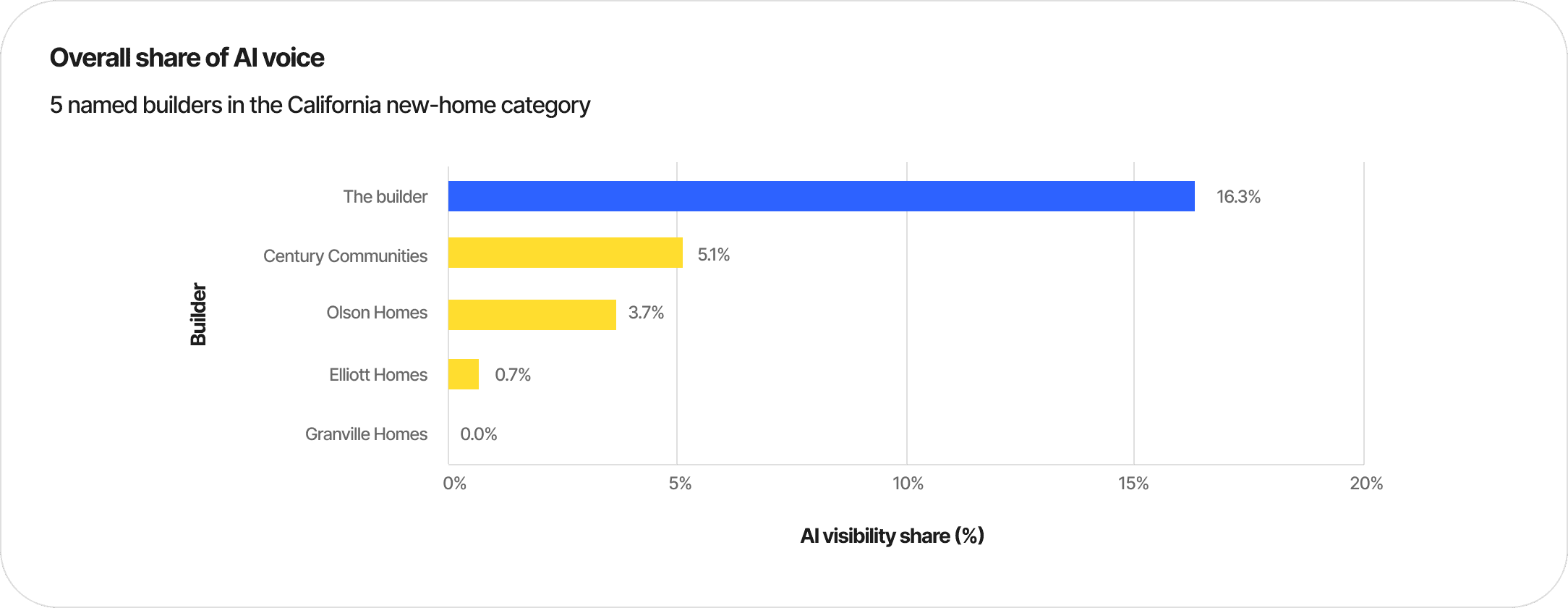
Category dominance. Across 830 non-branded category answers measured on 5 AI platforms, the builder holds 16.3% of visibility - leading the nearest named competitor by more than 3Γ—.

‍

‍

‍

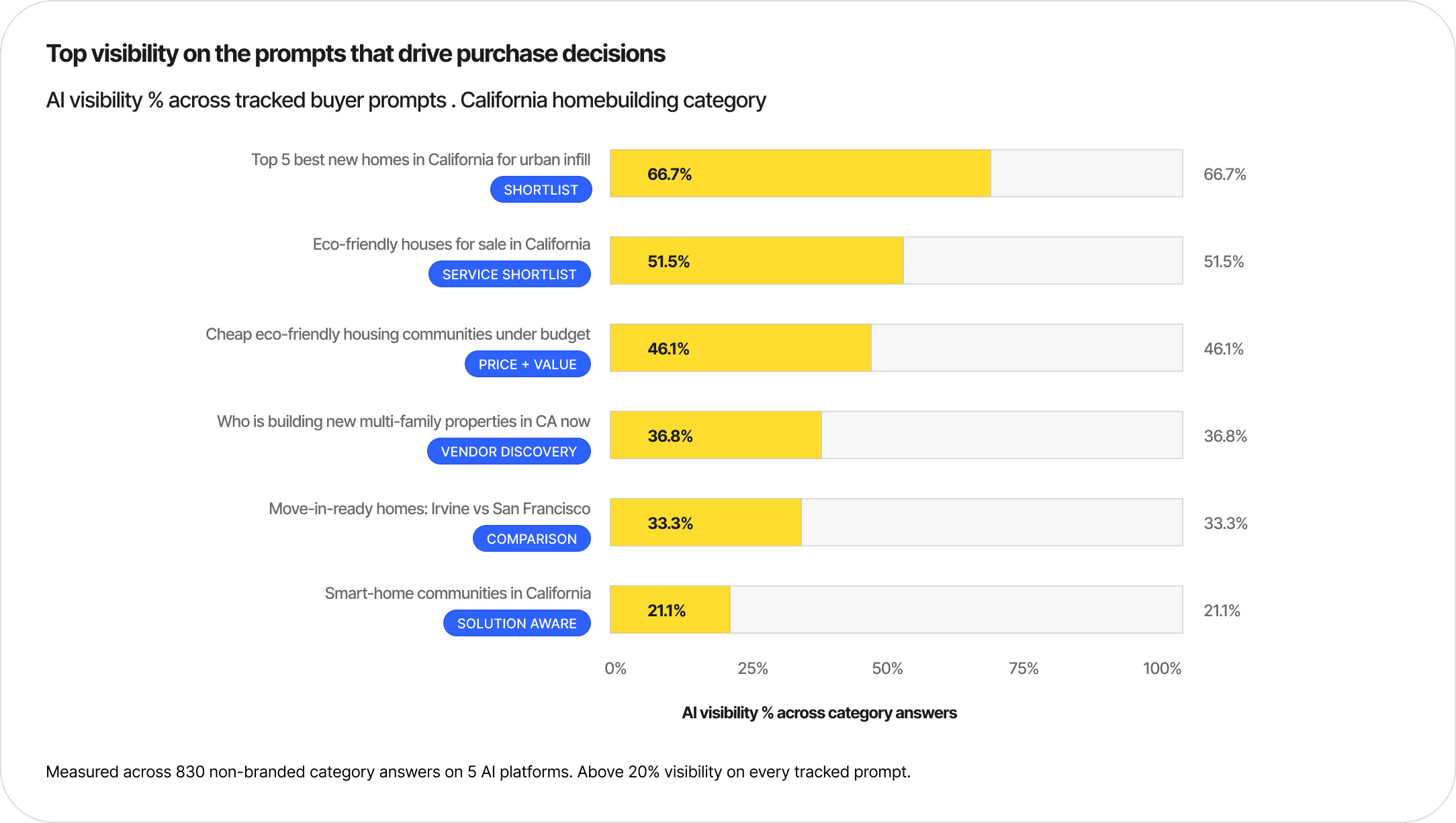
Above 20% visibility on every tracked prompt. The broadest shortlist query returns this builder as the cited answer two thirds of the time.


Strong on the surfaces buyers actually use.


Roughly 1 in 4 Google AI Overviews and Gemini answers in the category cite this builder. These are the two AI surfaces where homebuyers run the most category-level queries.


  • Google AI Overviews: 24.0% answer share Β· 25.0% citation share
  • Gemini: 23.0% answer share Β· 18.0% citation share

‍

‍

The AI is pulling directly from the builder's own pages.

2,580 total citations across 63 pages. The homepage alone appears in 84 AI answers.


Cited page Citation share Citing answers
Homepage 10.1% 84
Affordable places to live in California 1.8% 15
Average cost to build a house in California 1.6% 13
Northern California new homes 1.3% 11
About page 0.6% 5

‍

Owns the topics that define the category.Β 

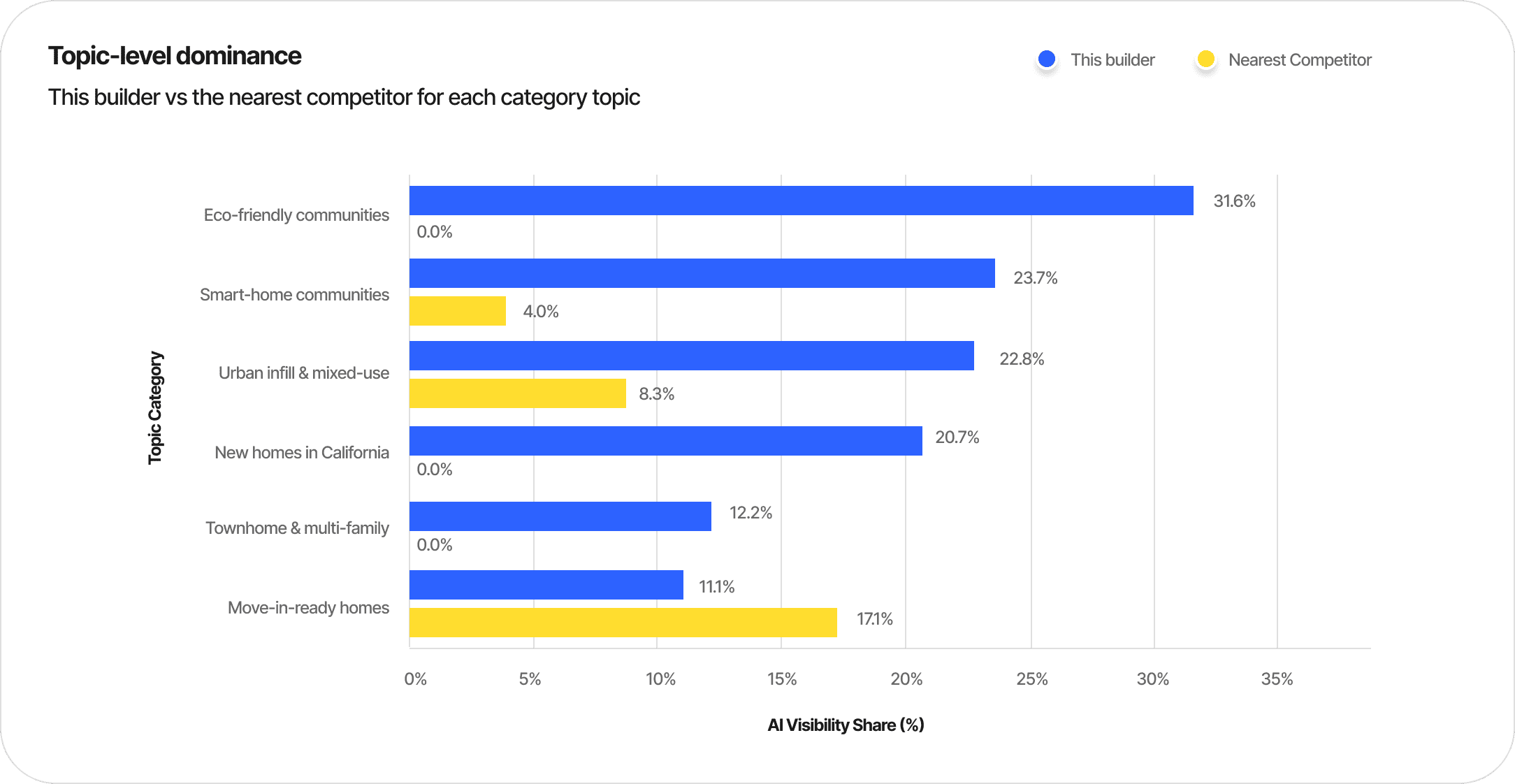
The builder leads 5 of 6 topic categories outright. Most competitors score zero on most of them.


  1. Eco-friendly communities: 31.6% (competitors: 0%)
  2. Smart-home communities: 23.7% (nearest competitor: 4.0%)
  3. New homes in California: 20.7% (competitors: 0%)
  4. Urban infill & mixed-use: 22.8% (nearest: 8.8%)
  5. Townhome & multi-family: 12.2% (competitors: 0%)
  6. Move-in-ready / quick delivery: 11.1% (Olson Homes leads this one at 17.1%)

‍

The strategic insight Z

AI engines describe California's entire new-home category in this builder's own vocabulary. Eco. All-electric. Smart-home. Urban infill.

Meanwhile, four of the five named competitors are effectively absent from those same answers.

In homebuilding, AI search doesn't reward the biggest builder or the highest-ranked one. It rewards the one with the clearest, most differentiated entity and the most answerable positioning.

Sandra Field

Related Case Studies

Results that speak
for them selves.

Migrating 9,000+ pages across 12 languages

Successful migration of 9,000+ pages across 12+ languages, with no critical downtime.

80% CPR reduction and 3x ROI over 6 years

Multi-channel strategy driving 50%+ monthly registration growth.

35% cost reduction while scaling SEO delivery globally

Ogilvy needed to scale SEO delivery across multiple markets without expanding headcount. Mavlers stepped in as their invisible production partner.