Ready to make the switch?
Move from Salesforce to HubSpot without losing the data or workflows you rely on.



Organization
Industry
Technology stack
Project type
Products / Services Used
The client had grown rapidly over five years, but its CRM setup had not kept pace.
Sales and customer success teams worked in a heavily customized Salesforce environment, while marketing operated inside HubSpot Enterprise. The two systems were connected through the standard HubSpot-Salesforce connector, but the integration could not reliably handle the client’s custom Apex triggers, validation rules, and complex object structure.
The business needed to move from Salesforce to HubSpot without losing years of customer history, sales activity, ownership records, pipeline data, or reporting accuracy.
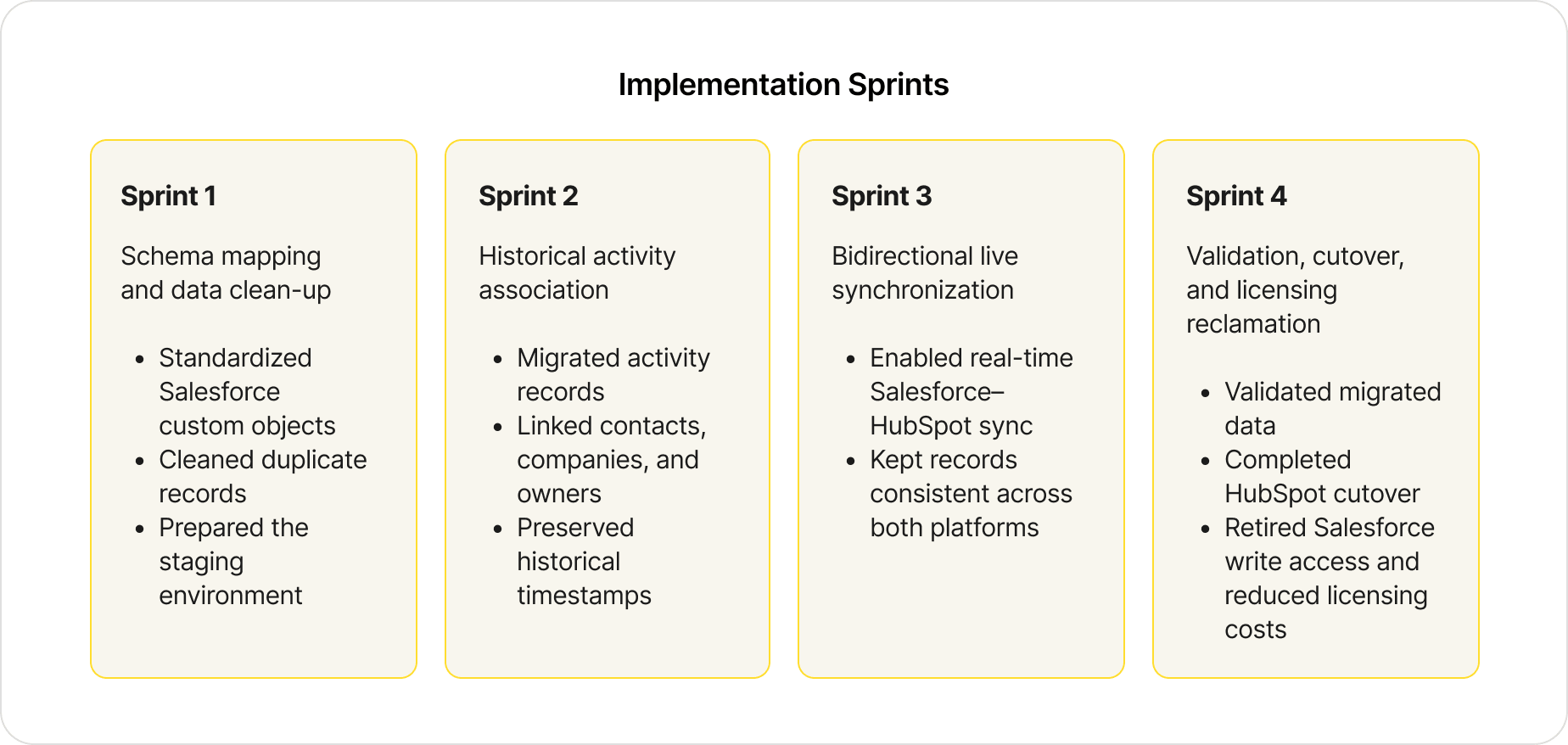
Mavlers designed a phased migration and synchronization framework that allowed both systems to operate together during the transition.

CRM records migrated
Overall data fidelity
Annual platform licensing costs reclaimed
Increase in cold-to-warm pipeline conversions
Mavlers Agency avoided a single cutover weekend.
Instead, the team deployed a white-label Phased Coexistence Framework supported by a custom bidirectional synchronization layer. This allowed different divisions to move to HubSpot gradually while Salesforce remained active for teams that had not yet transitioned.
For 60 days, changes made in one CRM were reflected in the other.
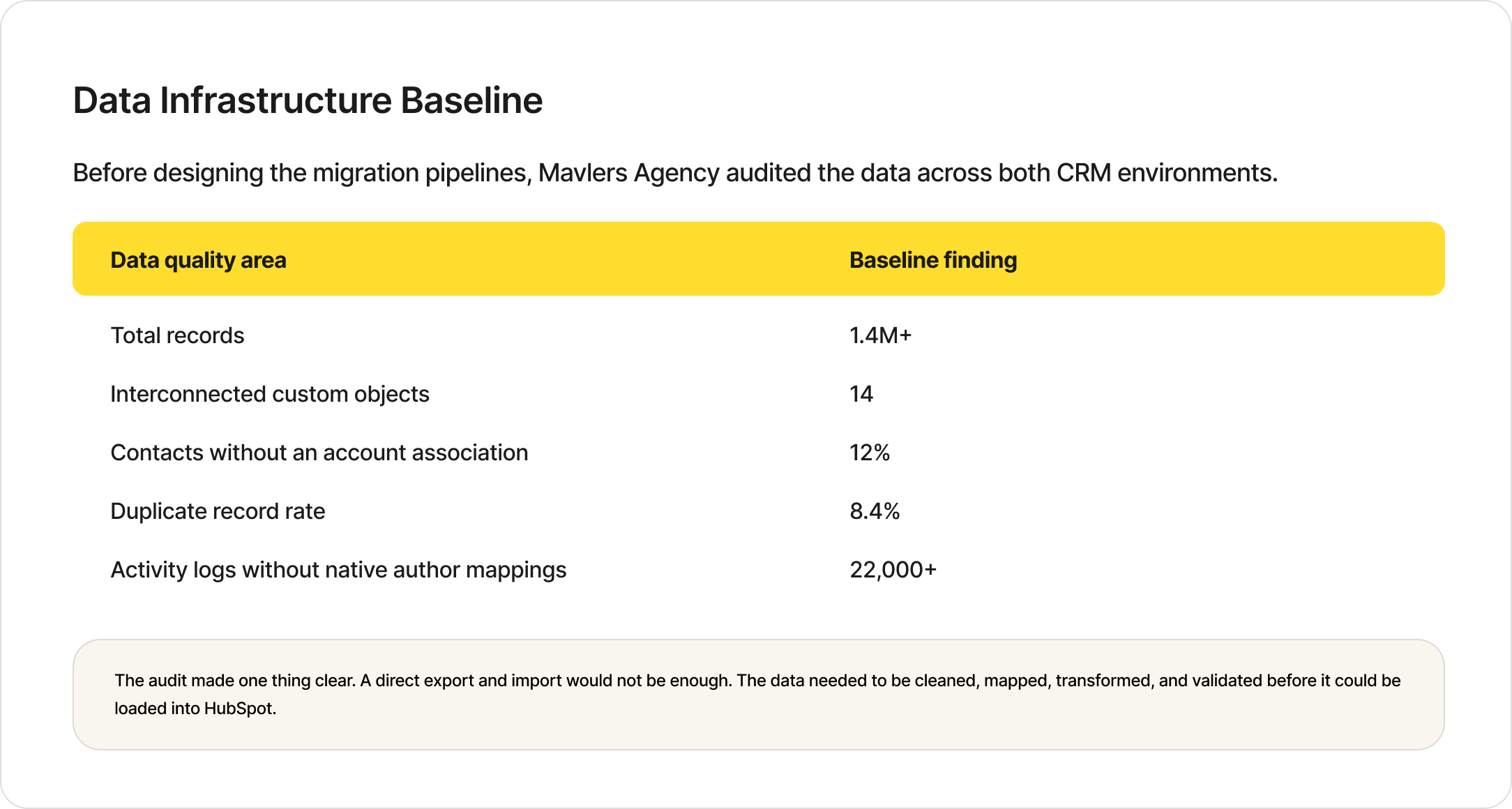
Raw records were extracted from Salesforce using Bulk API 2.0 and processed in an isolated SQL staging environment - outside the live CRM systems. This allowed the team to standardise records, remove 8.4% duplicate rate, and map complex relationships without placing any load on production systems.
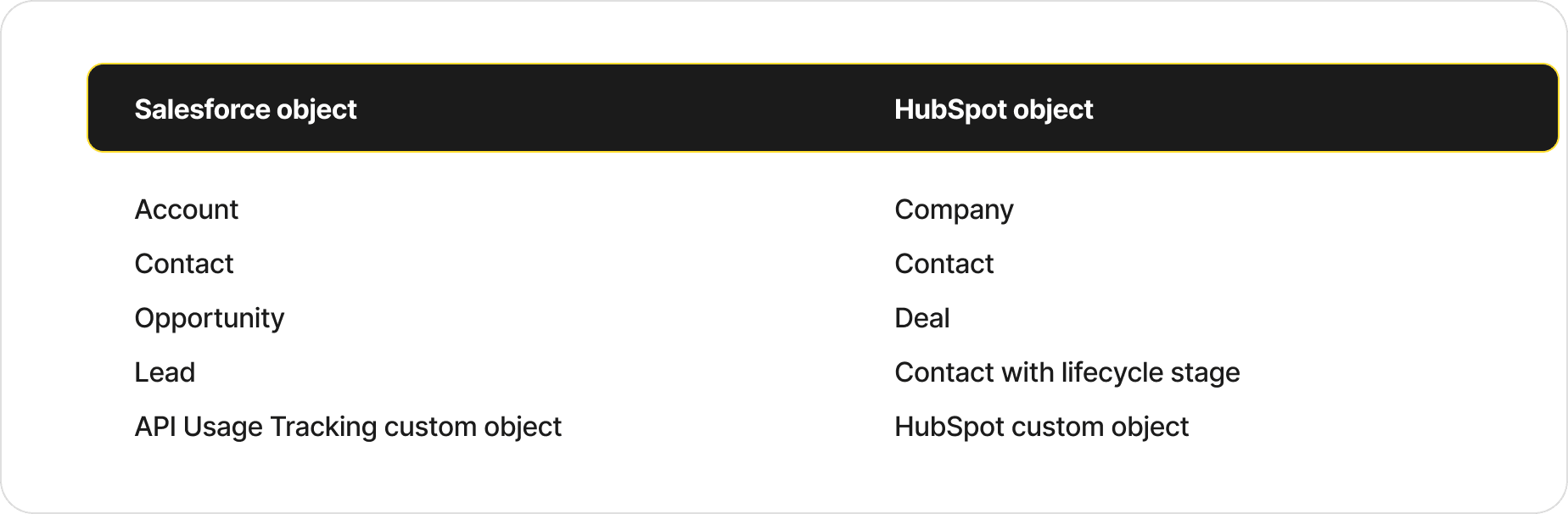
The migration mapped the existing Salesforce structure to the corresponding HubSpot architecture.
We mapped the Salesforce relational architecture to HubSpot's object structure according to the following matrix:
To preserve relationships between records, the team created an identity mapping dictionary.
The dictionary tracked the relationship between every legacy Salesforce ID and its new HubSpot ID. It also recorded the record type and whether the relationship had been reconciled.
This mapping became the foundation for the activity migration, object associations, and bidirectional synchronization.
The migration engine processed Salesforce tasks, events, notes, and emails individually instead of importing them as unstructured text.
For each activity, the system resolved:
The activity data was then posted into HubSpot using the engagement API with historical timestamp values. Due to which, the client retains the original timeline of customer interactions instead of showing every migrated activity as if it had been created on the import date.
Deals were not imported only at their final stage. The migration engine recreated each deal's full journey - starting at the original stage, moving through subsequent milestones, and applying the original stage-change dates through API pipeline overrides. This preserved the data needed for sales velocity reporting and ARR projections.
During the transition, Salesforce outbound messages and Apex triggers captured changes on the Salesforce side; HubSpot webhooks captured changes on the HubSpot side.
Both streams passed through a middleware worker that normalised data, applied identity mappings, and passed updates to the destination system - keeping both CRMs in sync while different teams transitioned at different paces.
Bidirectional sync creates a risk of infinite update cycles: a Salesforce change triggers a HubSpot update, which triggers another Salesforce update, and so on.
Integration metadata was embedded in both systems so the sync engine could detect whether an update originated from the integration itself - and block the duplicate before it propagated.
The client's Salesforce API usage tracking object was mapped to a new HubSpot Enterprise custom object - Product Usage Snapshots. Each snapshot was associated with the correct company using the identity mapping dictionary, allowing growth marketers to build workflows that trigger when a user's API consumption crosses 85% of their plan threshold.


Organization
Industry
Services Used
Lorem ipsum dolor sit amet, consectetur adipiscing elit. Suspendisse varius enim in eros elementum tristique. Duis cursus, mi quis viverra ornare, eros dolor interdum nulla, ut commodo diam libero vitae erat. Aenean faucibus nibh et justo cursus id rutrum lorem imperdiet. Nunc ut sem vitae risus tristique posuere.
Lorem ipsum dolor sit amet, consectetur adipiscing elit. Suspendisse varius enim in eros elementum tristique. Duis cursus, mi quis viverra ornare, eros dolor interdum nulla, ut commodo diam libero vitae erat. Aenean faucibus nibh et justo cursus id rutrum lorem imperdiet. Nunc ut sem vitae risus tristique posuere.
Lorem ipsum dolor sit amet, consectetur adipiscing elit. Suspendisse varius enim in eros elementum tristique. Duis cursus, mi quis viverra ornare, eros dolor interdum nulla, ut commodo diam libero vitae erat. Aenean faucibus nibh et justo cursus id rutrum lorem imperdiet. Nunc ut sem vitae risus tristique posuere.
The client is an enterprise B2B SaaS company operating across sales, marketing, account management, and customer success. Its technology environment included Salesforce Sales Cloud and HubSpot Enterprise, supported by a complex ecosystem of custom objects, integrations, and customer data.
Over five years of rapid growth, the company had built a substantial customer and sales data footprint across its CRM systems.

Successful migration of 9,000+ pages across 12+ languages, with no critical downtime.

Multi-channel strategy driving 50%+ monthly registration growth.

Ogilvy needed to scale SEO delivery across multiple markets without expanding headcount. Mavlers Agency stepped in as their invisible production partner.
We'll get back to you within 4 business hours.



See how Mavlers Agency appears across AI search. Each button takes you directly to an AI search for “Mavlers Agency – White Label Digital Agency.”