







Table of contents
Get in touch
Expect response in 4 hours.
Most in-house AEO teams at agencies underdeliver in year one for a reason that has almost nothing to do with talent. They fail because the agency sold AEO on a 90-day commercial clock, and AEO pays out on a 270-day citation clock. That gap is structural, and no amount of specialist skill closes it.
Here is what it looks like in practice. A senior SEO gets retitled, or a specialist gets hired. A service page goes live. Two or three clients sign. Months one to three produce technical wins that look impressive. Months four to nine produce silence that looks like work being shipped, dashboards moving sideways, and clients asking what exactly they are paying for.
This piece gives you the diagnosis, the role structure that actually holds, the outsourcing math, and the 90-day launch sequence to run instead.
Why do in-house AEO teams struggle in the first year?
Simply, because they are funded like a service line and behave like a research function.
Agencies build service lines on a familiar rhythm that is, hire, train, sell, deliver, report, renew. AEO breaks that rhythm at “report.”
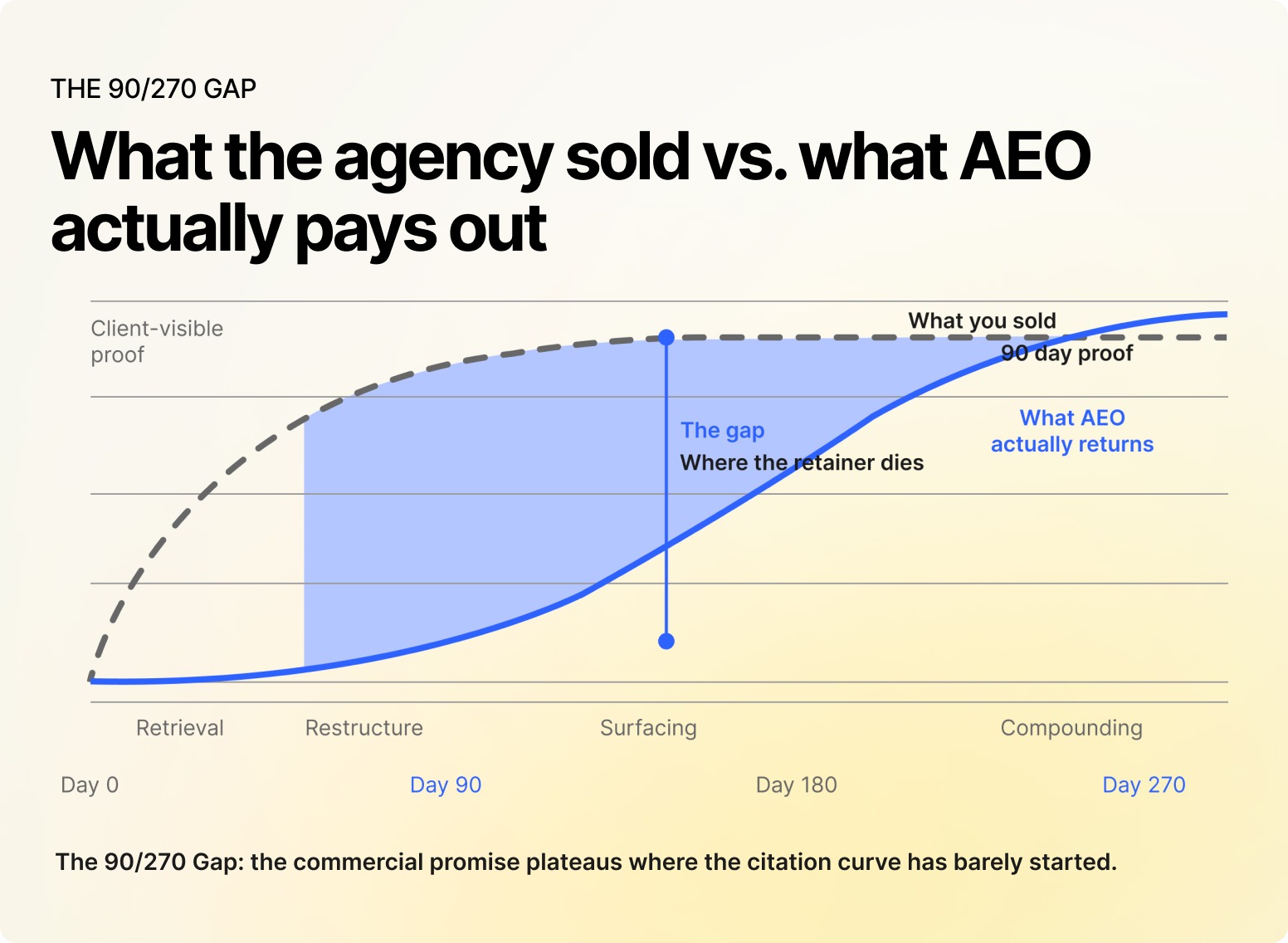
The timeline is layered, and each layer moves at a different speed. Technical changes (schema, llms.txt, server-side rendering, crawler access) produce measurable effects in roughly two to four weeks. Citations across ChatGPT, Gemini, and Perplexity typically start surfacing between 8 and 12 weeks, and durable citation authority builds over 6 to 12 months as engines re-index (UnoSearch, 2026).
Goodie AI maps a similar curve from client work; first AI mentions inside weeks one and two but volatile, citation patterns stabilizing across months two and three, compounding visibility from months 3 to 6, and stable, measurable ROI only after month six.
The 90/270 gap (Mavlers Agency framework)
We call this the 90/270 gap, which is the distance between the 90-day proof window an agency sells on and the 270-day compounding window AEO actually runs on. Every underperforming first-year AEO team we have audited was losing money and credibility inside that gap, not outside it.
Why does AEO fail inside agencies?
Here are the four reasons, ranked by how often we see them in delivery audits.
- The team is one person. AEO execution requires technical implementation, content restructuring, off-site entity work, and measurement to run in parallel. A single specialist sequences them. Sequencing is what makes year one slow.
- There is no baseline. Teams start optimizing before recording where the brand stood across engines. Without a pre-work baseline, month-six reporting has nothing to compare against.
- Reporting is borrowed from SEO. Large language models are probabilistic; the same prompt returns different answers to different users at the same moment. Neil Patel’s team frames the failure precisely: measuring a probabilistic system with deterministic tools produces data that looks clean but does not reflect how the system behaves.
- Nobody separates AEO from GEO internally. AEO, winning the direct answer, moves fast. GEO, being cited inside longer generative responses, moves slowly and depends on off-site signals. Selling both as one line item lets the slow half drag down the fast half’s reputation.
Why are agency AEO teams slow to deliver results?
There are three bottlenecks which are all fixable at contract stage.
- Client-side implementation queues. Schema and rendering changes sit in dev backlogs. Agencies that do not secure implementation access at signature lose four to six weeks immediately.
- Prompt sets built from keyword tools. The average US Google query runs about 3.4 words, while the average ChatGPT prompt with web search switched off runs about 23 words (Semrush, 2025). Keyword-derived prompt sets test what Neil Patel’s team calls a user who does not exist with no context, history, or specific intent.
- No off-site motion. Citation share is built partly on third-party mentions. Teams that only touch the client’s own site hit a ceiling by month four.
What mistakes do agencies make when building an AEO team?
Interestingly, the mistakes are commercial rather than technical.
- Adding AEO as a fifth service instead of replacing something. Promethean Research’s 2026 State of Digital Services found that agencies which reduced their service mix in 2025 grew 13% on average and posted 30% net margins, around triple the net margin earned by agencies that expanded their service mix. Bolting AEO on without retiring anything is the most reliable way to gut your margin.
- Underpaying for genuinely scarce talent. Kaleigh Moore’s July 2026 analysis of AEO job postings found AEO has separated into a discipline with its own titles and its own budget lines, with roles such as Experian’s AEO and SEO Manager posted at $100,000 to $174,000. Her read on where the money lands: agency-side roles skew lower, in-house brand roles skew significantly higher. You are recruiting against brands with deeper budgets for a skillset barely 24 months old.
- Buying tools before writing a methodology. G2’s Answer Engine Optimization category went from 7 products to more than 150 in ten months, over 2,000% growth since March 2025. Tools tell you where you stand. They do not create a delivery process.
- Promising citations. You cannot promise placement inside a system you do not control. Promise prompt coverage, retrieval readiness, structural completeness, and measured directional movement. On that note, please read ~ 8 AEO mistakes costing you margins.
How should an agency build an in-house AEO team?
Build the pod before you build the pipeline. Building an AEO team as a single hire is the founding error.
If you are wondering what roles are required for an AEO team, well, four roles are required, and two of the four can be shared with existing SEO and content pods.
AEO is engineering work with a marketing outcome. Staff it that way.
How do agencies structure an AEO team?
Two AEO team structures work, while a third, the “everyone does a bit of AEO” model, never does.
- Embedded pod (under 30 FTE, Full-Time Equivalent): AEO roles sit inside the existing SEO team with hours ring-fenced. Cheaper, faster to launch, vulnerable to hours being raided by business-as-usual SEO.
- Standalone practice (30+ FTE): separate P&L, its own utilization target, a named methodology owner. Slower to stand up, but the only structure that survives a busy quarter.
Ring-fencing matters more than the org chart. The single most common cause of a stalled AEO team is its hours getting eaten by urgent SEO work in month two.
Is it better to outsource AEO services?
For most agencies in year one, partially yes. Here is the honest in-house AEO vs outsourcing comparison.
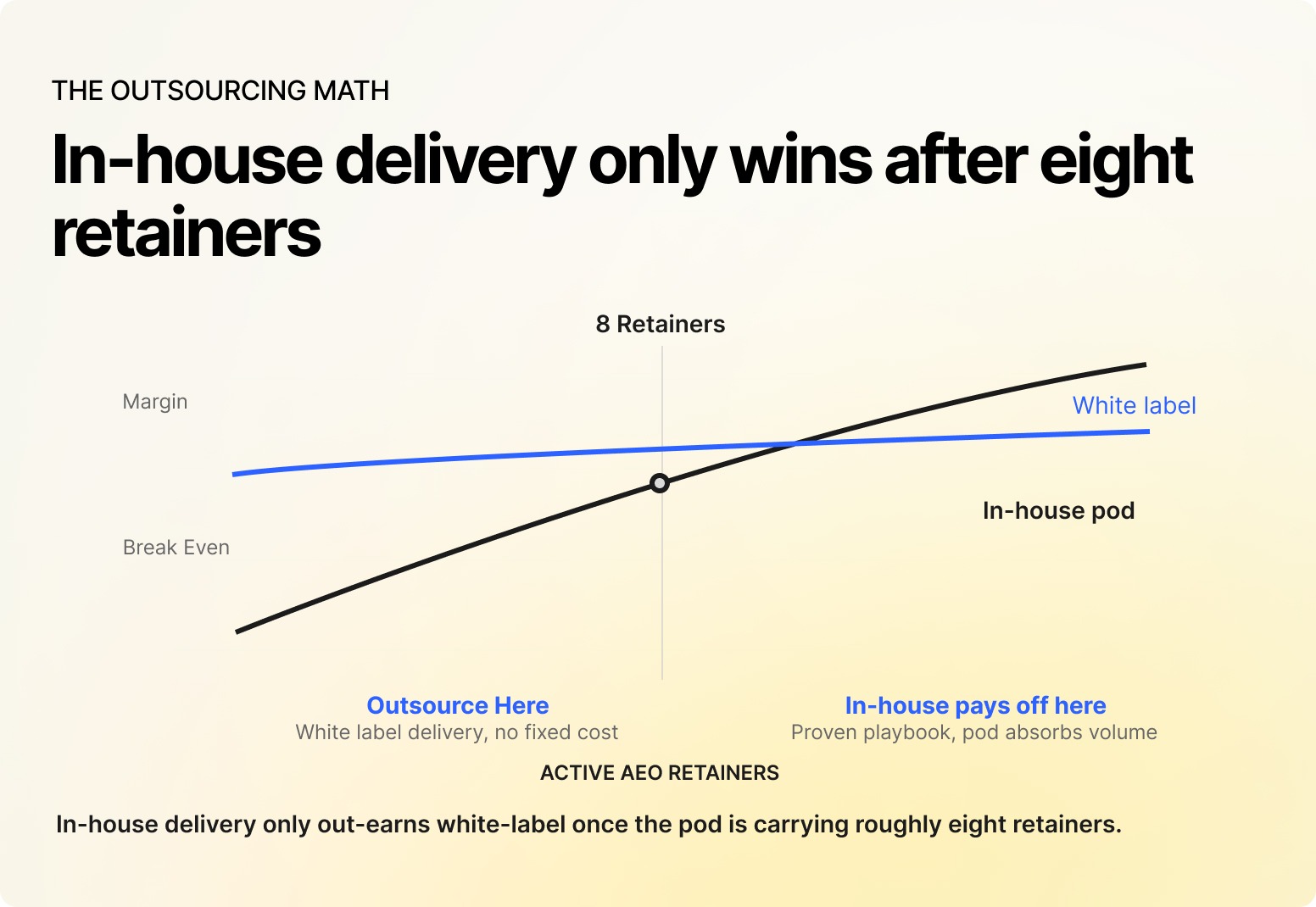
The hybrid is simple: strategy, positioning, and the client relationship stay with you, while AEO execution runs through a white-label AEO and GEO delivery partner until you have eight to ten accounts and a documented playbook. Then you in-house delivery with a proven process instead of a hypothesis.
How do agencies scale AEO delivery?
It is recommended to scale the artifacts, not the headcount.
- Standardize the audit. One 40-point retrieval audit producing the same output every time. Variable audits mean variable margin.
- Template the answer layer. Definition blocks, FAQ schema patterns and atomic-fact formats should be reusable components, not per-client invention.
- Fix the prompt-set process. Thirty to fifty prompts per client drawn from sales calls and support tickets, sampled repeatedly rather than once. A single query is a dice roll, not a data point.
- Report on one fixed index. Build a single composite visibility score so clients compare against last month, not against a competitor’s screenshot.
- Retire what AEO replaces. Fold low-margin legacy technical SEO deliverables into the new offer rather than running both.
How can agencies launch AEO services successfully?
The 90-day sequence we run with agency partners:
- Days 1 to 30: Pick one vertical. Build the audit and the prompt-set process. Run both on your own site first, so the first case study is yours.
- Days 31 to 60: Deliver to two existing clients at cost, in exchange for baseline data and permission to publish results.
- Days 61 to 90: Price on staged outcomes: retrieval readiness at day 30, structural completeness at day 90, citation movement at day 180.
- Day 90+: Sell 9-month contracts with a 90-day proof gate, instead of a three-month pilot. A three-month pilot guarantees you are judged during the Restructure phase, when the data is at its noisiest.
FAQ
1. How long before an in-house AEO team is profitable?
Typically months 10 to 14 with a four-role pod carrying eight or more accounts.
2. Can we retrain existing SEO staff instead of hiring?
Yes for the Answer Architect and Visibility Analyst roles, because those are extensions of skills your content and analytics people already have. The Relevance Engineer role usually needs a technical hire or a technical SEO with real implementation experience.
3. What is the minimum client count that justifies an in-house AEO team?
8 active retainers. Below that, white-label delivery is more profitable and materially less risky.