







Table of contents
Get in touch
Expect response in 4 hours.

Agency owners love talking about growth. More revenue. More people. More clients. More services. And, in 2026, inevitably, more AI.
Profitability gets discussed too - but usually in the vague, reassuring way: “We’re profitable.”
Okay. But by how much?
What’s left after salaries, contractors, software, tools, office costs, and the overhead that quietly eats into every dollar you bring in?
We wanted the unvarnished answer. So we asked more than 200 agency leaders what their fully loaded net margin really looks like, which services are profitable and which aren't, what are they doing about it?
The result: a set of agency margin benchmarks that shows which services are making money- and which are merely keeping people busy.
The average? 12.3% net.
Here's what they told us. Including the parts they were reluctant to admit.
How was this agency margin research data collected?
For this agency margin research, we asked more than 200 agency founders across the US, UK, and Australia to show us the number that matters: their fully loaded net margin.
The research combined conversations with agency owners at industry events such as the BABA Summit, our agency partner network, and a structured profit margin survey.
We deliberately asked for fully loaded margins - not the rosier gross or project-level numbers.
And there was an important catch: roughly three-quarters of respondents gave us an estimate rather than a recently calculated figure. We recorded those separately rather than pretending the numbers were more precise than they were.
What is the average agency profit margin in 2026?
The short answer: 12.3% net.
.webp)
That is the average across the agencies in our agency profit margin survey - after salaries, contractors, software, account management, revisions, project overruns, office costs, and the founder’s time are accounted for.
A service showing a 40% gross margin can look very different once the hours behind client calls, project management, rework, and delivery delays are counted.
Our agency margin research produced these practical agency margin benchmarks:
At 6%, one lost client or unexpected hire can create a serious cash-flow problem. At 27%, the business has room to invest, hire, absorb a bad month, or pay the founder properly.
But the more revealing agency profitability insights were hiding behind the averages.
Many owners had a sense of their margin without knowing the number with confidence.
- 61% had only a rough idea of their fully loaded margin.
- Just 23% had calculated it properly within the previous six months.
.webp)
Agency owner survey showing that 61% had only a rough idea of their fully loaded margins, 23% had calculated them properly, and 16% had not looked at them.
That points to one of the most persistent agency owner margin challenges: you cannot fix a margin you cannot see.
It also explains some of the agency owner profitability concerns that surfaced in the research. The hidden margin problems are often not hidden at all - they are difficult to quantify: too much unbilled work, too many services, underpriced accounts, or senior people spending hours on delivery.
And that may be the clearest answer to what founders fear about profitability: not that the margin is low, but that they might finally calculate it and discover how low it really is.
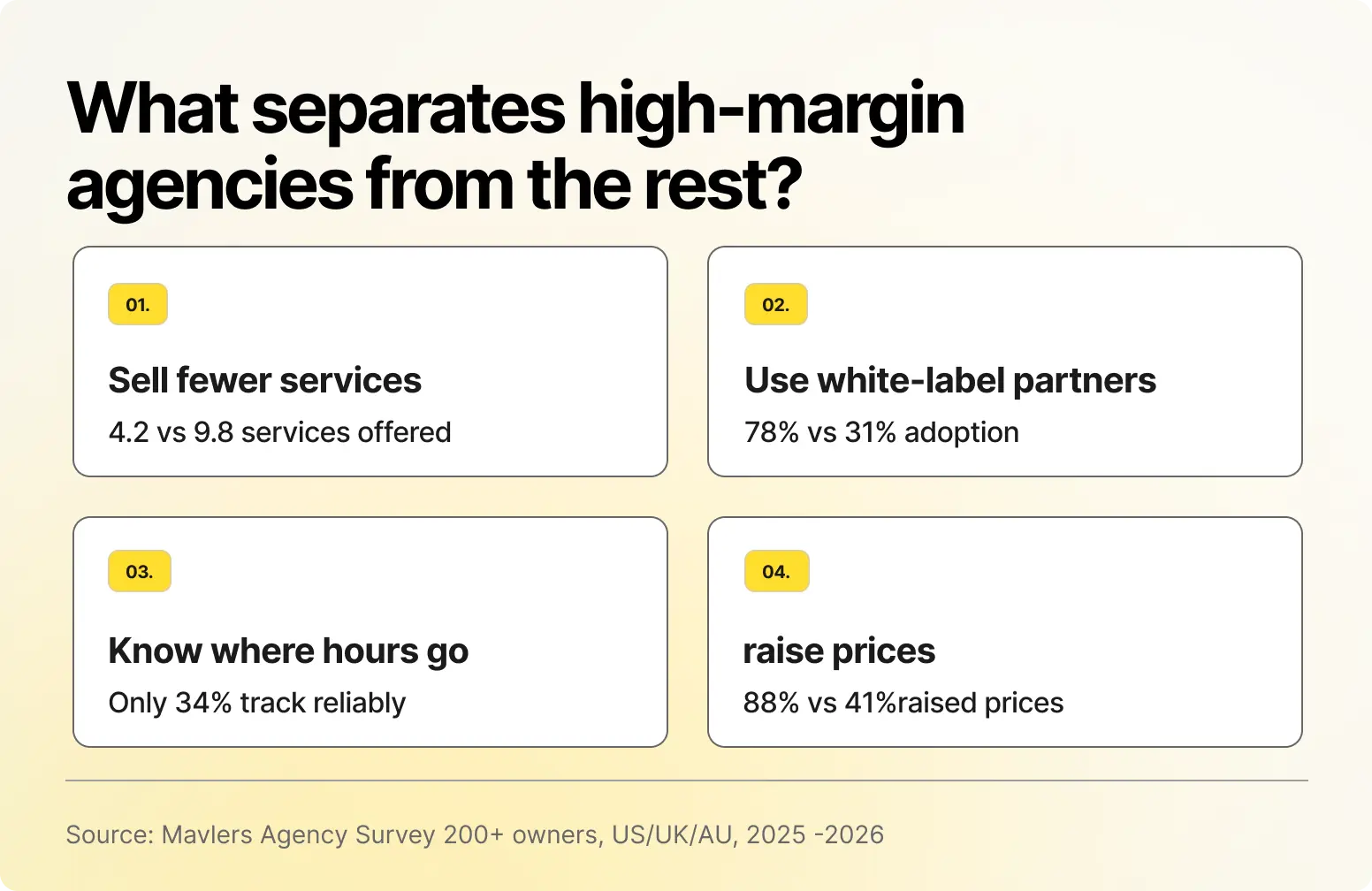
What separates high-margin agencies from the rest?
The agencies at 27%+ were not simply working harder, selling more, or chasing bigger clients. They were making a handful of decisions that the 12% agencies were not.
1. High-margin agencies sold fewer services
The 27%+ agencies offered an average of 4.2 services.
The lowest-margin agencies? 9.8. Almost ten services.
That sounds impressive in a capability deck. But less impressive when every service needs its own people, tools, processes, training, reporting, quality checks - and eventually, its own little collection of “while you're at it” requests from clients.
More services create more complexity. Complexity creates more places for agency margin to leak.
Promethean Research found a similar pattern in its own agency research: agencies that cut services grew fastest and reported average net margins of around 30%.
So one of the clearest agency profitability insights from our survey is also one of the least glamorous: sometimes the route to better agency profit margins starts with taking things off the menu.
One agency owner in Chicago described the change this way.
2. High-margin agencies didn't insist on doing everything themselves
Among agencies above 25% margin, 78% used white-label partners for at least one service line.
Among agencies below 15%, that figure was 31%.
The data doesn't prove that white labelling creates higher margins. It may also be that financially disciplined agencies are simply more comfortable deciding what belongs inside the business - and what doesn't.
But the pattern was hard to miss.
The higher-margin agencies tended to keep strategy, client relationships, positioning, and creative direction close. For execution that was expensive or inefficient to build internally, they used specialist partners.
That is a more useful way to think about white labelling. Not “We're too busy, so let's outsource.”
More like: “Is this capability worth owning?” That question can save an agency a surprising amount of money.
3. High-margin agencies knew where the hours were going
Only 34% of agencies in our sample had time tracking detailed enough to calculate a reliable margin by service line.
The rest were estimating.
And estimation has a funny way of making everything look slightly better than it is.
Of course, agencies with better visibility don't automatically fix margins. However, they surely have a clearer view of what’s happening. And agencies with access to real-time reporting are more likely to maintain healthy margins, says the State of the Agency Business.
The agencies with better visibility weren't necessarily tracking every six-minute increment of the day. They simply knew enough to answer questions such as:
- Which services regularly run over budget?
- Which clients generate the most unbilled work?
- Which deliverables need too much senior attention?
- Which projects looked profitable in the proposal and quietly stopped being profitable during delivery?
That visibility is one of the biggest agency owner margin challenges we found.
Because when you don't know where the hours go, revenue becomes an awfully convenient stand-in for performance.
It isn't.
A service can grow. The team can stay busy. The pipeline can look healthy. And the margin can still be disappearing.
4. High-margin agencies raised their prices
88% of the highest-margin agencies had raised prices in the previous 12 months. Among the lowest-margin agencies, only 41% had.
The fear here is familiar. Lose a client. Damage the relationship. Give the competitor an opening.
Those are real agency owner profitability concerns.
But there is another number worth knowing before you decide to hold the line on price: your contribution margin by client.
Because protecting a client who barely makes money isn't quite the same thing as protecting the business.
And that may be the uncomfortable thread running through the benchmarks: the hidden agency margin problems aren't usually hidden because nobody knows they exist.
Owners often know.
They know which service is a headache. Which client takes too much time. Which price hasn't moved in three years. Which capability exists mostly because it looks good on the website.
The harder part is doing something about it.
That is also what sits underneath what agency owners fear about profitability.
Not necessarily discovering that the margin is low. Discovering that they already knew.
Which agency services are most profitable in 2026?
.webp)
We asked agency owners a slightly uncomfortable question: Which of your services actually makes money after the work is done?
Not the margin in the proposal. Not the number that looks good in a sales deck. The margin after salaries, delivery time, revisions, management, and all the other costs that have a habit of turning up later.
The results from our agency profit margin survey make one thing clear: not all services are created equal.
Strategy came out on top in our agency profitability benchmark. Social management, basic reporting, and social graphics landed at the other end of the table.
That isn't particularly surprising once you look at how the work gets sold.
Strategy is harder to commoditize. It depends less on production hours. And when it is positioned well, clients are paying for judgement rather than a list of tasks.
Basic social work and reporting have a different problem. They tend to arrive as “small” recurring requests. A post here. A dashboard there. One more revision. One more version.
Small work has a way of becoming very large when nobody is counting it.
The middle of the table is where things get interesting.
SEO, content, and paid media can all be profitable. They can also become expensive when every client gets a custom process, every task stays in-house, and pricing is still based on assumptions made years ago.
That is where some of the agency margin benchmarks become useful. A service does not need to be the most profitable service on the list to deserve a place in your business. It needs a delivery model that makes economic sense.
And sometimes that means asking a question agency owners don't always enjoy:
Should we really be doing this ourselves?
For some agencies, the answer will be yes. For others, the numbers may make a strong case for a specialist or white-label partner.
That is one of the more practical profitability insights from the agency margin research: the service itself isn't necessarily the problem. The way you price, staff, scope, and deliver it might be.
Many of the hidden agency margin problems aren't hiding in the service list. They're hiding in how the work gets done.
What did agency owners admit about their financial health?
The most revealing answers were not the percentages. They were the admissions, more candid than we had any right to expect. This is what leaders fear about profitability when nobody's listening.
“I have not taken a salary in four months because I needed to make payroll for the team. I tell everyone we are growing. We are. The margin just has not caught up yet.”
“We have a service on our deck that we have not actually delivered in two years. We keep it there because it looks good in pitches.”
“I know our content service loses money. I have known for eighteen months. I keep telling myself we will fix the process. We have not fixed the process.”
“We raised our prices last year and lost two clients. Both were our lowest-margin clients. I wish we had done it three years earlier.”
The agency margin research suggests that owners often know where the pressure is coming from. The harder part is acting on it.
It is easier to:
- Keep an unprofitable service on the website than explain why it is gone.
- Keep a low-margin client than have the pricing conversation.
- Promise to fix a broken process than measure whether it actually improved.
That is where some of the hidden agency margin problems become expensive.
The loss accumulates in underpriced projects, unpaid work, excess senior time, and service lines the agency is not equipped to deliver profitably.
How do you calculate fully loaded agency profit margin?
To calculate a fully loaded agency profit margin, you must divide your Fully Loaded Net Income (Revenue - All Costs) by your Agency Gross Revenue, then multiply by 100.
Step 1. Pick one service line
Start with whichever one you already quietly suspect.
Step 2. Calculate gross revenue
Sum all incoming revenue before any deductions. Include all client retainers, project fees, and hourly billings.
Step 3: Total your fully loaded expenses
For a truly "fully loaded" picture, your expenses must include:
- Direct labor: Salaries, benefits, and payroll taxes for billable delivery staff and freelancers.
- Operating overhead: Rent, software subscriptions, insurance, legal fees, and marketing.
- Administrative labor: Salaries for non-billable roles (HR, internal finance, management).
- Market-rate owner compensation: If the owner takes a low salary and relies on profit distributions, adjust this number to reflect what it would actually cost to hire a non-owner CEO to do the same job.
Step 4: Apply the formula
Subtract your fully loaded expenses from your revenue to find your true net profit. Then, calculate the final percentage.
If the number is below 20% on any service line, that service is a candidate for white labelling or retirement. Because delivering it in-house is costing you more than the alternative.
If the number is below 10%, that service is losing you money and you are subsidising it from the services that are working.
Frequently asked questions
What is a good net profit margin for a digital agency?
In our agency profit margin survey, the overall average was 12.3%, while the top quartile reached 27%+. A margin above 20% is a useful target for an established agency, but the right benchmark depends on its service mix and delivery model.
When should agencies use white-label partners?
When a service is commercially valuable but expensive or inefficient to maintain internally. The decision should come from the economics of delivery, not simply from a team being busy.
Can AI improve agency profitability?
Yes - but only if the time saved becomes better margins, faster delivery, or higher-value work. If AI simply allows the agency to absorb more unpaid scope, the margin problem remains.
Not sure which services to keep and which to white label?
We help agencies identify loss-making services, audit delivery margins, and shift low-margin execution to specialist white-label teams without disrupting client relationships.
Further reading:


.webp)