







Table of contents
Get in touch
Expect response in 4 hours.
.png)
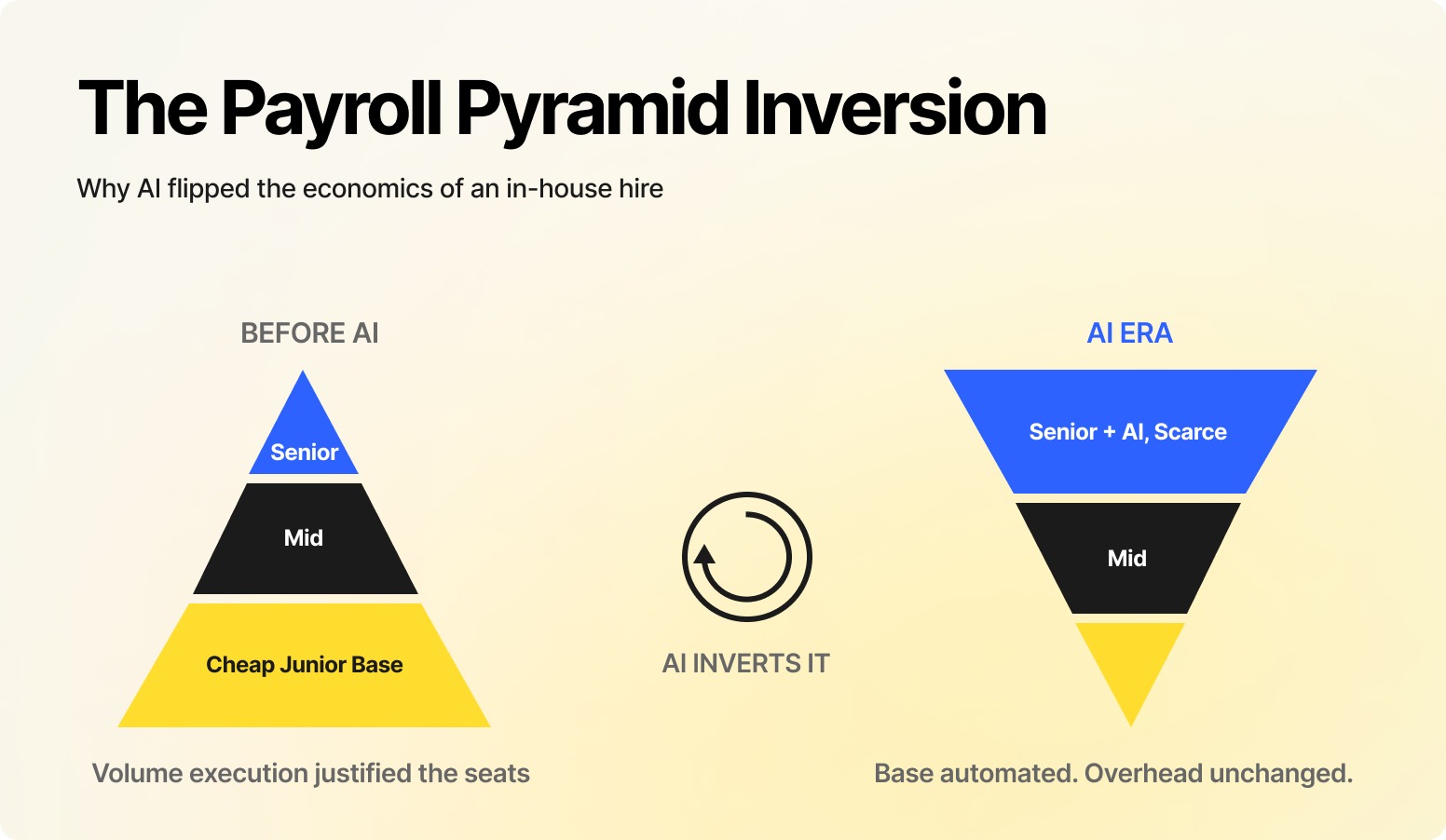
AI has quietly broken the math that once made an in-house marketing hire worth it.
The junior-level production work that used to justify a full-time seat is now among the cheapest things generative AI does, yet the fully loaded cost of that seat has not moved.
That is the short answer on AI and in-house hiring in 2026; the technology automated the bottom of the org chart without lowering the cost of employing it, and that gap is why the dedicated team model is winning the reshuffle.
This piece breaks down the AI impact on in-house hiring, why hiring senior-only does not fix it, and how a dedicated team absorbs the shift. You will leave with the cost lens we use with clients, a four-model comparison of dedicated teams vs in-house hiring, and a test for when to hire versus when to embed.
What did in-house hiring economics look like before AI?
For 20 years, the in-house team ran on a simple pyramid. You paid one senior strategist to think, then hired several lower-cost juniors to execute the volume: the briefs, the first drafts, the reporting decks, the campaign QA. The economics worked because execution labor was cheap relative to the output it produced, and the fully loaded cost of those juniors was easy to justify against the hours they filled.
That fully loaded cost matters more than most founders admit. Fully loaded cost means everything an employee costs beyond base salary, such as payroll taxes, benefits, tooling, recruitment, onboarding, and management time.
MIT Sloan senior lecturer Joe Hadzima puts salary plus benefits and payroll taxes at 1.25 to 1.4 times base pay, and the figure rises toward 2.5 to 2.7 times once rent, equipment, tooling, and management time are layered in.
A single mid-level SEO or content hire at an $80,000 base rarely costs less than $110,000 to keep. A fully staffed team of five, according to 2026 estimates from Datamatics, runs $600,000 to $900,000 a year before a dollar reaches actual campaigns.
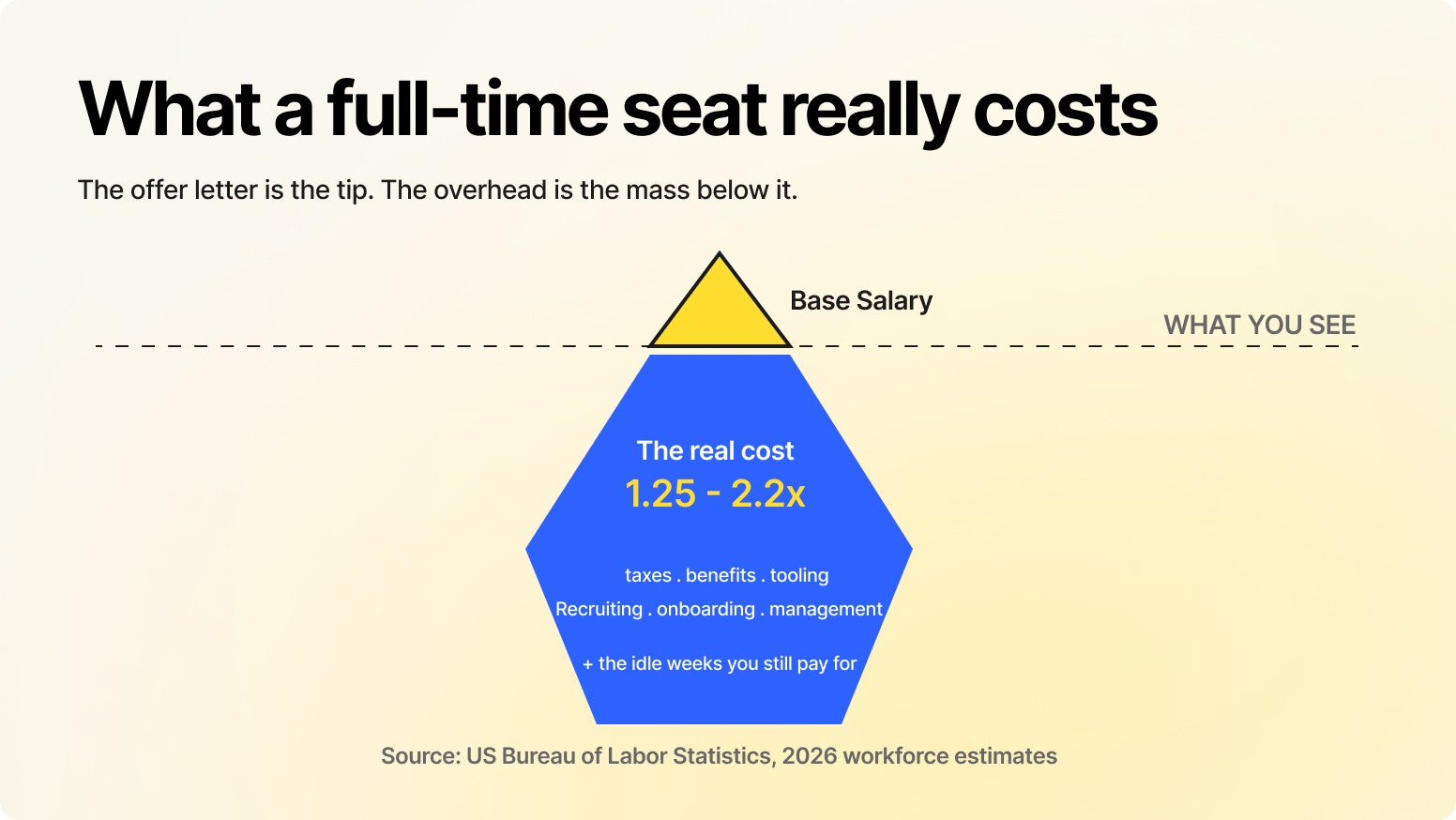
The pyramid tolerated that overhead because the base carried real work. AI removed the work without removing the overhead.
How is AI breaking the math on in-house marketing hires?
The productivity gain is now measurable, and it lands on exactly the tasks that used to justify junior headcount. Net marketing headcount is roughly flat, but the composition has moved as the base shrinks, and the top gets scarcer and more expensive.
Pay data confirms where the value moved. PwC's 2026 Global AI Jobs Barometer found that workers in AI-skilled roles commanded a 62% wage premium over comparable roles without those skills. Seniority plus AI fluency is the asset that appreciated, while everything below it depreciated.
Forrester named the underlying dynamic directly, predicting a structural inversion, a move away from less costly junior talent matched to senior managers, toward high-paid creator skill sets paired with generative AI assistants. It sized the direct automation impact at roughly 32,000 US agency jobs by 2030, concentrated in clerical, sales, and market research roles.
The Payroll Pyramid Inversion (our lens for this)
We call the resulting problem the Payroll Pyramid Inversion, and it is the cleanest way to see why in-house hiring got expensive without anyone raising a salary:
- The base got automated, not cheaper to employ. AI does the junior tasks, but a junior employee still costs their full-loaded amount whether AI does the work or they do.
- The apex got scarcer. The senior, AI-fluent operator you actually need now sits inside a 62% wage premium and a hiring market where everyone wants the same person.
- You cannot buy half a pyramid. In-house forces you to either overpay for a base AI made redundant, or hire only apex talent you cannot realistically staff, retain, or keep busy year-round.
Key takeaways
- AI compressed the cheap layer of the org chart and inflated the expensive one.
- Fully loaded cost did not fall to match the automated work.
- In-house hiring now asks you to fund a structure the technology already reorganized.
Why doesn’t hiring only senior in-house specialists fix it?
The obvious response is to skip juniors and hire senior, AI-native operators outright. However, it fails for reasons that are structural, not budgetary.
- Scarcity and price. The exact profile you want commands a premium of roughly 25 to 45% over base pay for specialized skills (Rise, AI Talent Salary Report 2026), and 72% of employers globally report difficulty finding skilled talent (ManpowerGroup, 2026 Global Talent Shortage Survey). You are bidding against every other company that read the same memo.
- Retention risk. Senior specialists move. When one leaves, institutional knowledge and active campaigns leave too, and replacing a senior hire costs roughly six to nine months of their salary in recruitment and ramp (SHRM).
- Single-threaded exposure. One senior generalist cannot cover technical SEO, paid media, lifecycle email, GEO, and analytics at depth. Modern marketing needs a bench, and a bench of seniors is the most expensive thing you can build.
- Utilization gaps. You rarely need a paid-media lead or a technical SEO at full capacity every week. Full-time seats bill you for the idle weeks too.
Hiring only seniors solves the capability problem and multiplies the cost and fragility problem. That is the wall most in-house builds hit around the third or fourth specialist.
Why do dedicated teams benefit from this shift?
A dedicated team is a group of specialists who work exclusively on your account, embedded in your tools, standups, and Slack, while the provider carries employment, tooling, retention, and management overhead. You direct the work; however, you do not own the payroll.
The model benefits from the Payroll Pyramid Inversion because it was already shaped like the answer. A dedicated team gives you a senior-led, AI-equipped pod on a variable cost, without asking you to fund a junior base or gamble on a single senior hire. When your channel priorities shift from paid to GEO, you swap the seat rather than manage a layoff.
The ANA’s In-House Agency report shows 82% of major marketers built in-house capability, up from 42% in 2008, precisely for control and brand intimacy. The dedicated team model preserves that intimacy and drops the fixed overhead that the AI shift made hard to justify.
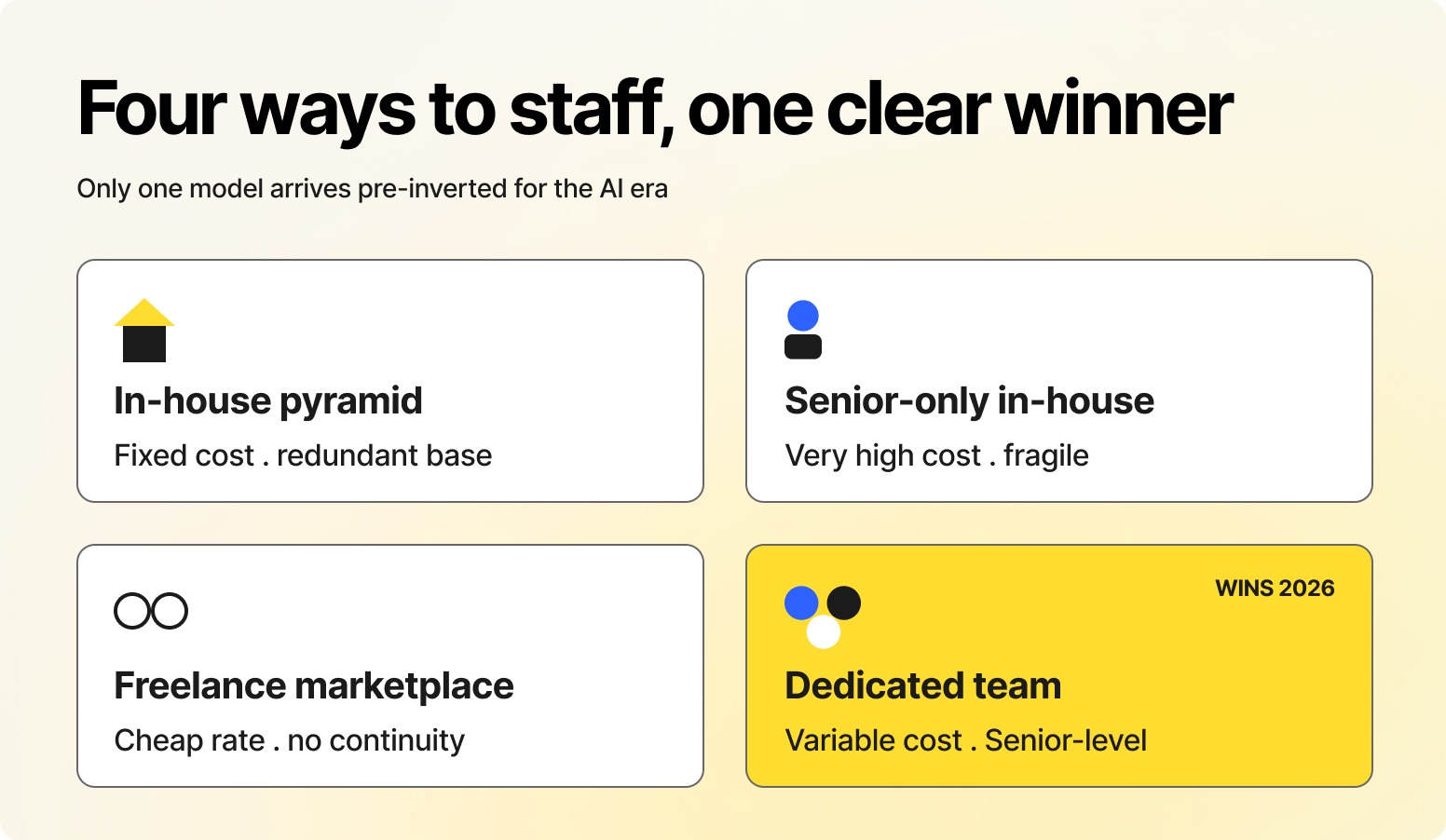
Here is how the four common staffing models compare against the inverted economics:
A pattern from our own book
Across our dedicated team engagements, the recurring outcome is a materially lower blended cost than an equivalent in-house build, because clients stop paying for redundant execution capacity and idle weeks. In our dedicated-team engagement with Ogilvy Social.Lab, the model delivered roughly 35% in cost savings versus in-house hiring in global hubs while scaling the team from 1 to 20 specialists in under four months and keeping senior firepower on delivery.
Key takeaways
- The dedicated team model is the only structure that arrives pre-inverted.
- It hands you the senior, AI-fluent capability that appreciated in value.
- It removes the junior overhead AI made redundant and shifts retention and tooling risk to the provider.
When should you still hire in-house versus use a dedicated team?
This is not a case for never hiring. Sound AI-powered workforce planning still keeps some roles in-house. We recommend using the Loaded-Seat Test, three questions to run before you open a full-time role.
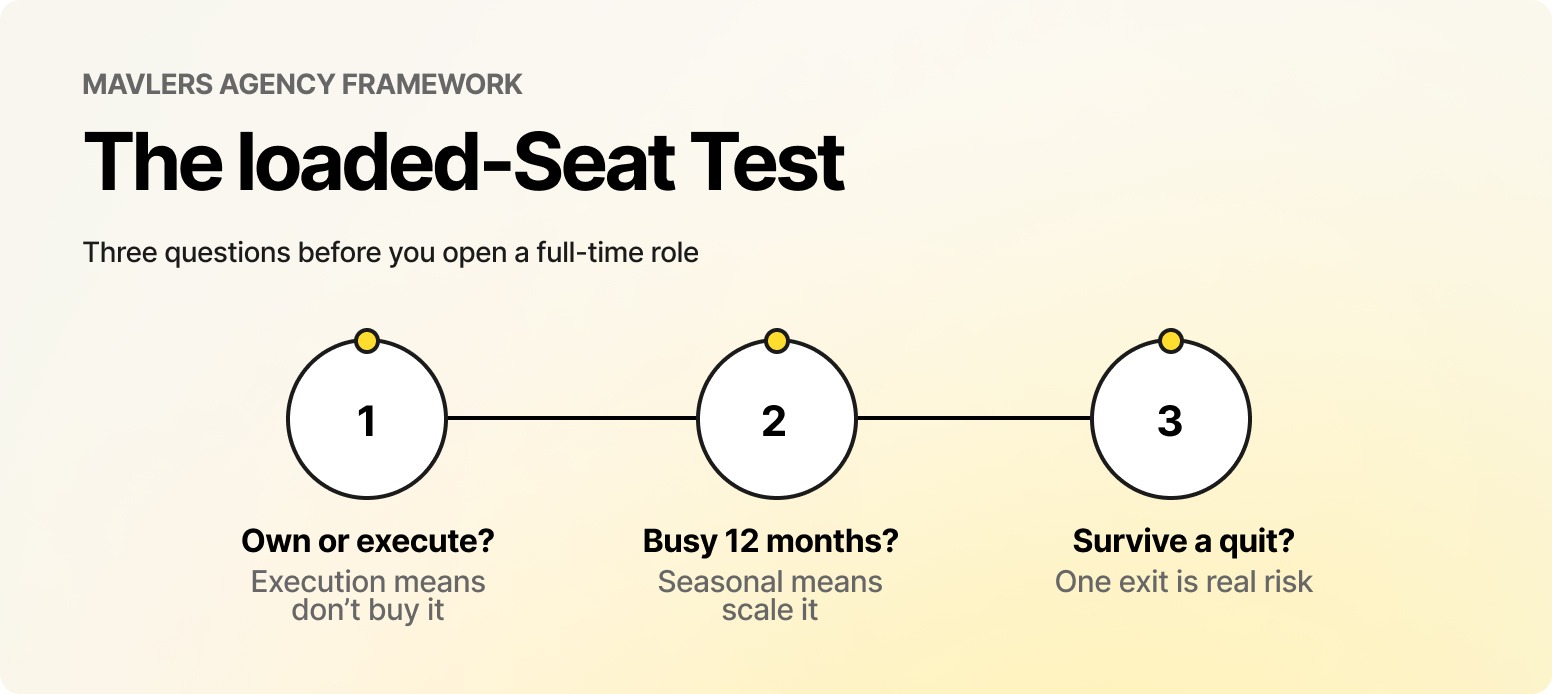
- Is this role executing or owning? If the work is primarily production, AI now accelerates; a full-time seat overpays for it. If the role owns strategy, brand, and cross-functional decisions, keep it in-house.
- Can you keep it busy at senior level for twelve months? If utilization is seasonal or channel-dependent, a dedicated seat you can scale beats a fixed hire.
- Can you absorb the day it leaves? If one departure stalls campaigns, you have single-threaded risk a dedicated team is built to prevent. On that note, we recommend reading ~ How many clients are you one resignation away from losing? (Agency audit).
The strongest 2026 setup is usually a hybrid where you keep one senior in-house leader to own strategy and brand, then build execution through a dedicated marketing team across SEO, AI search visibility, paid, and lifecycle. You get in-house dedication without in-house overhead.
FAQs
Is a dedicated team just outsourcing with a nicer name?
No. Outsourcing typically hands a project to a vendor-managed team you do not direct. A dedicated team works only on your account, inside your workflow and cadence, while you set priorities and review output. The distinction is ownership and continuity rather than headcount.
Does AI make agencies unnecessary since I can use the tools myself?
AI compresses execution, but it does not supply the senior judgment, strategy, and quality control that now carry the value. The AI wage premium exists because that judgment got scarcer, not more abundant. AI lowers the cost of producing the work, not the cost of knowing which work is worth doing.
How much can a dedicated team actually save versus in-house?
It depends on role mix and how many redundant execution seats and idle weeks you remove. In our own Ogilvy Social.Lab engagement, the model delivered roughly 35% in cost savings versus in-house hiring in global hubs. The mechanics are straightforward: you stop paying the fully loaded multiplier (1.25 to 1.4 times base, per MIT's Joe Hadzima) on execution roles AI has already compressed, and you shed benefits, which run about 30% of total compensation on their own (US Bureau of Labor Statistics, 2026).
Will AI eventually replace dedicated teams too?
AI is already embedded inside them. A well-run dedicated team is AI-equipped by default, which is the point: you are buying the senior operators who direct the AI, not the manual labor it replaced.
The move worth making in 2026 is to stop pricing marketing capacity by the seat and start pricing it by the outcome. AI has already reorganized the marketing org chart, and the dedicated team model is the staffing structure that reorganized alongside it.
Suggested further reading
You might now be interested in exploring: Should you hire in-house or outsource? 6 services where dedicated teams deliver faster ROI.