White label

Healthcare SaaS brand rebuilds consent, tracking, and attribution

Project Overview

Organization

Enterprise digital health & wellness provider

Industry

Healthcare / Wellness / Digital Health SaaS, operating across the United States and the European Union

Regulatory Frameworks

GDPR, ePrivacy Directive, CCPA/CPRA, and HIPAA guidance on digital tracking technologies

Platform Ecosystem

HubSpot Enterprise + Cookiebot CMP + GTM

Integration Type

Consent and compliance integration, delivered white-label

Products / Services Used

  • Consent Management Architecture
  • HubSpot Enterprise Development
  • Cookiebot CMP Implementation
  • GTM Consent Mode v2
  • Privacy Engineering
  • Compliance Workflow Automation

The client faced the compliance-versus-attribution paradox in its sharpest form. As a digital health provider, it operates under the strictest privacy frameworks in existence, and its visitors search for sensitive topics like mental health support, where unconsented tracking carries the gravest regulatory risk.

At the same time, its growth depended on paid acquisition across Google, Meta, and LinkedIn, which had scattered tracking pixels, behavior recording scripts, and automation tags across the site. An internal audit found the infrastructure fundamentally non-compliant: tracking fired before consent, exposing the company to fines of up to 20 million Euros or 4% of global annual turnover. The mandate was to fix compliance completely without blinding the marketing team.

Performance Insights

Key results for the client

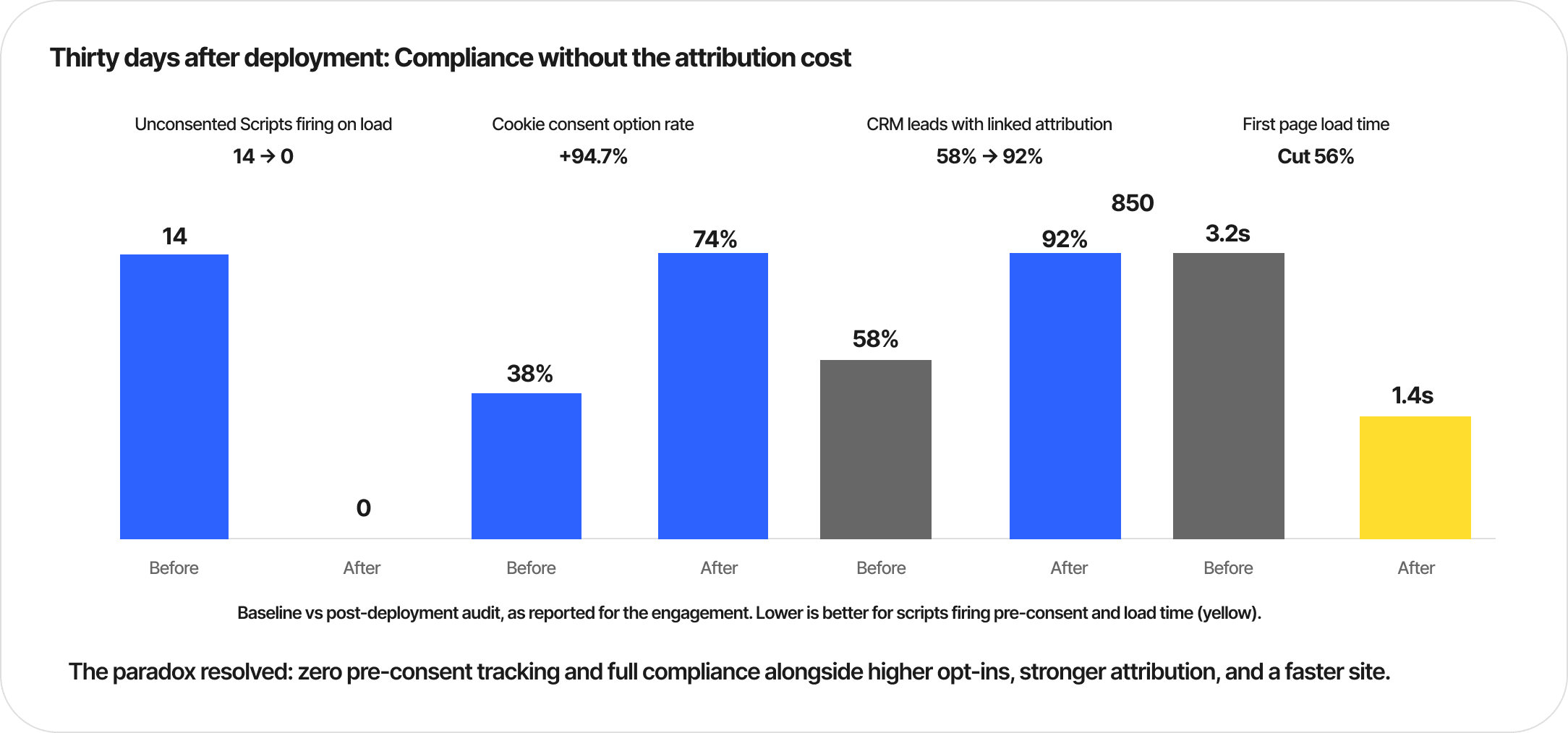
14 → 0

Unconsented tracking scripts firing on load

38% → 74%

Cookie consent opt-in rate (+94.7%)

92%

CRM leads with linked attribution, up from 58%

30 days

To verified GDPR, CCPA/CPRA, and ePrivacy compliance

Client Objectives

The challenges the client faced

1.
Tracking leaks and regulatory exposure

Marketing scripts, including the HubSpot tracking code, Meta Pixel, and Google Analytics, executed immediately on page load, before any banner interaction. The baseline audit found 14 tags firing without consent and a failing compliance score, in a healthcare context where the stakes are highest.

2.
An all-or-nothing consent bottleneck

The legacy banner was binary, blocking everything or unblocking everything. Users who would happily allow functional cookies but not advertising pixels had no middle option, and the intrusive design held opt-ins to 38%.

3.
A consent banner that never spoke to the CRM

Banner choices lived only in the browser. A user who opted out and later submitted a demo form generated a HubSpot contact with no tracking history, leaving 42% of incoming CRM leads marked "Unknown Source" and campaigns impossible to attribute.

4.
Script fire chaos

Engineering and marketing teams had hardcoded tags into individual page code panels and GTM without proper triggers, 28 unique tags across 4 departments, so tags kept firing in the background regardless of what the banner claimed.

5.
Compliance blocking the sales pipeline

Institutional enterprise partners, including large healthcare networks and corporate wellness insurers, run privacy reviews the client could not pass, which kept entire sales pipelines closed.

Mavlers Strategy

How we built the zero-trust consent middle layer

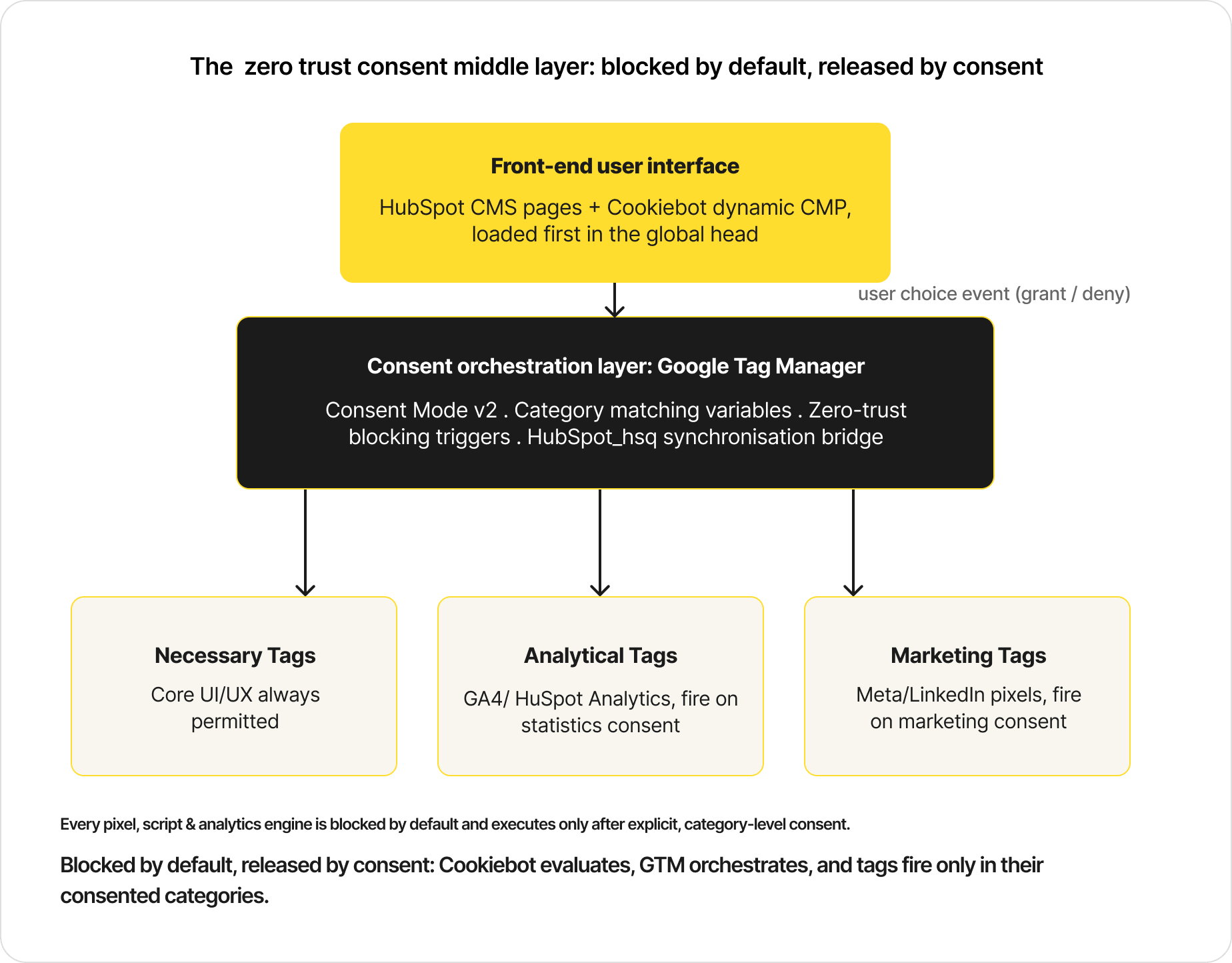
Our engineering philosophy treats every marketing pixel, behavioral script, and analytics engine as blocked by default. Scripts execute only after a verified user grants explicit consent, parsed by Cookiebot and routed in real time through Google Tag Manager and the HubSpot CRM API.
1.
Installed the edge consent gatekeeper

Cookiebot's engine injected as the first element in the HubSpot CMS global head, in automatic blocking mode, scanning and classifying every cookie and intercepting all tracking before page rendering.

2.
Orchestrated tags through GTM Consent Mode v2

Cookiebot pushes standardized consent events into the dataLayer, and GTM maps categories (preferences, statistics, marketing) to conditional firing, with a custom consent-enforcer wrapper for legacy tags that don't support Google's consent API natively.

3.
Built the HubSpot consent bridge

A client-side JavaScript bridge mirrors every Cookiebot choice into HubSpot's internal privacy queue (_hsq) instantly, so contact records always match the user's actual privacy selections across grant, partial-grant, and deny states.

4.
Routed banners by regulation, not by guess

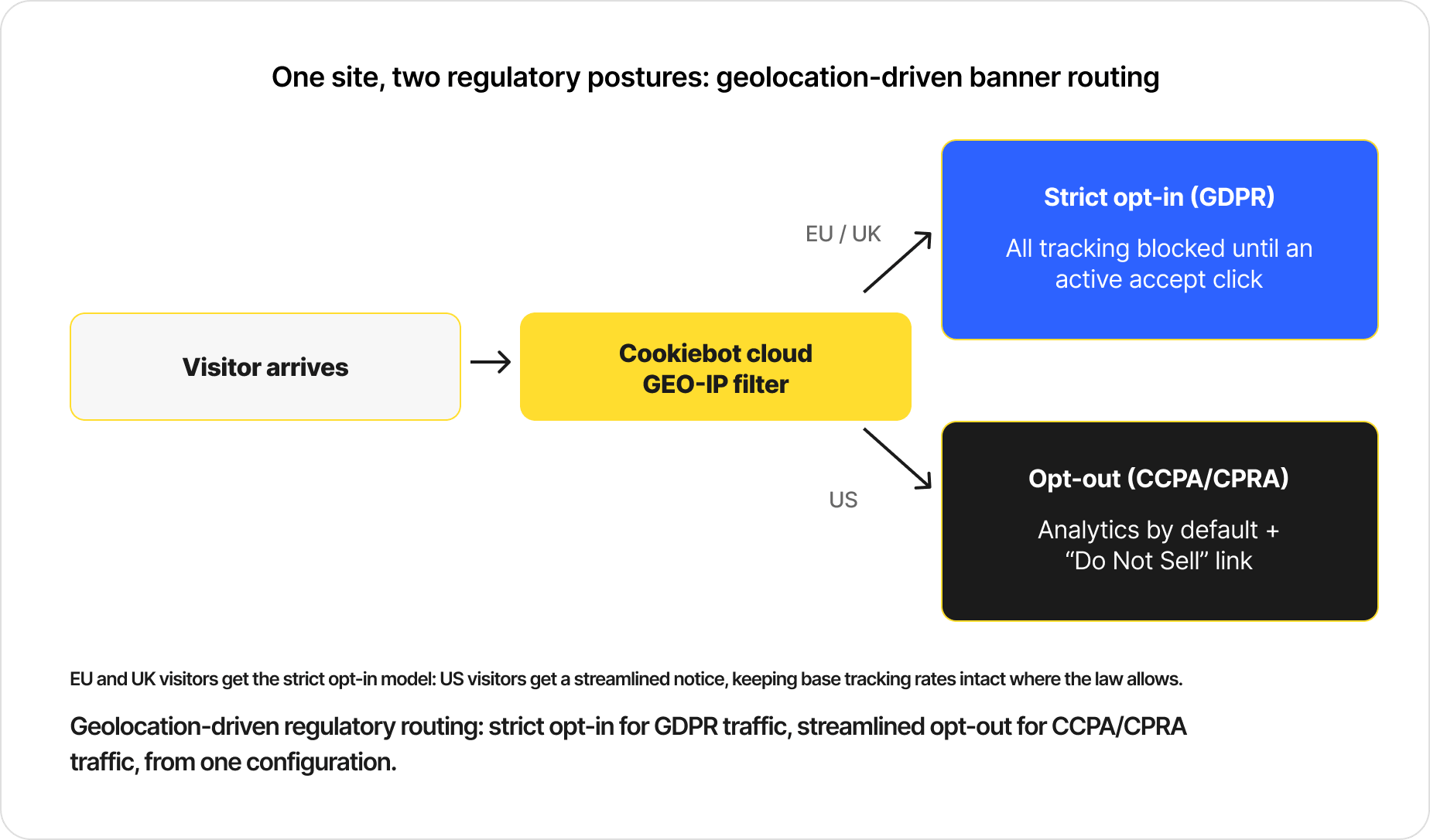
Geolocation profiles serve EU and UK visitors a strict opt-in banner that blocks everything until an active click, while US visitors get a streamlined notice with a "Do Not Sell or Share My Personal Information" link, keeping base tracking rates intact where the law allows.

5.
Automated the privacy request lifecycle

A Make workflow triggered by an erasure flag in HubSpot calls the Cookiebot API to invalidate the tracking ID and clear consent history, and the GA4 deletion API to remove identifier logs, executing right-to-be-forgotten requests across every system without manual verification work.

Results

What the client achieved

Thirty days after launch, data validation audits confirmed regulatory compliance with zero negative impact on lead generation performance, and with attribution visibility dramatically improved rather than sacrificed.


Key metric Before After Change
Unconsented tracking scripts firing 14 violations 0 leaks Eliminated
Regulatory compliance rating Non-compliant (failing) Verified compliant Risk resolved
Cookie consent opt-in rate 38% 74% +94.7%
CRM leads with linked attribution 58% 92% +58.6%
First-page load time 3.2 seconds 1.4 seconds Cut 56.2%
Data transparency controls Poor/missing Clear granular toggles Trust standard met

Baseline configuration vs post-deployment audit, as reported for the engagement.

Beyond the metrics

Passing institutional privacy reviews unlocked enterprise sales pipelines with healthcare networks and corporate wellness insurers that compliance concerns had previously blocked. And removing hardcoded tracking bloat halved first-page load times, a performance dividend most compliance projects never deliver.

The insights

Why it worked

  1. Zero-trust as the default posture - Blocking every script until explicit consent made compliance structural rather than aspirational, which is why the audit found zero leaks instead of fewer leaks.
  2. Consent synchronized to the CRM, not stranded in the browser - Mirroring choices into HubSpot in real time is what turned privacy compliance into an attribution gain instead of an attribution loss.
  3. Granularity preserved the data worth having - Separating statistics from marketing consent let the team keep essential analytics even when users blocked retargeting, holding 92% attribution while fully honoring choices.
  4. Trust design lifted opt-ins - A transparent, localized, granular banner nearly doubled consent rates over the intrusive binary popup it replaced, proving users grant more when they're asked honestly.

Sandra Field

Related Case Studies

Results that speak
for them selves.

Migrating 9,000+ pages across 12 languages

Successful migration of 9,000+ pages across 12+ languages, with no critical downtime.

80% CPR reduction and 3x ROI over 6 years

Multi-channel strategy driving 50%+ monthly registration growth.

35% cost reduction while scaling SEO delivery globally

Ogilvy needed to scale SEO delivery across multiple markets without expanding headcount. Mavlers stepped in as their invisible production partner.