







Table of contents
Get in touch
Expect response in 4 hours.
.png)
As an agency owner, the truth you need to know is that your clients did not stop searching for your services or products; they just stopped needing to click.
And that distinction matters more than most agencies realize.
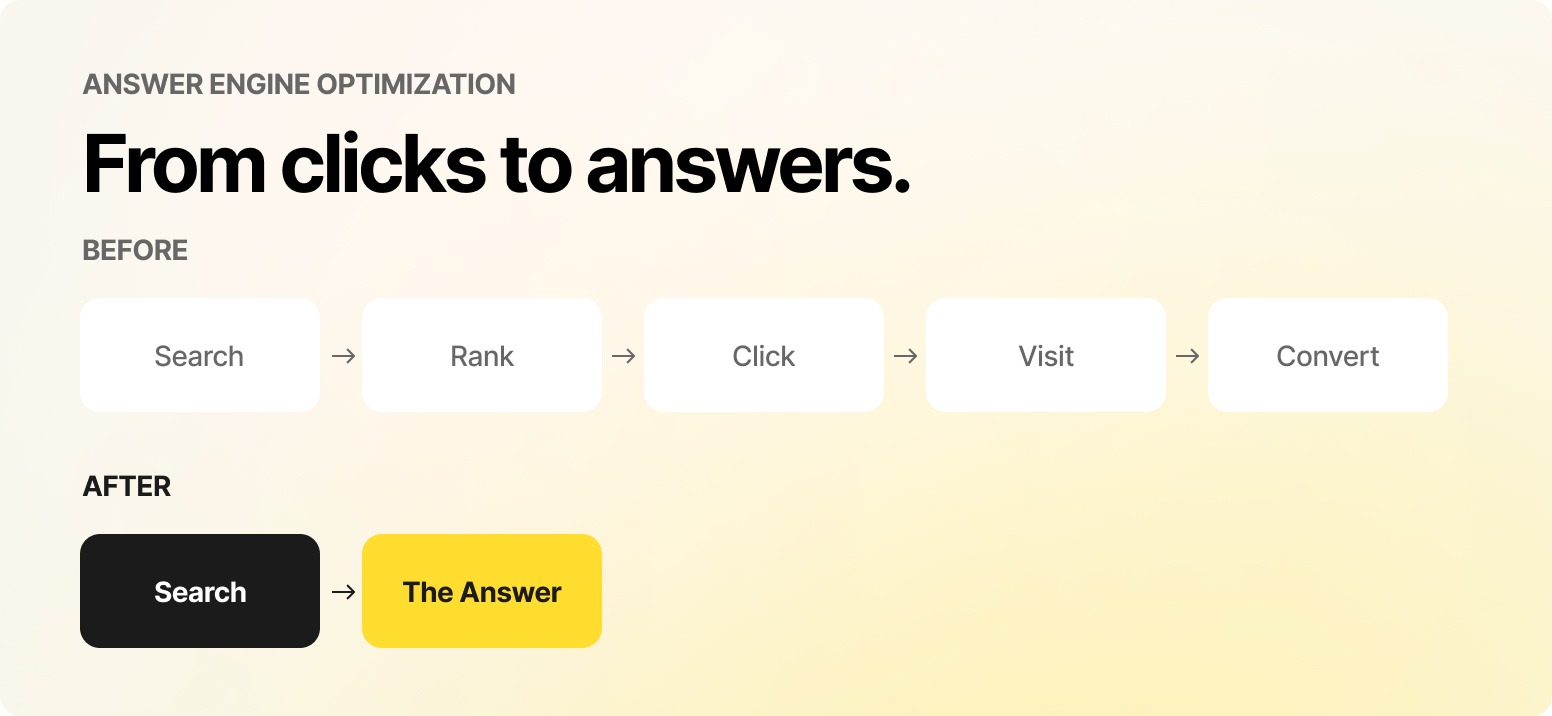
Traditionally, search was a traffic exchange that roughly translated into rankings, clicks, and conversions.
Now, the answer is increasingly delivered inside the platform itself before a click ever happens, be it Google’s AI Overviews, ChatGPT, Perplexity, or voice assistants.
The user frames their concern, the system responds, and the journey compresses.
And if your client isn’t part of that response layer, they’re invisible at the exact moment intent is highest.
Most agencies are still trying to fix this with better SEO, more content, links, and more “optimization.”
That’s not where the leverage is anymore; instead, the leverage lies in owning the answer.
That’s what AEO (Answer Engine Optimization) actually is and why the agencies that understand it aren’t just adding a new service line.
They’re quietly building one of the highest-margin revenue streams available right now. Here’s another relevant read that might interest you ~ 12 best AEO tools in 2026.
Let’s get into why.
1. AEO doesn’t compete with SEO budgets; it reframes them
The fastest way to lose this opportunity is to pitch AEO as a “new service.”
The agencies closing this work are doing something else entirely; they’re reframing a metric clients are already questioning.
Many times, clients wonder, “Why are impressions growing, but clicks are flat or declining?”
Well, that’s neither a CRO issue nor a content volume issue.
It’s a zero-click environment problem.
According to SparkToro’s analysis of clickstream data, 68.01% of US Google searches ended without a click in early 2026, up from roughly 60% in 2024 as AI Overviews expanded.
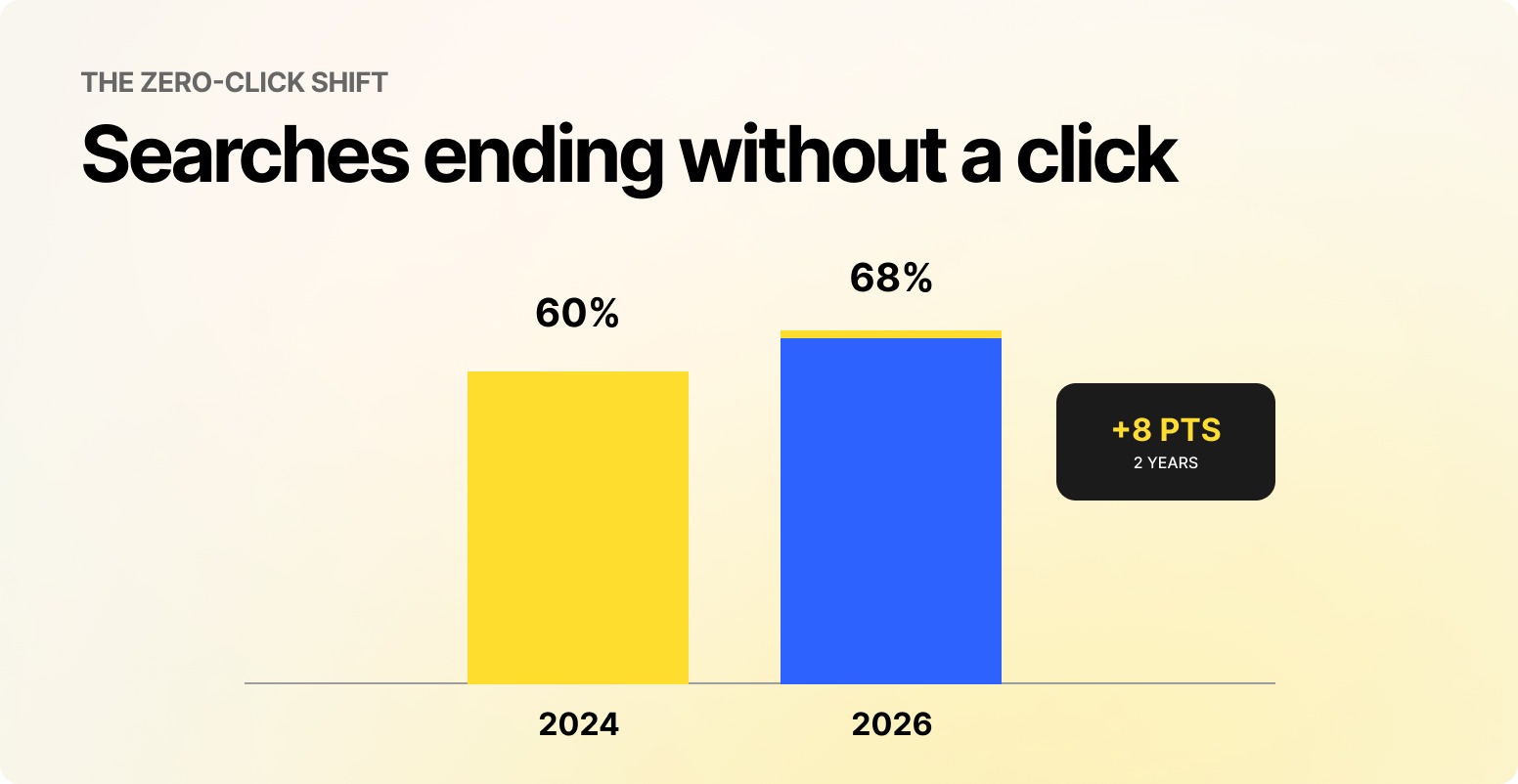
So the conversation shifts from “We’ll improve your rankings” to “We’ll make sure you’re included in the answers, replacing those clicks.”
That positioning moves you out of execution pricing and into strategic relevance pricing.
And that’s where margin starts.
2. The delivery is lean, but the perceived value is high
This is where AEO becomes commercially interesting.
Unlike traditional SEO, which often requires ongoing link building, high-volume content production, and technical audits across large sites, AEO is more about precision than scale, because you’re optimizing for:
- Structured, extractable answers
- Entity clarity
- Semantic relationships
- Authoritative positioning within a topic cluster
In many cases, this means reworking existing content rather than producing net-new volume.
For example, instead of writing 20 new blogs, you might choose to;
- Turn 5 existing pages into answer-ready formats
- Add structured Q&A sections
- Strengthen entity associations
- Align content with how AI models retrieve and synthesize information
The output is smaller, but the impact is disproportionately larger.
And the cost to deliver is lower than most agencies are used to.
That gap, between perceived strategic value and actual delivery effort, is where margin lives.
3. The market is still early, and most agencies are underprepared
While Google formally introduced AI-generated summaries in Search as part of its generative AI rollout about 2 years ago, most agencies haven’t yet translated that into a service model.
They’re acknowledging the shift, but they’re probably not operationalizing it.
This creates a familiar window where clients are noticing the change, internal teams don’t have a framework, and most vendors are still selling legacy SEO.
So when an agency walks in and says, “You’re losing visibility because answers are replacing clicks and here’s how we fix that,” they’re not among the 5 competing proposals; instead, they’re among the first few to explain the problem correctly.
That’s not a positioning advantage but rather a category advantage that is rare and short-lived. Therefore, the agencies that move now get to define the conversation before it commoditizes.
4. AEO expands naturally into higher-retainer conversations
Here is how reasons 2 and 4 fit together, because at first glance, they may seem contradictory.
The lean delivery is the entry point. It is what lets you start the relationship at a high margin with low effort. But AEO rarely stays contained, and that is the good news for retainer growth.
The moment you start optimizing for answer inclusion, you run into a deeper constraint: the system doesn’t just rank content; it evaluates entities.
Which in turn forces a broader conversation centered around;
- How consistently is your brand referenced?
- Do authoritative sources validate your expertise?
- Are you topically dominant or just present?
Answering those questions opens the door to digital PR, authority building, thought-leadership ecosystems, and content-architecture redesign.
None of that is lean, and none of it should be priced like a cheap add-on. That is the point. The lean engagement gets you in at a strong margin; the entity and authority work is where the retainer compounds. You land with precision and expand into market positioning, and market positioning has never been priced like an SEO retainer.
5. Attribution is imperfect, which makes the service more defensible
AEO does not produce clean, click-level attribution, and counterintuitively, that is a feature, not a flaw.
Because the impact shows up in influence, not just clicks.
So, if a buyer asks “Best CRM for SaaS startups” and your client is included in a generated response, that’s the perfect example of brand positioning at the moment of intent.
Even if the click happens later, the journey becomes multi-touch, or the conversion is assisted rather than direct.
This is exactly what current B2B buying research shows. In its 2025 Buyer Experience Report, 6sense found that buying groups fill most of their shortlist on day one, and the winning vendor is already on that Day 1 shortlist 95% of the time. In other words, preference is largely set before the measurable conversion event ever happens. AEO inserts your client into that early, anonymous phase, and with implied authority.
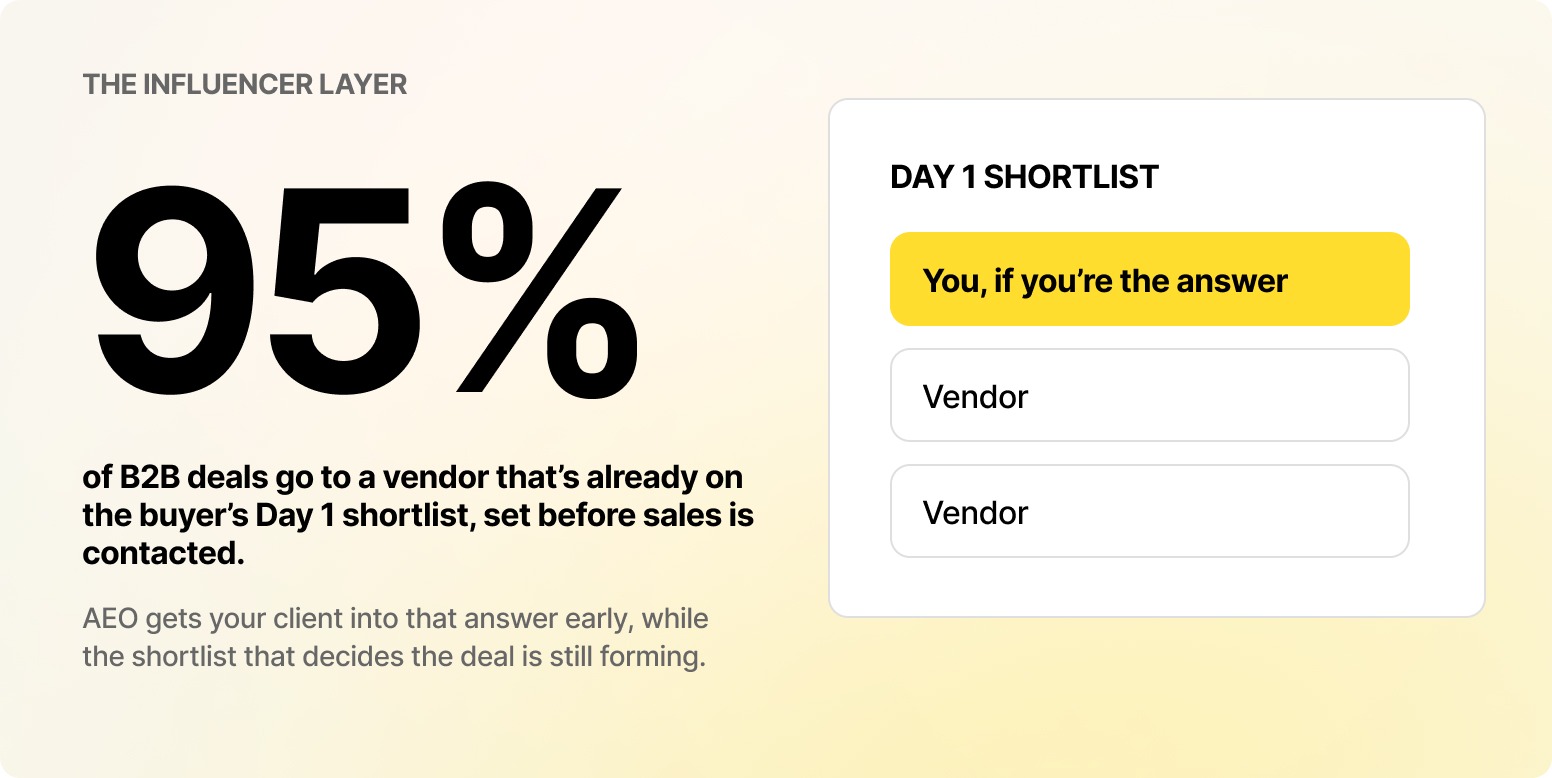
That is hard to capture in a single dashboard metric, and it is even harder for a client to walk away from once they understand it. Services that operate in that influence layer, namely PR, brand, and strategy, have sustained higher margins for a reason. AEO now lives in that same layer.
The objection you'll hear is predictable, "If you can't measure it, why am I paying a premium?"
To counter that, all you need to do is arm yourself with proxy metrics before the question lands. Track AI Overview citation share, presence in ChatGPT, and Perplexity answers for your target prompts, branded search lift, and share of voice across answer engines.
These won't give you last-click attribution, but they show movement in the layer that actually decides the deal.
The opportunity most agencies are still missing
It's important to understand that this isn't about AEO replacing SEO. It's more about AEO exposing where SEO alone is no longer sufficient.
Now, this creates a very specific commercial opportunity in which you can sell more meaningful visibility rather than pitching more activity.
Because once the conversation shifts from “Can you get us traffic?” to “Can you make sure we’re the answer?” you’re no longer competing on output, you’re competing on understanding.
And understanding is where margin compounds.
Own the answer while someone else owns the delivery
Here's the practical catch. The window is open now, but building an AEO and entity-authority engine in-house, with the structured-content, technical, and digital-PR muscle it requires, takes time most agencies don't have before the category commoditizes.
That's the case for white-labeling the delivery while you own the strategy and the client relationship. You define the category for your clients and capture the margin. The build runs quietly in the background.

.webp)
.png)