


Table of contents
Get in touch
Expect response in 4 hours.

You’ve raised funding, hired your first marketer or brought in a sales leader. Yet your relationships - the founder’s - bring in most new business.
There is more marketing, sure. But a repeatable way to build a qualified pipeline feeding into revenue? That’s the part I would still inspect.
The founder could be negotiating proposals. Sales could be working active deals. But it doesn’t tell me what keeps qualified pipelines full, growing, and active as existing deals move to closed-won or closed-lost?
I’ve always thought of referrals as the founder’s safety net. Paid campaigns and marketplaces are a good addition to the mix. Collectively, they can all bring in good business. But when these sources slow down for whatever reasons, what keeps qualified opportunities coming in? Is it a consistent pipeline engine or is it a few disjointed channels?
At Mavlers Agency, we call dependency on sources the business doesn’t control rented growth. It can disguise itself behind a full pipeline for a while. But a busy sales team doesn't have to mean the business has a repeatable way to generate qualified opportunities when those relationships or platforms stop delivering.
What is rented growth?
Rented growth is pipeline or sales from sources a company does not control. These include the founder's network and referrals, lead marketplaces that sell the same lead to five competitors, portals, booking and listing sites that take a cut of every sale, and campaign-only agencies whose results stop when the contract does.
Rented growth delivers until it doesn't. For instance, a software company’s new business may come entirely from the founder-referred prospects. A property business from listing portals. And a premium furniture brand from marketplace sales. But referral volume can fluctuate, marketplace rankings can change, and portal fees can increase.
By “companies can't control rented sources” I don’t mean they CAN control other platforms such as Google, LinkedIn or its own website. No business can claim to control any of these platforms. Nor am I suggesting you discard referrals, marketplaces, and paid campaigns.
My concern is: how much of your pipeline depends on relationships, access or customer data that you have limited ability to retain, access, or build on?
Hence, as a demand generation agency building and running pipeline engines for growing companies, Mavlers Agency measures in every Pipeline Audit how much of a company's pipeline is rented and how much it owns.
What is owned demand?
Owned demand is the audience, data, channels and acquisition capabilities a company builds to grow its pipeline. Unlike rented growth, owned demand creates an owned foundation the business can retain, improve and build on.
That foundation starts with tracking, website conversion, CRM and reporting. Channels such as paid media, SEO, AEO, GEO, content and email can then work in unison to attract potential buyers and fill a qualified pipeline. The end result is a demand that compounds, not growth that resets when a source goes quiet.
Owned demand does not mean controlling platforms such as Google or LinkedIn. External dependencies remain, but the business develops more control over how it creates demand. It means building business-owned assets and capabilities that reduce dependence on any single source.
As Krunal Bakraniya, Director of Technology at Mavlers Agency, puts it:
“We build every system in our client’s own accounts. Their CRM, their data, their automations. Ownership starts with the infrastructure.”
This is the shift from buying marketing services to building a growth function. Owned demand compounds. Rented growth resets.
Rented growth vs owned demand: what's the difference?
The core difference between rented growth and owned demand is this:
Rented growth buys access to demand. Owned demand builds the infrastructure, data and capabilities to generate demand.
Picture your pipeline as your businesses’ water supply, and the tap as market access.
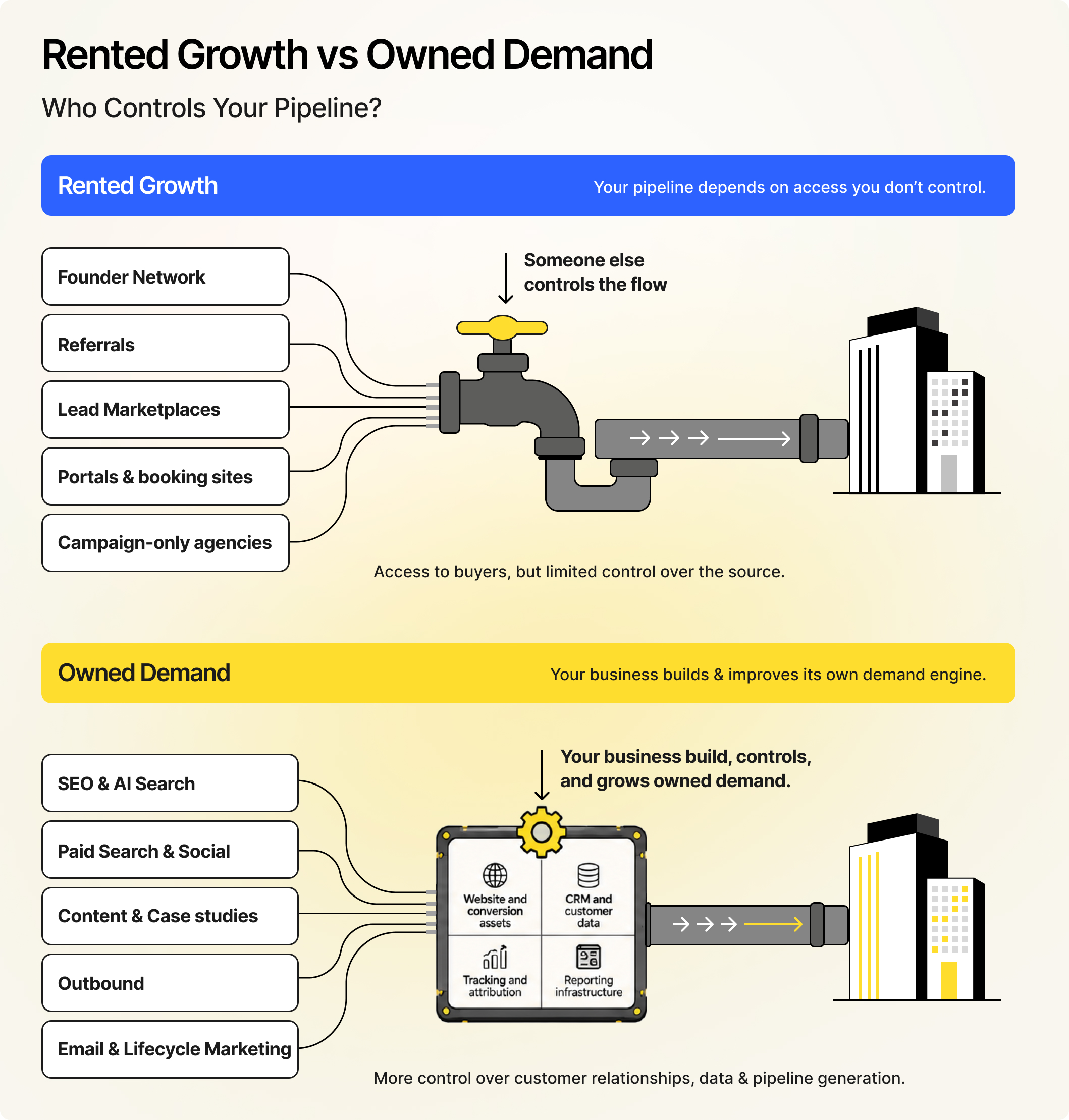
With rented growth, someone else's hand is on the main water valve. When you rely entirely on external partners, marketplaces, or lead vendors, they dictate the flow. They change priorities, raise prices, or turn off the flow and your pipeline runs dry instantly. Without your own reservoir, an external shift leaves your business in a drought.
Owned demand puts your business back in the driver’s seat so that you build your own plumbing. External specialists might help you engineer the pipes or direct the current. But the customer data, conversion assets, and infrastructure belong to you.
The difference between rented growth and owned demand is who controls the tap, and what demand generation capability remains when it turns down. Therefore, we ask every company one question in the audit: how much of your pipeline would survive if your top source disappeared?
Why do growing companies stall on rented growth?
Let’s call out the common culprits causing the growing companies to stall on rented growth:
1. Your network has a ceiling.
Founders close deals through personal credibility, industry reputation and relationships built over years. A referral transfers some of that trust, which can shorten the sales process.
But the network is finite, and the founder's availability becomes the limit. When a new account executive joins, those relationships do not automatically transfer. If every important deal still needs the founder's introduction, the sales function cannot grow beyond the founder's reach.
2. Someone else controls the tap.
Referral partners change priorities. Marketplaces revise access terms. Platforms change the algorithms that influence visibility. A company can meet its sales targets and still lose a source it has relied on for years.
3. Your buyer may be shared.
Some lead marketplaces sell the same enquiry to multiple competing businesses. That means the buyer is comparing several offers, not just yours.
Describing shared-lead models, Darshan Modi, Director of Digital Marketing, Mavlers Agency, says:
Not every provider shares leads, so check the terms before assuming an enquiry is exclusive.
4. Your data may be rented too.
Receiving a lead doesn’t equate to owning the customer relationship or having permission to move the conversation.
Without access to customer information and follow-up permissions, the business loses opportunities to develop that relationship.
5. Acquisition costs have little room to improve.
When every new opportunity requires another referral, lead purchase or campaign, the process keeps starting over. Previous spending creates little reusable value if the business retains no customer data, content or learning.
These patterns do not mean rented growth channels should be abandoned. They mean growing companies need other ways to reach buyers, retain customer knowledge and create qualified opportunities.
What are the five ways companies rent their growth?
Companies typically rent their growth through five sources: founder networks, referrals, lead marketplaces, portals and booking sites, and campaign-only agencies. Each can bring in business, but each comes with a different dependency.
Is rented growth always bad?
No. I wouldn't tell a business to stop using marketplaces or turn away referrals. Both can bring in good customers. The question is how much the business depends on them.
Rented growth can work in your favour when:
- You're testing a new market. A marketplace can get your offer in front of buyers quickly, before you've built your own acquisition channels.
- Referrals are bringing quality leads. Keep those relationships going. A recommendation from a trusted customer can be worth far more than a cold enquiry.
- You need a short-term nudge. Paid campaigns or specialist agency support can help you capture seasonal demand or keep injecting enquiries while your team builds its capabilities.
Rented growth becomes a problem when:
- One source drives most of your sales. A change in marketplace terms or a slowdown in referrals can leave your pipeline exposed.
- You're buying the same leads as competitors. When several businesses approach the same prospect, price often becomes the deciding factor.
- Acquisition costs keep rising. The revenue looks good, but recurring fees and campaign costs leave little margin.
How do you know if you’re too dependent on rented growth?
You may have a rented growth problem when most of your pipeline comes from a few key relationships or platforms. The warning signs often appear before the sales numbers fall.
Here are some signs for rented growth dependency to watch for:
That's when Rented Growth Share helps you assess if your pipeline mostly derives from rented growth.
Rented Growth Share measures the share of pipeline value that comes from sources your business doesn’t control.
How to calculate Rented Growth Share?
To calculate Rented Growth Share:
- Review the last 12 months of pipeline activity.
- Add the value of opportunities from classified rented sources and calculate their share of total pipeline value.
- Keep opportunities with unknown sources separate. If you cannot trace them, you cannot confidently classify them as owned demand.
Rented Growth Share is your pipeline’s diagnostic lens, not a universal score. A high share is not automatically bad, but it flashes red warning light when it prevents you from replacing opportunities predictably.
So, when a founder tells us, “80% of our deals come from referrals and two marketplaces. How exposed are we?”, we don't stop at 80%. We understand what's behind that number with a Free Pipeline Audit and examine that evidence. Here’s what we analyze:
- What is the pipeline value behind those deals, not merely the number of deals?
- How concentrated is that value across the referral network and the marketplaces?
- Does the company have permission to contact, nurture, and market to buyers acquired through those platforms?
- Could a change in fees, rankings or referral activity slow down new opportunities?
- Are there replacement channels - SEO, content, outbound, email, partnerships, events, or community - that can keep the pipeline moving?
How do you move from rented growth to owned demand?
Shifting from rented growth to owned demand means building a pipeline engine connecting tracking, channels, content, CRM, and reporting.
With founder-as-pipeline doing most of the selling, growth becomes hard to sustain. When growth stalls, the instinct is often to hire more people or increase campaign spend. I've seen founders panic-hire when growth stalls. Onboard a freelancer. Bring in a branding agency. Get a fractional CMO. Increase paid campaign spend. The activity picks up, but the underlying problem often remains.
Despite the efforts, when a deal doesn't close, marketing blames sales. Sales blames lead quality. And the founder is left trying to figure out where their next qualified opportunity will come from.
You haven't built a growth engine. You've added more people to manage.
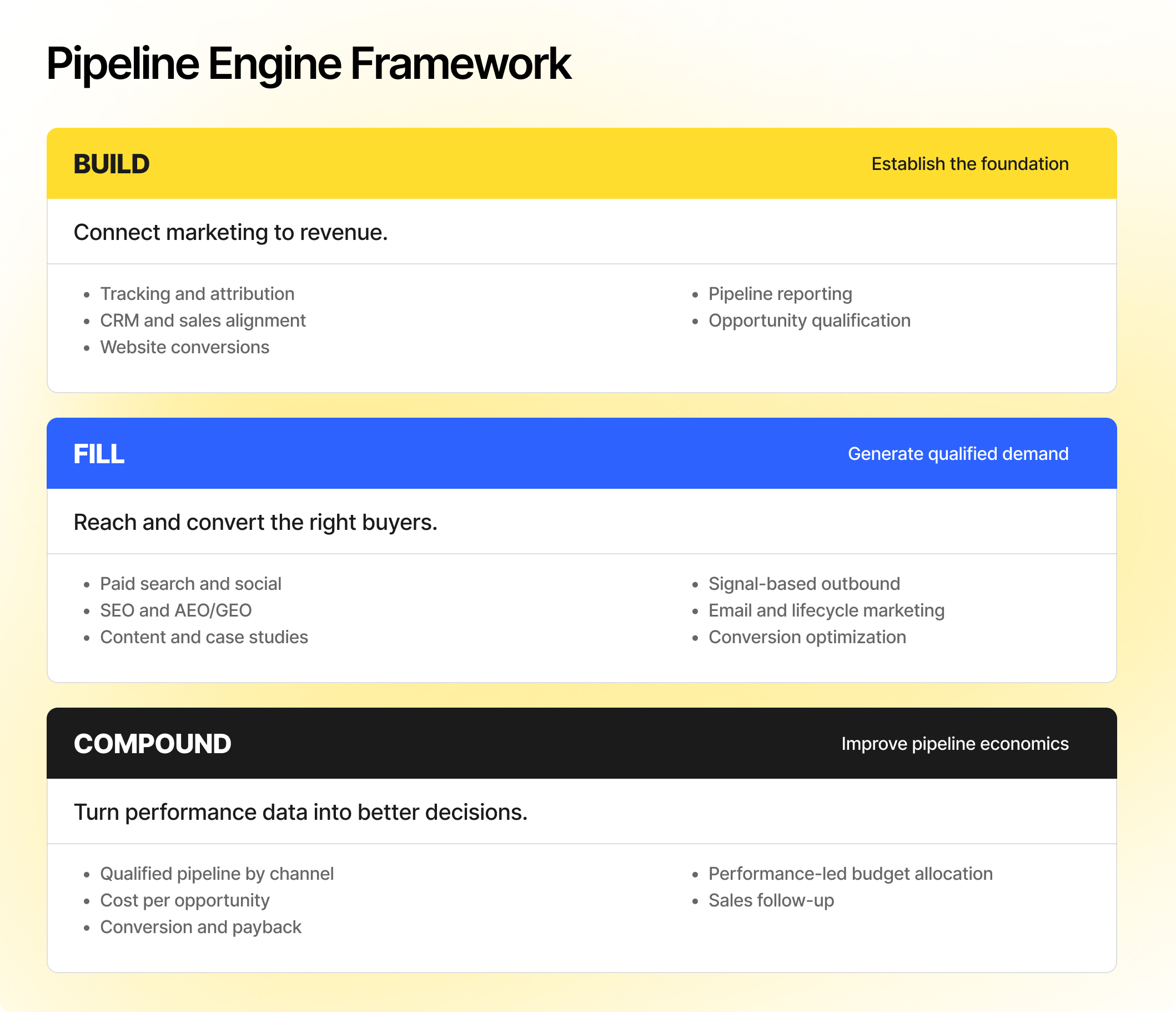
So, what should you build first? That's the problem we fix by building the infrastructure that connects the work. We use the Pipeline Engine Framework for this. Three stages: Build, Fill and Compound.
1. Build: First, get a clear picture of the pipeline
I know tracking and CRM aren't the exciting parts of marketing. Founders would much rather talk about campaigns, creative and new channels. But there's little point in spending more until you know what your existing spend is bringing back.
Connect website activity, campaign tracking, CRM stages and reporting. Marketing and sales also need to agree on what counts as a qualified opportunity.
Without that connection, you end up judging content on traffic and campaigns on leads. You miss how their combined activity contributes to the pipeline.
2. Fill: Bring the channels together
Now we have a foundation to build on. Search, social, content, outbound, paid media and AI search can work towards the same pipeline goal.
At Mavlers Agency, these aren't isolated services handed between different vendors. A dedicated, senior-led pod brings the channel specialists together, with one shared focus: qualified pipeline.
3. Compound: Put more behind what brings qualified opportunities
Every month, we look at which channels are producing qualified opportunities and what they cost. The budget moves where evidence supports it. accordingly. Some activities get more investment. Some may not deserve another month.
One thing worth being honest about: this takes time, money and expertise. A marketplace can send enquiries tomorrow. Building an acquisition engine takes longer, and it won't work perfectly from day one. So, keep productive rented sources running during the transition.
But the data, CRM, content and working processes stay with the business. That's what makes the investment worthwhile.
Let’s zoom in on how Pipeline Engine Framework is built.
How long does it take to build owned demand?
You can get the groundwork done and your first campaigns running within eight weeks. Building owned demand takes longer. There's tracking to fix, sales data to organise, and a fair bit to learn about which channels actually bring in qualified buyers.
Here's how we approach owned demand building at Mavlers Agency:
- Week 2: Audit and plan delivered.
- Week 4: Tracking and CRM live.
- Week 8: First campaigns live.
- Every month: Leading indicators reported, including traffic, engagement and pipeline.
What does owned demand look like for different companies?
Owned demand depends on how a business acquires customers. For B2B companies, it often means building a pipeline beyond founder referrals and resellers. For premium consumer brands, it's about generating direct enquiries without giving up marketplace sales.
Example 1: Software or cybersecurity company
I've seen how easily sales can revolve around a founder's contacts. The relationships are valuable, but there's only so much one person can do.
A cybersecurity company can build its own pipeline through buyer-focused search content, targeted outbound, CRM tracking and structured follow-ups. Referrals still contribute, but they're no longer the entire plan.
Example 2: Premium furniture brand
Marketplaces bring buyers. They also control much of the customer interaction.
A furniture brand can develop direct demand through its website, organic search, enquiry forms and CRM-based follow-ups. Marketplace sales continue, alongside a growing direct acquisition channel.
These are illustrative scenarios, not Mavlers Agency client results.
Frequently asked questions
Is referral marketing rented growth?
Referrals become rented growth when a business relies on a few relationships to keep new work coming in. A key contact changes jobs. A long-standing client stops making introductions. The pipeline feels the impact because there is no other reliable way to reach new buyers. Keep the referrals. Just don't make them your entire sales strategy.
Are paid ads rented or owned?
The reach you buy through paid ads is rented. The platform decides who sees your ads and what access costs. But the work doesn't have to end there. Send people to your own website, capture their details with consent, and connect enquiries to your CRM. Paid media can bring people in while your business builds relationships and data it can use beyond the campaign.
Is SEO owned demand?
SEO can help build owned demand, but organic rankings aren't yours to control. Google decides where your pages appear, and those positions can change. What your business does own is its website, published content and the first-party data it collects. SEO brings potential buyers to those assets. It shouldn't be treated as a guaranteed source of traffic.
Should we stop using lead marketplaces?
No. Lead marketplaces can put your business in front of buyers who are already looking. The problem starts when most of your opportunities come from one platform, especially when the same lead goes to several competitors. Keep the channel if the economics work. Build direct acquisition and customer relationships alongside it.
What is Rented Growth Share?
Rented Growth Share is the percentage of your sales pipeline coming from sources your business doesn't control. Mavlers Agency measures it during the Free Pipeline Audit. The calculation helps identify how much the pipeline depends on founder relationships, referrals, marketplaces, portals and other external sources.
Can a small company build owned demand?
Yes. You don't need a large marketing team or six acquisition channels to start. Get website tracking in place, organise your CRM, agree on what counts as a qualified opportunity and focus on one or two channels your buyers use. Build from there. The important part is keeping the data and learning from each opportunity.
Where should you start?
I've seen businesses keep adding channels when they haven't worked out where their existing pipeline comes from. More campaigns won't fix that. You need to know which sources bring in opportunities, what happens to those enquiries, and where the business is losing visibility.
That's the work behind Mavlers Agency's Pipeline Engine Framework: Build, Fill and Compound. The Free Pipeline Audit is where we look at your tracking, website, channels and CRM, and show you how much of your pipeline is rented.