







Table of contents
Get in touch
Expect response in 4 hours.
.png)
The private white-label conversation among agency owners is not about pricing or turnaround times. It is about finding answers to one question; “Who are you using right now, and did they nearly cost you a client?”
Most agencies think the biggest risk is discovery, whether the client finds out there’s a delivery partner. In reality, that’s rarely what ends accounts. What actually breaks relationships is undetected quality drift.
This article gives you the four failure patterns that make agencies switch partners, the briefing mistake behind most quality complaints, the evaluation question that flipped in under a year, and the timeline on which trust actually forms.
We have been on the receiving end of those corridor conversations since 2013, working with agencies across the US, UK, and Australia. Whether favorable or unfavorable, both taught us something worth writing down.
What conversations do agency owners have before outsourcing client work?
Before any agency commits to a white label partner, there is one fear that sits underneath every other question they ask.
And interestingly it is not pricing, turnaround, or even quality. It is: what happens if my client finds out?
We have heard this in Chicago, London, and Sydney. It is the most universal of all agency owner concerns about white label delivery, and it is almost never addressed in the content white label agencies publish, because addressing it means naming the thing that makes owners uncomfortable about the model.
So here is the direct answer. Your client almost certainly will not find out, and not because the model is hidden. It is because white label delivery is structurally identical to how every other professional services business already operates. Law firms brief barristers. Architecture practices use specialist contractors. Consulting firms bring in subject matter experts. Nobody calls that a breach of trust, because accountability stays with the firm the client hired.
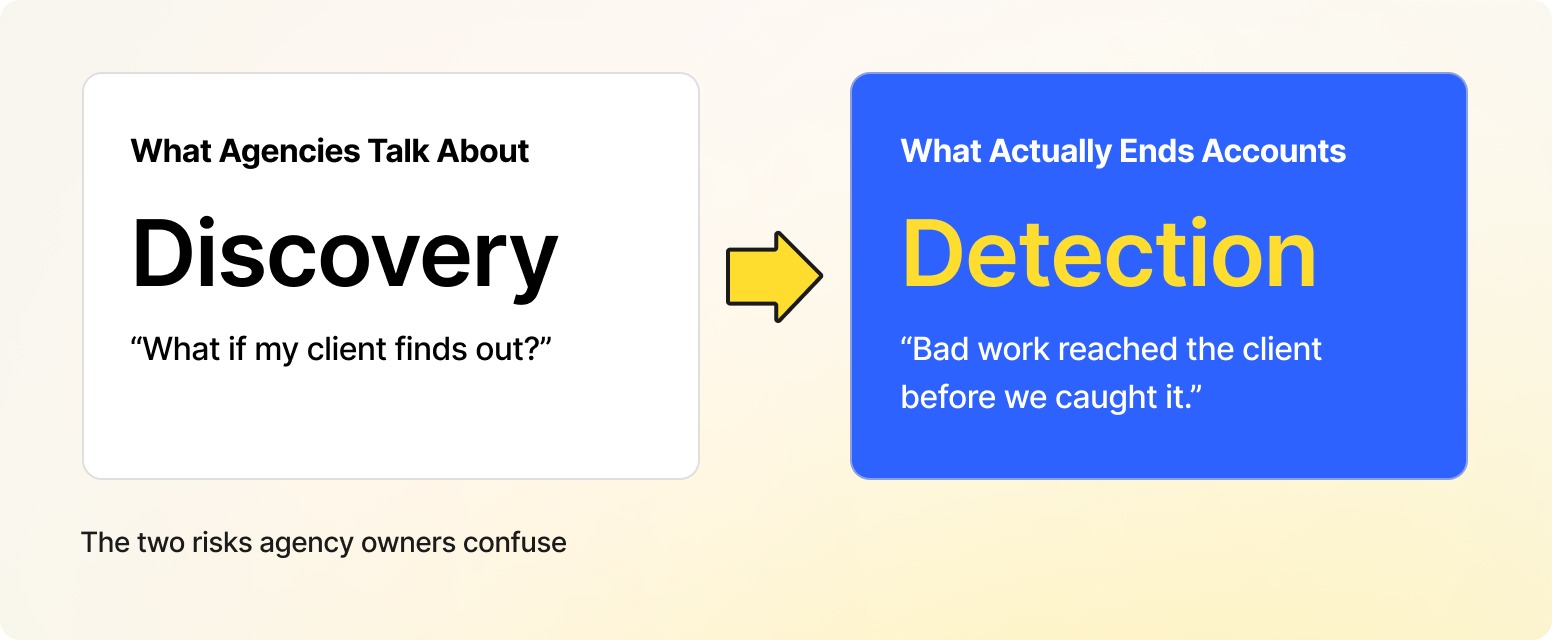
Key takeaway: The discovery risk is the one agencies talk about. While the detection risk is the one that actually ends accounts. Therefore, build your evaluation around the second.
Should my agency hire in-house or work with a white-label partner?
Now, this is a margin decision before it is a capability decision, and the current numbers make that uncomfortable reading.
The average digital agency earned a 13% after-tax net margin in 2025, down from 14% in 2024 and below the long-run average of roughly 15% since 2015, according to Promethean Research's 2026 State of Digital Services, a survey of 119 agency leaders fielded in February 2026. The same data shows studios under 10 full-time employees averaging 19%, while agencies with 50 or more averaged 8%.
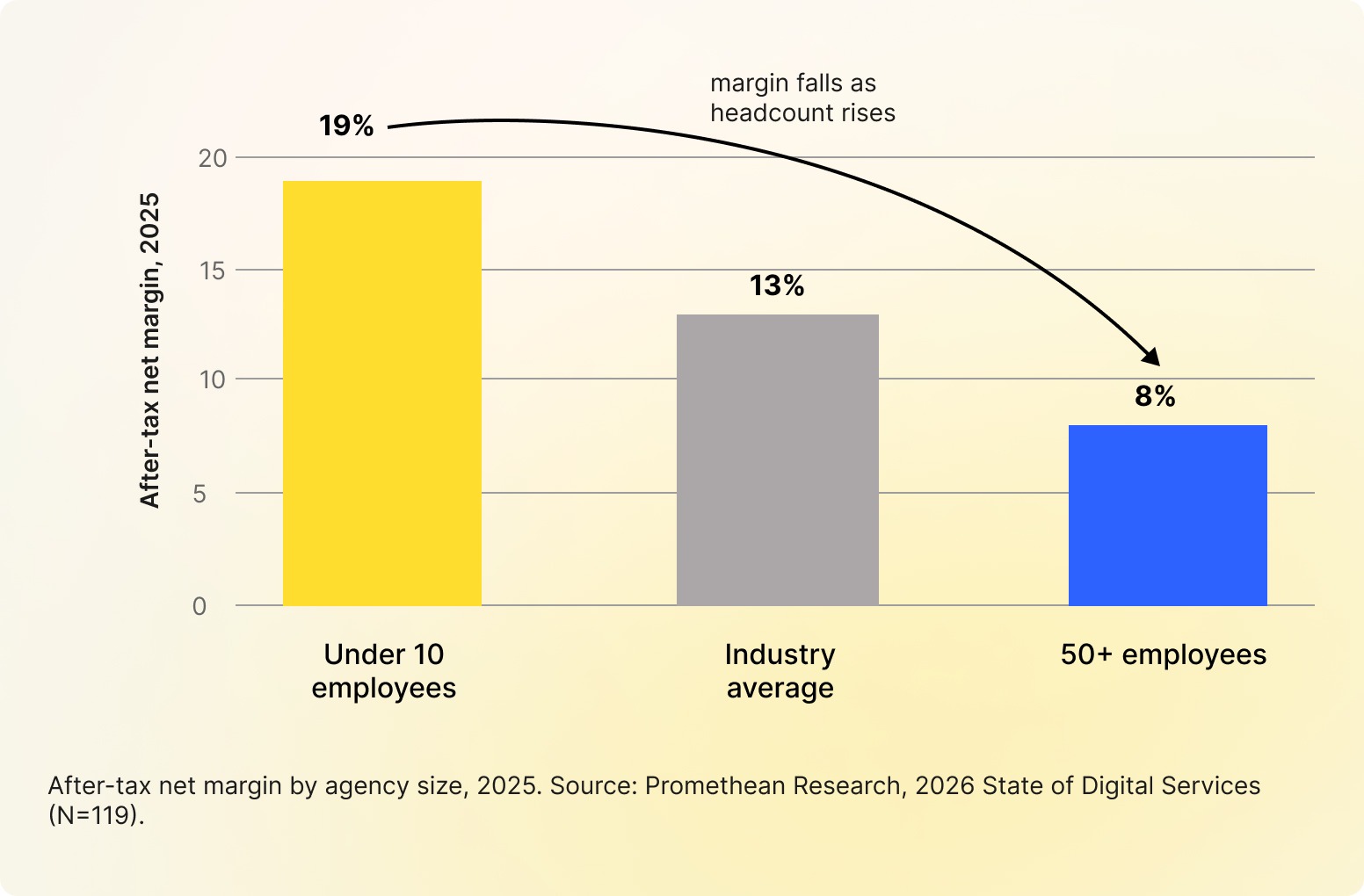
Margin falls as headcount rises. Every specialist hired to satisfy one client request adds fixed cost that must be fed whether or not the pipeline cooperates. That is the honest version of why agencies choose white-label partners, as it converts fixed cost into variable cost.
The pressure is not theoretical. Forrester's Predictions 2026 report, published October 1, 2025, forecasts a 15% reduction in agency jobs in 2026. As The Drum reported, that follows headcount reductions averaging around 8% in 2025 across the major holding companies, and Forrester's release cites an unnamed global holding company chief executive summarizing the strategy as: "By 2028, we'll double profits and halve the people."
Independent agencies do not get to halve the people. They get to choose which capacity they own and which they rent. That is the white label partnership decision, stripped of everything else.
Key takeaway: Keep the service you are hired for in-house. Rent the ones you cannot staff deeply enough to be credible in. Hiring for a single client request is how agencies buy permanent cost with temporary revenue.
What are the biggest risks of white label partnerships?
We asked agency owners in the Mavlers Agency partner network who had switched white label providers why they left. The answers clustered around four things, consistently, across markets. We call it the Corridor Test, because these are what owners warn each other about when no vendor is in the room. And interestingly, price was almost never first.
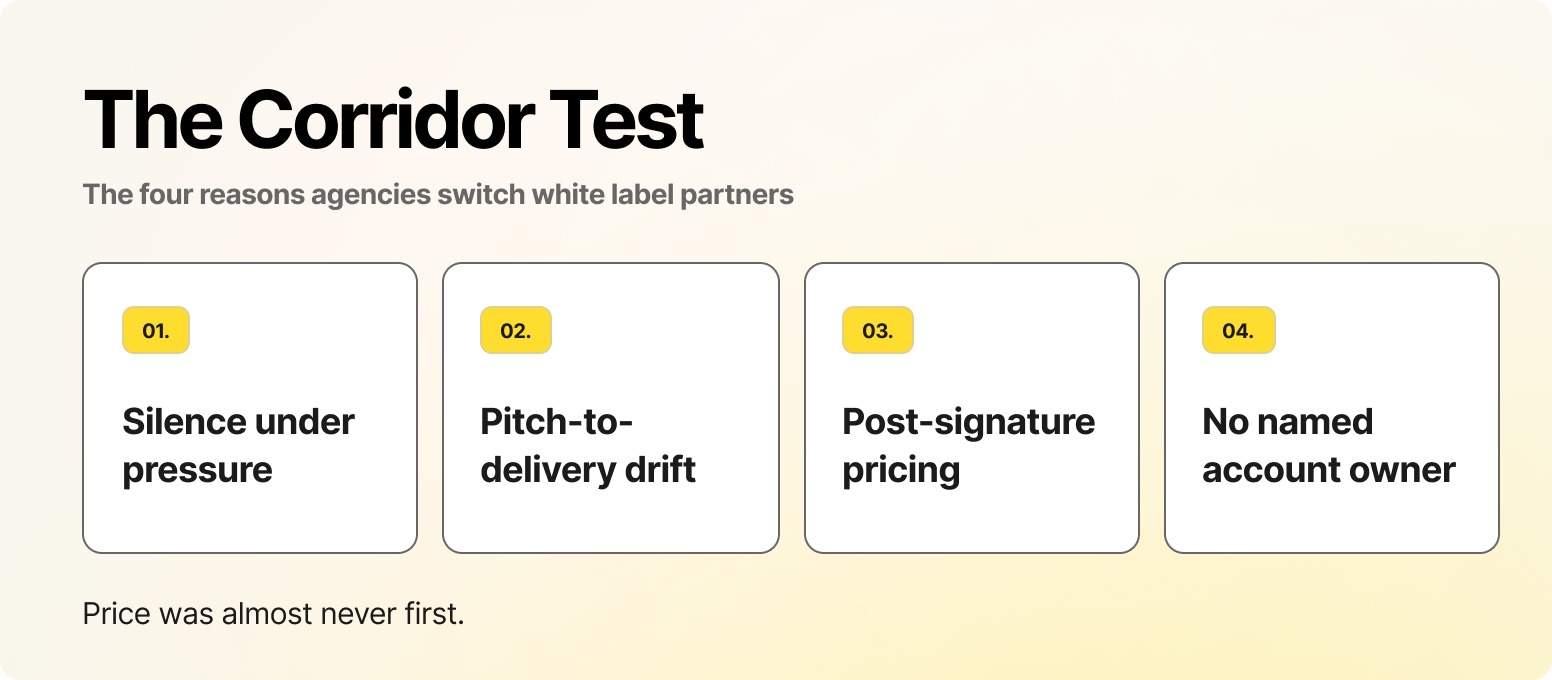
Silence is the worst of the four. The agency owner is the one facing the client, and when something breaks, they need information faster, not slower. Going quiet in that moment is not neutral. These are the hidden challenges of white label partnerships that never make a capability deck, and they overlap heavily with the white label marketing mistakes we see agencies repeat.
Key takeaway: Every white label partnership risk on this list is a behavior under pressure, not a line item. It is recommended to test behavior instead of brochures.
What mistakes do agencies make when choosing a white label partner?
The most expensive mistake is not partner selection. It is briefing.
The agencies with the worst white-label quality experiences are almost universally the ones that brief poorly, and not because they are careless. They have never had to brief an external team, and they underestimate how much institutional knowledge lives in their own heads and never reaches the document.
An owner who has run an account for two years knows the brand voice, the historical sensitivities, the feedback the last agency got wrong, and the one thing the CMO cares about that nobody wrote down. None of that transfers automatically. It transfers through the brief, and most briefs do not carry it.
Here’s what belongs in a white label brief that most agencies leave out;
- The specific feedback the client rejected last time, and the reason they gave.
- The internal stakeholder who actually approves, and what they optimize for.
- Brand voice rules expressed as things to avoid, not adjectives to aspire to.
- The commercial context: what this deliverable has to prove, and by when.
- Where the account sits on renewal risk, so the partner knows how much rope there is.
The test is pretty simple: could the partner execute this brief without a single follow-up question? If not, the gap shows up in the output and gets blamed on the partner.
Key takeaway: Judge a partner by the quality of the questions they ask about your brief. A partner who accepts a thin brief without challenge is telling you how the first bad deliverable will happen.
How do agency owners evaluate white-label agencies now that clients are asking about AI search?
This is the newest conversation in the corridor, and it has flipped inside a year.
Twelve months ago, the question was defensive. Is my partner quietly using AI tools and passing generated work off as specialist output?
Today it is offensive. Does my partner understand AI search well enough that I can sell it to my clients?
The shift is driven by client questions agencies cannot answer with traditional SEO reporting. Pew Research Center tracked 900 US adults across roughly 69,000 Google searches in March 2025 and found that users clicked a traditional result in 8% of visits when an AI summary appeared, against 15% when it did not. Links inside the summary were clicked in just 1% of visits. Around 18% of all searches in the study produced an AI summary, and 58% of participants saw at least one.
That is the mechanism behind the email landing in agency inboxes right now: rankings hold, traffic falls, and the client wants an explanation. A partner who cannot supply one becomes a liability in the room. We covered the commercial version of this pressure in AI vs agencies: why clients are choosing tools over retainers.
Definition: Citation share
The share of AI-generated answers, across a defined set of buyer prompts, in which a brand is named or linked as a source. It is the AI search equivalent of rank tracking, and it is the number a partner should be able to show you before you sell the service.
What questions should agencies ask before choosing a white label partner?
Here are the six questions that do most of the work in an evaluation. Ask them in this order.
- Show me a client where rankings stayed flat, and AI visibility improved. What did you change?
- How do you measure citation share inside ChatGPT, Perplexity, Gemini, and AI Overviews, and how often do you report it?
- Who specifically will hold my account, and how many other accounts do they carry?
- What is your escalation path when a deadline is at risk, and how quickly do I hear about it?
- What is excluded from this rate, and what triggers a re-quote mid-engagement?
- Which of your agency partners can I speak to who left and came back, or who has been with you past year two?
The last one does more work than most agencies expect. Tenure past year two is the single cleanest of the white label agency trust factors, because it can only be earned.
Key takeaway: A partner who cannot show you an AI visibility result is not behind on tooling. They are behind on the conversation your clients are already having.
How do you know if a white label partner is reliable?
Ask any owner with a genuinely good white label relationship what made it work and they say a version of the same thing: it took about six months before I really trusted them. Not because anything went wrong. Because trust here is built on accumulated evidence of a partner behaving the way they said they would, across enough situations that the pattern becomes predictable.
We call it the Month Six Curve. Four moments carry almost all the weight, and they are not equally weighted.
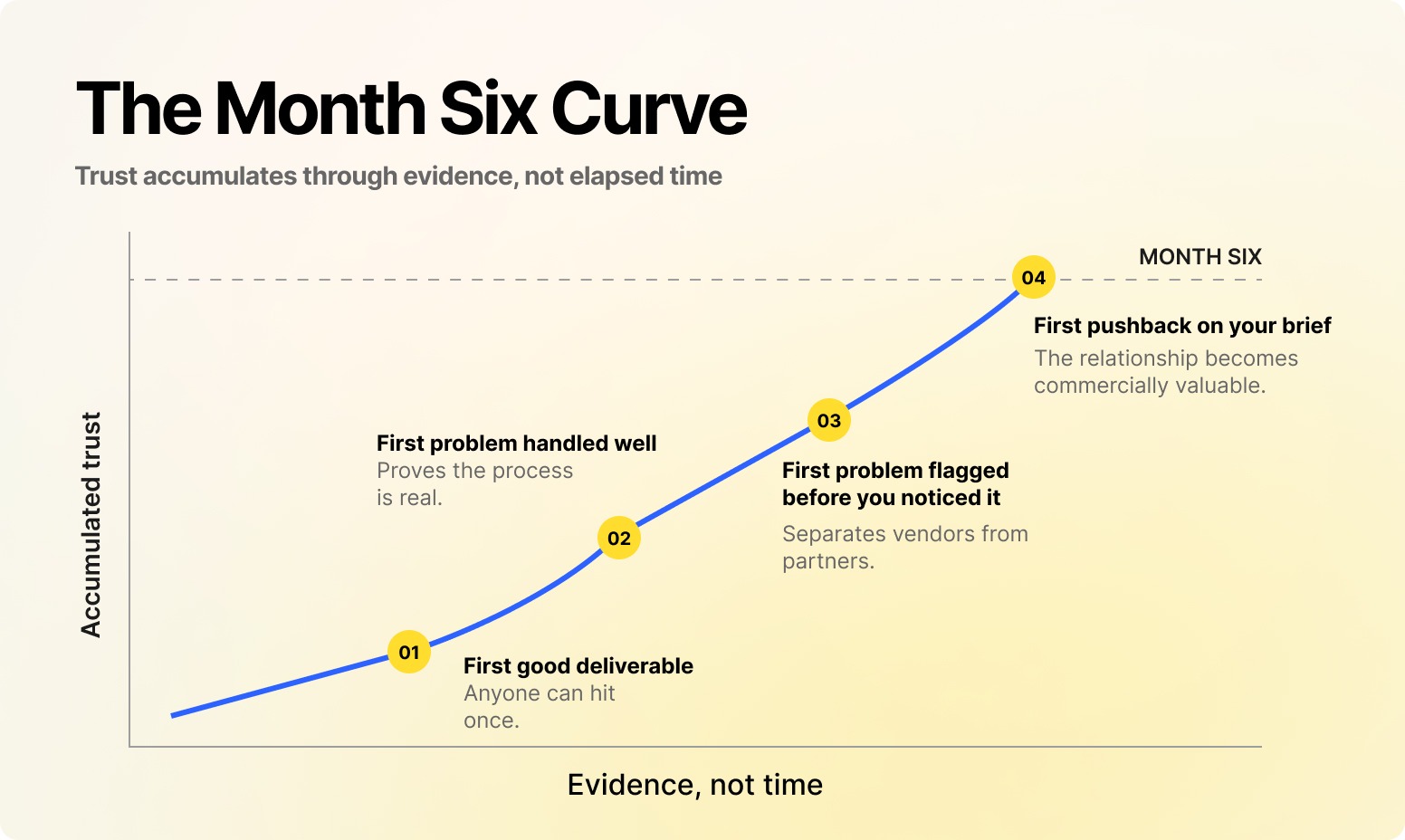
- The first good deliverable. Builds a little, and anyone can hit once.
- The first problem handled well. Builds significantly more, because it shows the process is real.
- The first problem flagged before you noticed it. Builds more still. This is the one that separates vendors from partners.
- The first time they push back on your brief because it will not get the client the outcome. This is where the relationship becomes commercially valuable, which produces a counterintuitive conclusion.
In our own partner data, the longest white label relationships did not have the smoothest starts. They hit something difficult early, and the partner handled it the right way. Difficulty is the fastest trust builder in this category, which is an awkward thing for a white label agency to write down and still true in our tenure numbers.
Key takeaway: Run a paid pilot on a real account with a real deadline, and watch what happens when it gets tight. A single clean deliverable proves nothing.
What is the private conversation actually asking for?
Underneath every objection, switching story, and pricing question, agency owners are asking for the same four things from their partner.
- One that makes them look good in front of their client.
- One that handles problems before they have to.
- One that tells them the truth when it is inconvenient.
- One that treats their margin as a real constraint, not an abstraction.
Now, that is not a complicated brief. Judging by how often the corridor conversation happens, it is not a common delivery either. The agencies that find a partner meeting it stay for years, expand scope because the trust supports it, and refer other agencies without being asked.
The conversation changes from "who are you using" to "you should speak to the people we use." That is the conversation Mavlers Agency is built to be in.
Frequently asked questions
Is it unethical to use a white label partner without telling the client?
No, provided accountability stays with you. Clients are entitled to the standard you promised and one accountable contact, not an org chart of every contributor. Most agency contracts already permit subcontracting. Read yours before you worry about it.
How long should a white-label trial run before I commit?
Long enough to include one deadline under pressure. A single clean deliverable proves nothing. Run a paid pilot across at least two cycles on a live account, because that is where the four failure patterns surface.
What is the difference between white–label and outsourcing?
Outsourcing is any delegation to a third party. White label is outsourcing where the deliverable carries your brand and the partner stays invisible. The commercial difference is that white label pricing has to leave you a resale margin, so exclusions and re-quote triggers matter far more.
Should I tell my white-label partner who the end client is?
Yes, unless a confidentiality clause prevents it. The quality gap between a briefed partner and an anonymized one is large. Use an NDA rather than withholding context. Anonymized briefs are one of the most reliable predictors of disappointing work.
What margin should I expect to keep on white-label work?
That depends on how much rework sits on your side, not on the markup alone. If you are rewriting reports, re-explaining context, and reviewing every deliverable line by line, your real cost includes that time. Agencies that hold healthy margins on this model invest in briefing templates and a defined QA step before work reaches the client.
How do I check whether a partner can actually deliver AI search work?
Ask for a live citation report, not a capability slide. A partner running this properly can show you which buyer prompts they track, which AI platforms they sample, how citation share moved over a defined period, and what content or off-site change caused the move.