







Table of contents
Get in touch
Expect response in 4 hours.

Founder-led sales cease to scale when the founder remains both the company's primary source of demand and the person responsible for converting it. Hiring a sales team to close deals may delegate some random sales activities. But without a repeatable system, salespeople can’t create sales out of thin air. The next qualified opportunity still depends on the founder.
Being the one using your personal network, referrals, and intuition-driven deal-making to build pipelines and bend the deals was not a mistake…early on. It got your business initial traction before building a team and nobody should criticize it. But the company hasn’t yet found what matters for scaling - a commercial engine that can be codified to sales hires or amplified with marketing spend.
We are not here telling the founder to stop selling because the company has reached a particular milestone. We are here helping you recognise at what point founder-led sales has reached its limit. And how to decide what your business needs to build next without losing the pipeline momentum the founder built.
How do you know founder-led sales has hit its ceiling?
Founder-led sales has reached its ceiling when the business can’t close deals or fails to keep injecting fresh leads into the pipeline without the founder's involvement.
The unique credibility as a founder lets you get more responses from referrals and heavy networking, and more founders to talk to you. With these inherent founder advantages, you expend all your energy closing active deals, pushing late-stage proposals over the finish line, negotiating contracts, and getting signatures. You’re so busy being a rainmaker that you stop creating a sales system other people can run better than you.
After an initial pipeline growth, new opportunities stop entering the sales process to replace the ones that close. The pipeline gets exhausted. Such businesses often rely on rented growth, where inconsistent and unreliable fuel keeps the pipeline engine running (erratically!).
Read more about: Rented growth vs Owned demand: Why growing companies stall
Your business's growth may be capped because sales depend on your personal charisma and network - and as a founder, you only have so much time and so many contacts. Here are the signs that the founder-led sales has hit its plateau:
1. The founder is the source of the most revenue
The State of B2B GTM report 2026, based on a survey of 300 B2B software and AI companies, found that:
- 62% depended on networks and introductions as a core go-to-market channel.
- 26% of companies between $1M and $10M ARR still relied primarily on founder-led sales.
The figures raise a question for founders: is your business’s primary pipeline coming from you? How much of the current pipeline will survive if you hit the referral plateau?
To know if you are the source of the most revenue, make a quick assessment using the company's last 20 qualified opportunities. Record the original source of each opportunity and whether the founder's personal network helped bring it in.
How do you interpret this table?
There's no single revenue number in this table that tells you when founder-led sales has reached its limit. At the same time, don't use someone else's revenue milestone to decide when to step away from sales.
SaaStr, for instance, points to 1M–2M ARR as a common inflection point for founder-led sales. However, your average deal value, sales cycle and business model matter far more than a number picked from someone else's experience.
A company generating $5 million in annual revenue with its founder still overseeing production, suppliers and delivery faces very different demands from one with an established operations team handling those responsibilities. Both have reached the same revenue level, but their founders have very different capacities to keep leading sales.
So, read the five metrics together rather than looking for one number that confirms you've hit a ceiling.
- Where do most qualified opportunities come from? Tells you how much new business still depends on your network and personal effort.
- Which sources contribute most to closed-won revenue? Shows whether other acquisition channels are producing actual business or just enquiries.
- How involved are you in closing deals? Reveals whether your team can convert opportunities without relying on your relationships or intervention.
The ceiling becomes visible when the business cannot grow its pipeline and revenue without increasing its dependence on your time and involvement.
Mavlers Agency measures this in every Pipeline Audit through Rented Growth Share.
2. The founder's calendar is setting the company's growth limit
Another sign that founder-led selling has plateaued is when the founder spends a week selling, revenue picks up. The following week, a client delivery issue takes over. Prospecting gets sidelined, new conversations dry up, and the pipeline starts thinning. A month or two later, the founder is back chasing deals to fill the gap.
Growing the business gets harder when the founder is occupied with delivering what they've already sold. This is the catch-22. Winning more customers increases the founder's delivery and operational responsibilities. And leaves less time to bring in the next ones. The work that comes with winning customers can end up slowing down the next stage of growth.
That's the revenue rollercoaster many founder-led companies get stuck on. New business follows the founder's availability rather than a consistent acquisition process. Watch for these signs:
The issue is that sales stops when the founder looks away as there's no self-sustaining system to keep the pipeline moving.
3. The founder's sales knowledge hasn't become a company capability
Founder-led sales hits its ceiling when the founder's understanding of customers, deals and acquisition never becomes company knowledge. The founder knows why a buyer chose the business, which referrals converted and what objections delayed a deal. The CRM records a deal value and stage, but is too occupied to systemize the thinking behind the sale.
Without the playbook, every new salesperson learns through observation rather than following a proven sales process. They rely on the founder to explain the offer, qualify prospects and handle objections. Even when a salesperson takes ownership of a deal, the founder remains the person they turn to when a decision needs to be made.
It’s why just a sales target and some hand holding is not a substitute for that groundwork. A new hire needs a playbook that has a record of how deals move through the pipeline. For sales, it’s a blueprint for replicating top performer’s habits. For marketers, it identifies which channels attract qualified buyers.
The playbook should include:
- Offer and differentiation
- Messaging and values
- Decision-making process
- Buyer pain points
- Discovery notes
- Objections
- Win-loss reasons
This is the driving force behind Mavlers Agency’s demand generation engine: helping businesses connect acquisition channels, CRM and analytics to qualified pipelines. So, acquisition decisions become a repeatable company capability rather than a process dependent on the founder's memory and judgement.
4. You’ve hired for marketing and sales, but new business still comes from the founder
I’ve seen companies hire a marketer and a salesperson, only to find that most new customers still come through the founder’s introductions and outreach. The team is doing more of the work, but the founder is still the one getting buyers in the door.
A salesperson who takes over a deal after the founder makes an introduction has freed up some of the founder’s time. But the business still needs the founder to bring in the next opportunity.
To see whether hiring has reduced that dependence, look at the qualified opportunities created since the team came on board.
- Which came from the founder’s relationships or outreach?
- Which did the team generate without an introduction from the founder?
- And which of those turned into customers?
If the team is generating inquiries but few become qualified opportunities, study the course between the first inquiry and the first sales conversation:
- Are marketing and sales targeting the same buyers?
- Do they agree on what makes an inquiry worth pursuing?
- Is someone responsible for following up?
Those answers tell you whether to improve who you’re reaching or how you handle the interest you already have.
5. A new sales hire struggles without a repeatable pipeline system
One sign that founder-led sales has hit its ceiling is when a new sales hire inherits none of the pipeline as most revenue came from people who already know you, not them. It’s because, while the hire is expected to deliver revenue, the business hasn't built the demand channels needed to bring qualified opportunities into their pipeline.
Mark Gordon hits on this exact trap on The Growth Ceiling podcast. A sales leader in an established company benefits from a recognised brand, clear messaging, marketing support and an existing sales process.
Drop that same leader in a growing business and the game changes. Suddenly, they’re expected to build the entire engine while hitting a revenue target. That's not simply a sales role. It's a demand generation and sales-building role.
Before expecting a sales hire to deliver, the business needs this:
The foundations create a repeatable pipeline.
As Nevilson says, Growing companies don't need more tactics. They need one system where every tactic pulls towards the pipeline.
Until that system hardens, another sales hire risks inheriting a revenue target without the tools to reach it.
How do I hand off sales from the founder?
Don't hand over sales simply because you're tired and you want a sales rep to bail you out of selling. Because you might be stepping out of the sales seat before the seat can keep itself warm. Hand it over when you’re confident about what makes your customers buy and have a transferable sales process a new hire can learn and repeat.
There's a difference. A founder might have a strong close rate because of personal relationships, years of product knowledge or the freedom to customise an offer on the fly. A new salesperson won't have those advantages. The first job is to draw a hard line between what the business can repeat from what only you can deliver as founder.
Next, before the sales handoff can succeed, document the information and decisions that currently live in your head.
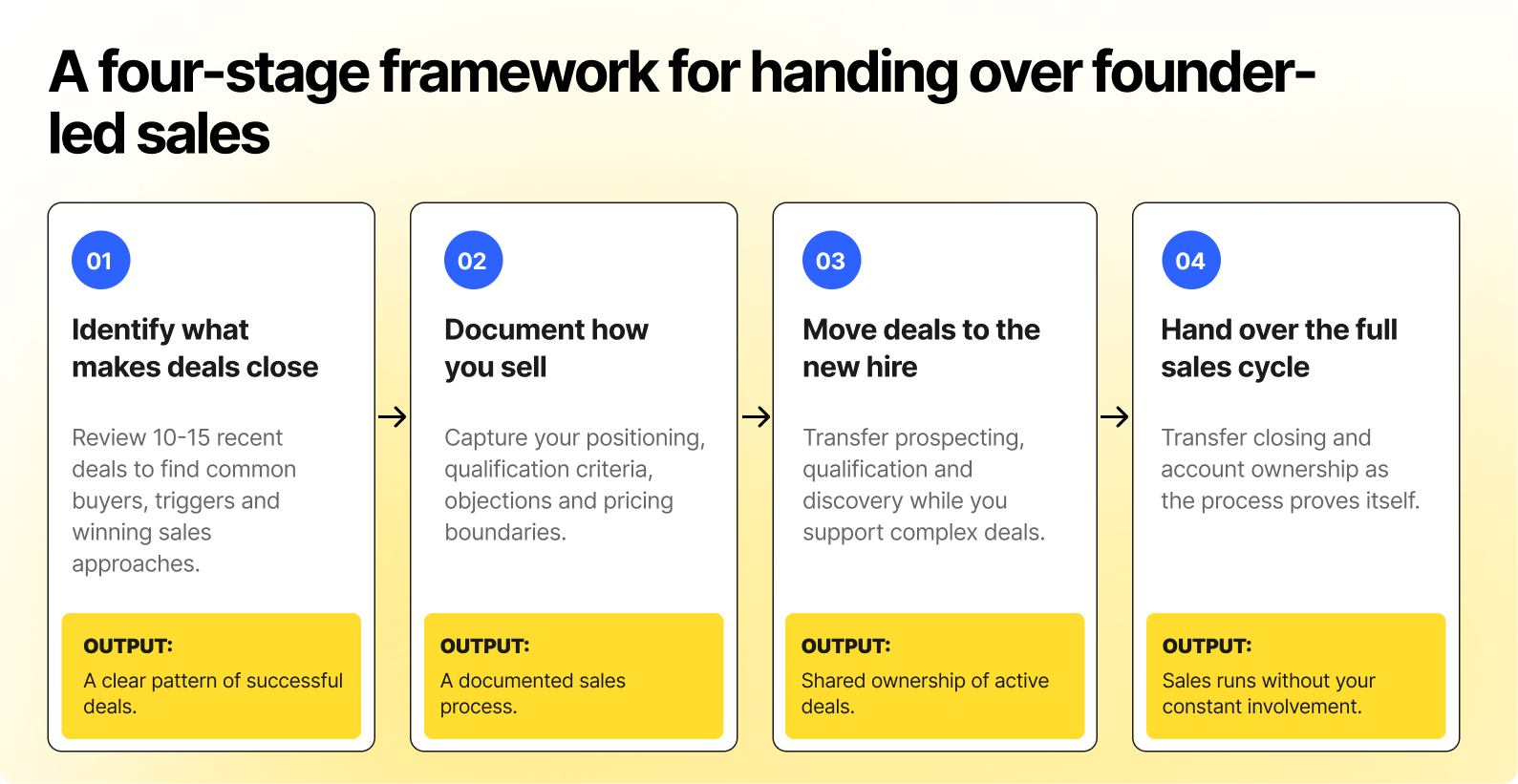
If these foundations are missing, use the next few weeks to establish them before you scale your sales team. Then, this framework.
1. Identify the sales motion worth transferring.
Review your last 10–15 deals. Separate customers who bought your core offer from those who needed personal introductions, custom solutions or special pricing. Identify the customer profile, buying triggers and sales approach behind the wins.
2. Turn those patterns into a working playbook.
Record sales calls, save proposals and follow-up emails, and document positioning, qualification criteria, objections and pricing boundaries.
3. Transfer ownership without putting every deal at risk.
Let the new sales hire handle prospecting, qualification and initial discovery. Retain strategic accounts and complex negotiations. Review calls and deal progression together.
4. Step back as the process proves itself.
Gradually transfer negotiations, closing and account ownership. Review conversion rates, deal progression and founder intervention. Address recurring gaps before adding more salespeople.
Pipeline generation needs attention throughout this transition from founder-led sales. Your new salesperson needs qualified opportunities beyond your personal network. Mavlers Agency builds this capability through connected demand generation, acquisition channels and CRM visibility.
The handover is complete when the business can attract and convert its target customers without depending on the founder to make every deal happen.
After founder-led sales, what comes first: a sales hire, a marketing hire or an agency?
There is no fixed order. A business should hire around the problem holding back growth. It may need someone to close more existing opportunities, someone to create demand beyond the founder’s network, or a team that can build the acquisition function across several disciplines.
These are different jobs. A salesperson cannot be expected to create demand. A marketer cannot become an entire marketing department. And an agency that only runs campaigns may leave the business with little more than campaign reports.
1. Hire a salesperson when the founder cannot keep up with qualified demand
There are more qualified conversations than the founder can personally take through discovery, proposals and negotiation. Customers are buying, the sales cycle is understood, and the founder can explain why some opportunities close while others do not.
That is a stronger hiring signal than revenue alone.
SaaStr suggests founders close 10–20 deals before hiring an account executive (AE). Andreessen Horowitz argues that founders in early markets may carry sales to around $4 million ARR or beyond. In my opinion, neither figure should dictate the handoff decision. The founder needs enough demand to justify another seller and a sales process that person can learn and run.
The first AE should:
- Turn qualified conversations into signed deals.
- Help the founder turn sales instinct into a process future sales team can learn.
- Test your sales playbook before handing off to a sales leader or VP.
2. Hire a marketer when the business can sell but struggles to create demand
The founder can close good-fit customers, but new business still depends heavily on personal relationships. The company needs to reach buyers who don't already know the founder.
A first marketing hire can help sharpen positioning, understand buyer needs, develop content and establish channels that fuel the pipeline with qualified prospects.
HubSpot makes a case for starting with a marketing generalist who can work across website content, landing pages, newsletters and social media. That's a sensible approach for a lean business. But as the company grows, the demands on marketing change.
Product marketing needs sustained customer research, positioning and sales enablement. Paid acquisition, SEO, content, email, AI search and CRM each require specialist expertise. Mavlers Agency believes these capabilities should work as one connected demand generation function, not a collection of disconnected marketing tasks. A generalist can coordinate the work, but specialists need to execute it, with everyone working towards shared qualified pipeline goals.
3. Bring in a demand generation team when the business needs more than one specialist can provide
Hiring several specialists may be premature. Hiring one marketer may leave critical areas uncovered. Working with separate agencies can create another problem: each partner delivers against its own brief, while the business is left to connect the work.
An integrated demand generation team brings strategy and specialist execution under one plan. Search insights inform content priorities, buyer objections shape positioning, and campaign and CRM data show which channels contribute to qualified opportunities.
The company should also retain the capability being built. Work should happen within its own accounts and systems, with CRM data, workflows, reporting, channel learnings and processes staying with the business.
How do you build a predictable pipeline beyond the founder?
A predictable pipeline starts with knowing which customers you win, why they buy and where similar buyers can be acquired. The business needs a defined ICP, clear positioning, a repeatable demand generation process and CRM data that connects acquisition to revenue. Without these, the founder's network remains the company's most dependable acquisition channel.
Four things need to be in place:
- ICP and positioning: Identify the customer segments with a consistent win record. Understand their buying triggers, decision-makers and reasons for choosing you. Build your messaging around these findings.
- Demand generation: Invest in channels that reach these buyers. SEO, paid search, LinkedIn, content, email and outbound are options. Measure their contribution to qualified pipeline, not just enquiries.
- Sales enablement: Transcribe the pitch, common objections, competitive alternatives and reasons deals are won or lost. A new salesperson should not have to learn the entire sales motion through trial and error.
- CRM and pipeline tracking: Record lead sources, deal stages, qualification details, sales cycle, conversion rates and closed-lost reasons. Without this information, forecasting and channel investment rely heavily on assumptions.
A high enquiry volume doesn't guarantee a healthy pipeline. Measure how many leads match your ICP, become qualified opportunities and convert into customers. Pipeline contribution matters more than lead volume.
Our related article, Demand generation vs. lead generation: The revenue gap, explores how do you move from lead generation to demand generation without losing pipeline.
How Mavlers Agency approaches this
Mavlers Agency connects these activities through its Pipeline Engine Framework:
BUILD → FILL → COMPOUND
- Build: Establish the ICP, positioning, CRM and tracking.
- Fill: Generate qualified demand across relevant channels.
- Compound: Improve acquisition and conversion using pipeline data.
Read more about the Pipeline Engine Framework.
What should the founder still own after the transition?
You've hired a sales team. They're handling prospecting, running calls and closing deals. Does that mean you can stop speaking to customers?
Not quite.
One thing founders shouldn't lose when they hand over sales is direct contact with the market. Your sales team will handle day-to-day conversations, but you still need to hear what customers are saying. Their expectations change. New competitors enter the picture. Sometimes, the reason customers chose you six months ago isn't the reason they'll choose you today.
I recommend setting aside five to seven hours a week for customer conversations and networking. That's enough to stay connected without taking sales responsibilities back from the team.
So, what should a founder continue doing after handing over sales?
- Customer conversations: Keep speaking to existing customers and prospects. Find out what they're happy with, what isn't working and what they wish your business offered.
- Market changes: Stay in touch with people in your industry. Pay attention to new competitors and changes in how customers make buying decisions.
- Business positioning: Use what you hear from customers to question whether your offer, messaging and target market still make sense.
- Important commercial decisions: Decide which markets to pursue, which strategic relationships to invest in and where the business should focus next.
There's one more thing. You also need to let your sales team make decisions without coming back to you every time. Set clear boundaries around pricing, negotiations and customer commitments. Let them handle routine decisions within those boundaries.
Frequently asked questions
When should a founder hire their first salesperson?
Hire when you know which customers you're targeting, why they buy from you, how to qualify opportunities and how to move a deal towards closing. You should also have enough qualified opportunities to support another salesperson. Revenue alone is not a reliable hiring trigger.
Should a founder hire a salesperson or marketer first?
Hire a salesperson when you understand why customers buy and have enough qualified opportunities but lack the time to close them. Hire a marketer when you know who you want to reach but need to generate demand beyond the founder's network. If the founder is still the only person who understands the customer and what makes them buy, document that knowledge before hiring either.
Can founder-led sales work alongside a marketing team?
Yes. The founder can continue bringing customer and market insight while marketing builds demand beyond personal relationships. But both need to follow what happens after an enquiry comes in. Channel reports may show leads and clicks, while nobody checks how many of those leads become qualified opportunities or customers. Marketing and sales need to share that responsibility.
Why do first sales hires fail at growing companies?
First sales hires often struggle because founders hand over sales activities before documenting how the business wins customers. The new hire may be experienced, but still lack a clear customer profile, positioning and a process for moving deals forward. Founders also need to transfer decision-making authority, not just tasks. Otherwise, the team continues waiting for the founder to make things happen.
What should you build next?
If this article has made you question how much of your pipeline still depends on you, there's probably a bigger question worth asking: Do you know where your growth system is working, and where it's leaking opportunities?
Before you hire another salesperson, invest in another channel or add more marketing activity, find out what's holding growth back.
Take the Free Pipeline Audit from Mavlers Agency. We'll look at your website, channels, tracking and CRM to help you understand what's holding your pipeline back from growing.
The goal is to build a demand generation function that your team can run and improve as the business grows. So, when you step away from sales, the pipeline doesn't slow down with you.
And if this article made you rethink how your business generates demand, share it with another founder who might be facing the same growth ceiling.