


Table of contents
Get in touch
Expect response in 4 hours.

While your marketing team ends up hitting its lead target this quarter, sales might have a different story to tell. Yes, they say that most of the leads are junk.
Wondering who to place the blame and frustration on? Well, both teams are telling the truth, and truly both are frustrated.
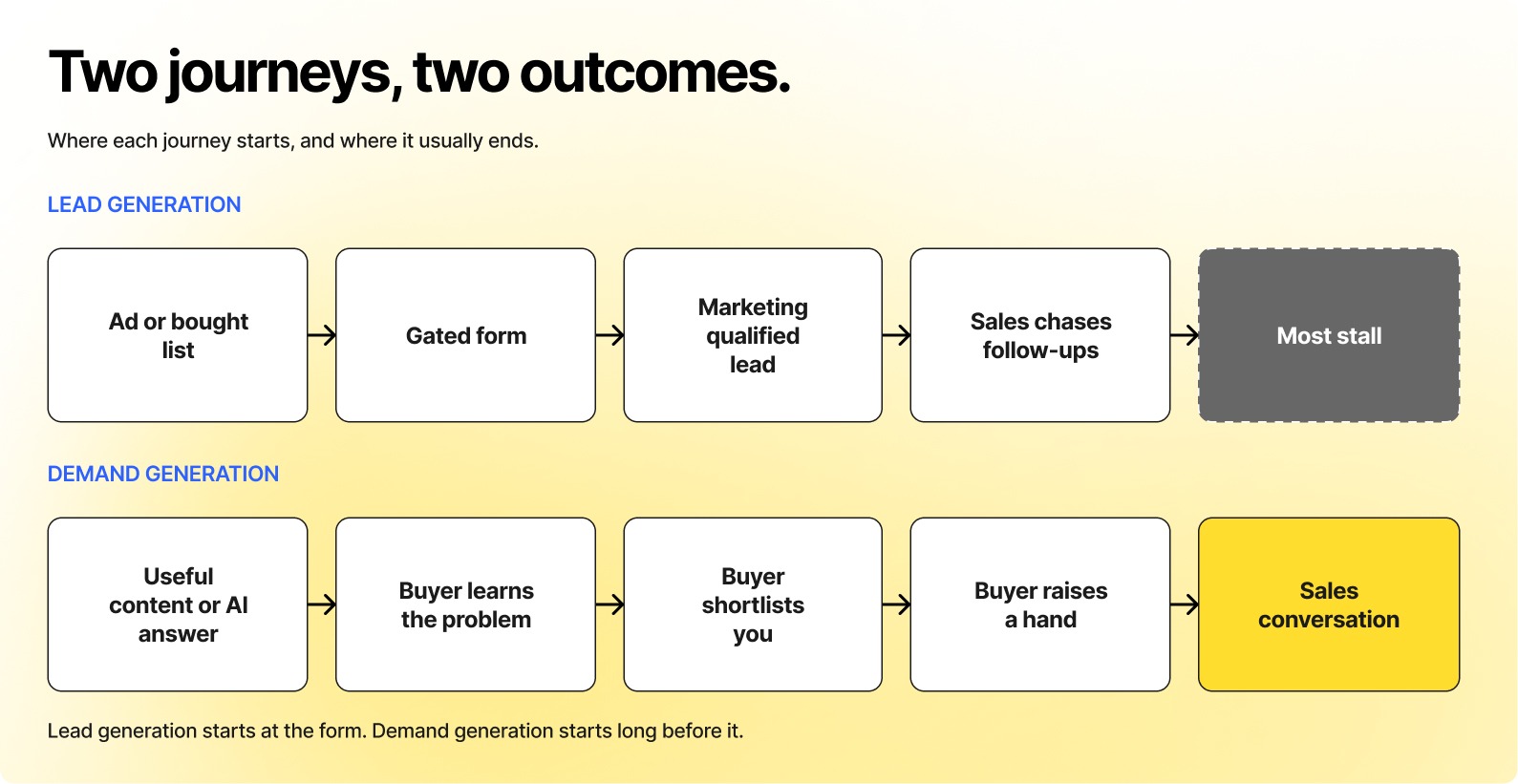
That gap is the real difference between demand generation and lead generation. Lead generation captures contact details from people who show interest. Demand generation creates the buyers who come looking later.
Lead generation still has a marked job, which is to capture buyers who are ready to invest now. The difference decides where your cost of selling lands, and that decides revenue.
Below, we cover what changes, how to diagnose junk leads, how to choose, and how to switch without losing pipeline.
What is the difference between demand generation and lead generation?
Lead generation captures contact details from people who have already shown interest, usually through forms and gated content. Demand generation creates that interest in the first place, by showing the right buyers why their problem matters before they're ready to buy. While one collects names, the other creates buyers.
Lead generation works at the end of the buying journey. Demand generation works across all of it, including the long stretch before anyone fills in a form.
When this doesn't apply: Most companies need both. The real question is which one leads, and which one you measure.
Is demand generation better than lead generation?
Neither demand generation nor lead generation is better on its own. Demand generation creates the buyers, and lead capture turns their interest into a conversation. The mistake is running lead generation alone and expecting it to create demand that isn't there, so build demand first, then capture it.
A common pattern we have observed is that a company doubles its lead budget, the lead count rises, and pipeline stays flat.
A caveat is due here: if buyers already search for your category by name, lead capture can carry more of the load for longer.
Why do bought and gated leads convert so poorly?
Most people who fill in a form aren't buying; they are simply there for the free download. B2B buyers also tend to choose favourites early, often before they ever speak to sales. Leads reach sales either too early to buy or too late to influence, and sales spends its week chasing names.
6sense’s 2025 Buyer Experience Report surveyed more than 4,000 B2B buyers. It found 94% of buying groups had ranked their preferred vendors before first contact.
We recommend watching for these signs that lead generation could be hiding a demand problem:
- Cost per lead goes up while lead volume stays flat.
- Sales quietly ignores whole lead sources.
- Booked demos don't turn up.
- The same companies download everything and never really end up buying.
When this doesn't apply: Lead quality varies by source. A list of people already researching your category behaves very differently from a cold, bought list.
What should you check first when sales says the leads are junk?
When Joe from sales lands up at your desk with a chip on his shoulder saying that the leads are trash, here’s what you should be checking for;
- Positioning
- Intent
- Platform
- Pricing
Junk leads are often a symptom, and one of these four is the cause. Fix the first one that's broken before you spend more on leads.
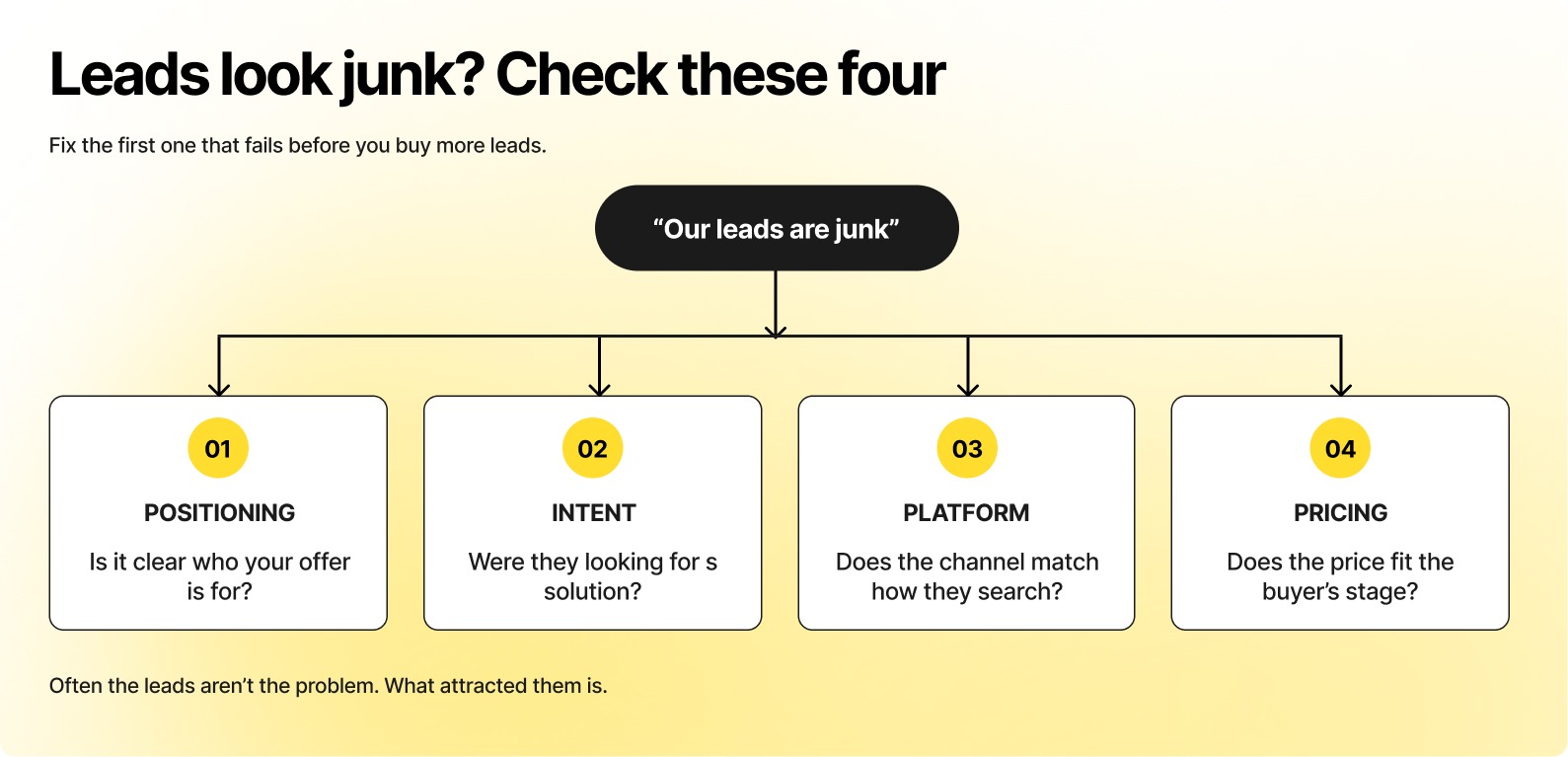
This is where we start every "our leads are junk" conversation. Often the leads aren't the problem. What attracted them is.
When this doesn't apply: If all four checks pass, it is recommended to look at sales follow-up next.
Why does the difference decide your revenue?
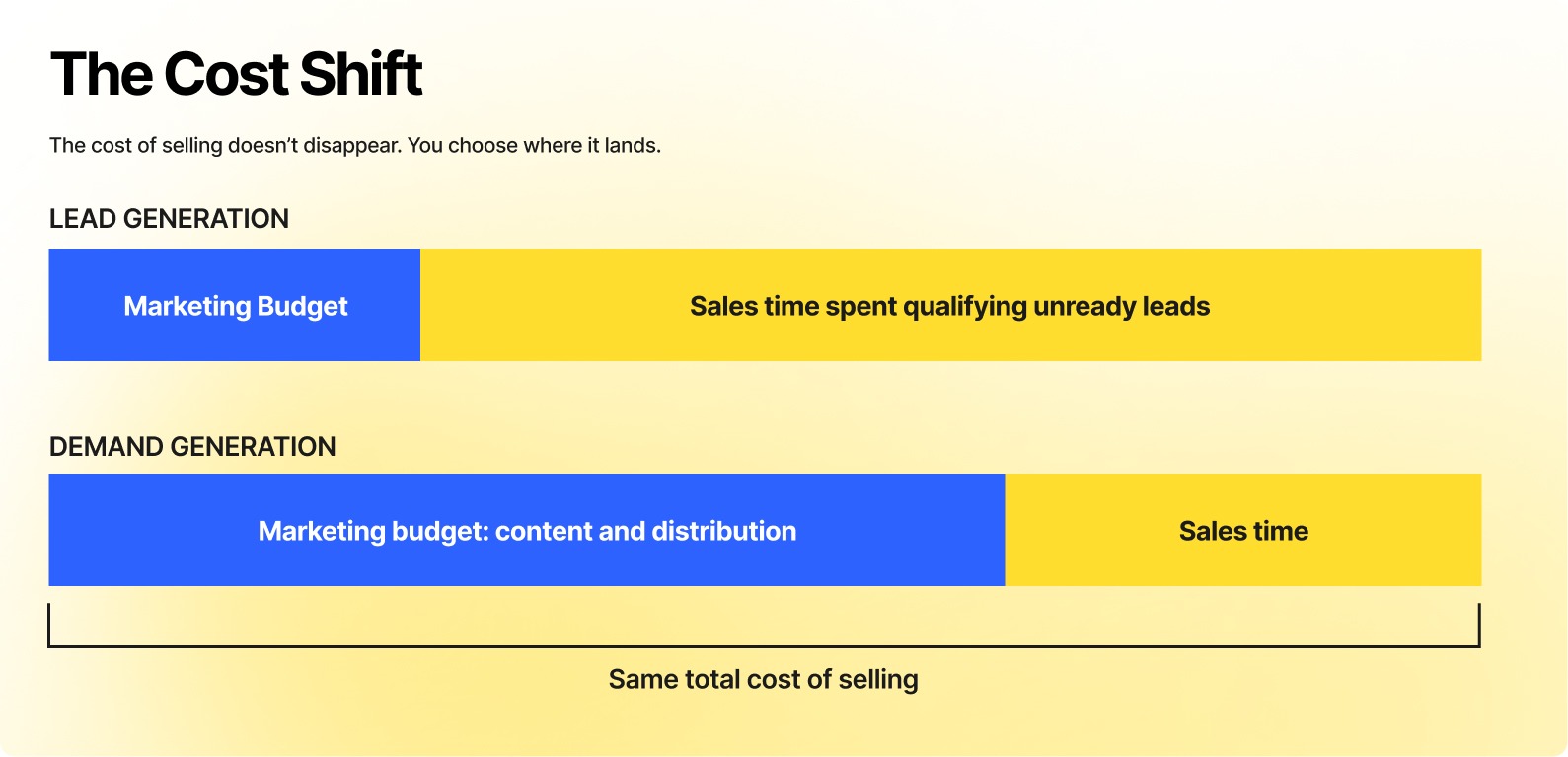
Cheap leads don't obliterate the cost of selling; instead, they move it from the marketing budget to your sales team's calendar.
Every unready lead potentially costs a call, a follow-up, and a forecast that won't close. Demand generation accounts for that cost earlier, so sales talks to people who already want to talk.
At Mavlers Agency, we call this the Cost Shift. The total cost of selling doesn't disappear. You only choose where it lands.
The Cost Shift has a root cause, which is an unclear ideal customer profile (ICP). Our Head of Growth, Nevilson Christian, has seen this from the buyer’s side. He has filled in contact forms and been told, politely, that the business wasn’t a fit.
Those companies don't have a lead quality problem. They know when to say no, and how to say no.
Let’s explore an illustrative example of two lead sources with the same spend, in indexed units rather than real prices.
When this doesn't apply: If sales has spare time and deals close in one call, the shift may be affordable for a while.
How do sales and marketing agree on what a qualified lead is?
It is important to agree on the ideal customer profile (ICP) first, then judge every lead against it. A qualified lead fits on industry, team size, and revenue, and shows a real need, clear intent, and a plan to start soon. Without that shared definition, sales and marketing will end up arguing about every lead.
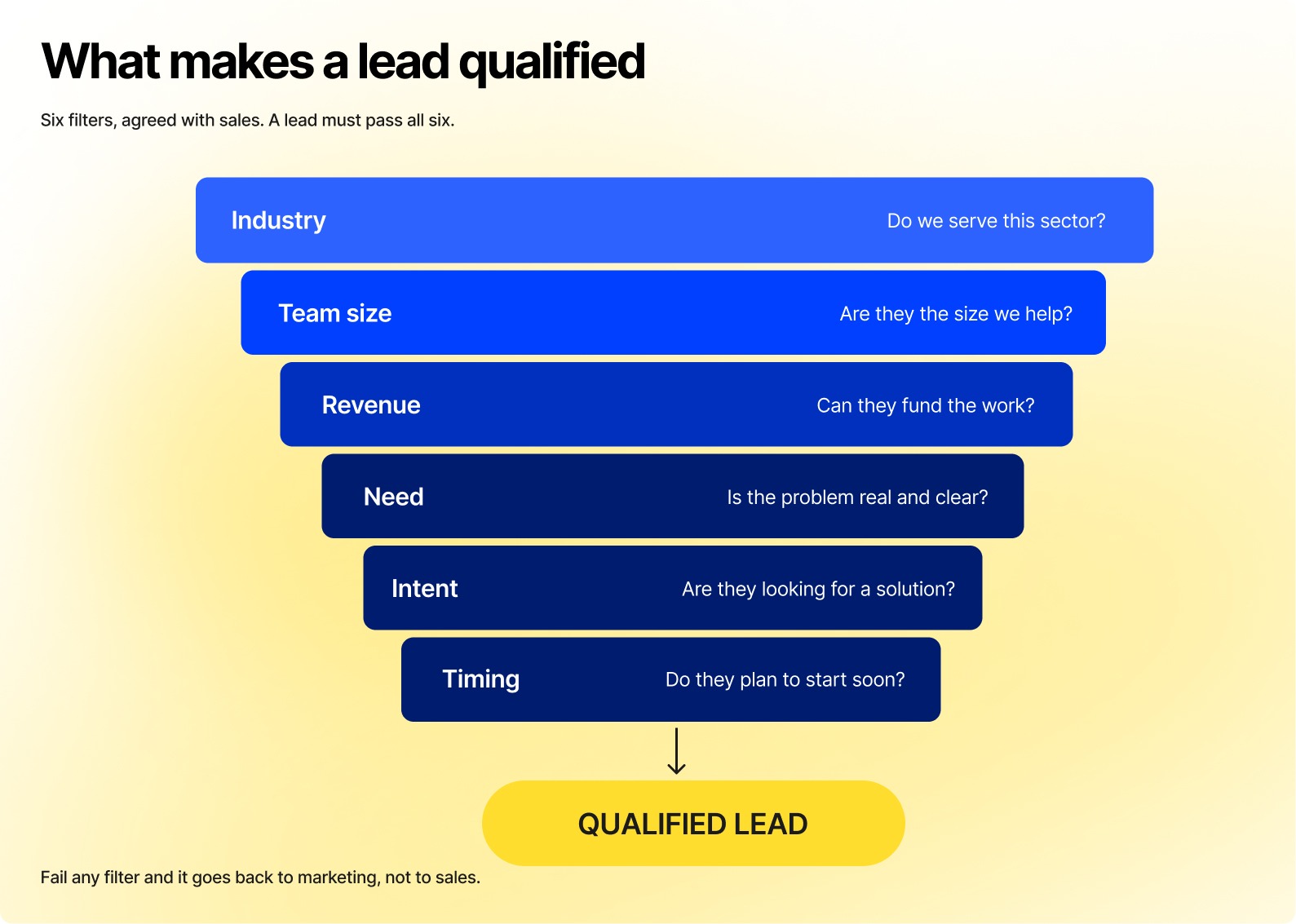
A marketing-qualified lead (MQL) is often a lead whose need and intent aren't clear yet. That's why clarity on your ICP and positioning makes all the difference.
When this doesn't apply: Your ICP will shift as you grow. Review the filters with sales regularly.
What should you measure instead of lead volume?
We recommend measuring what sales can close, not what marketing can count. Track qualified opportunities, pipeline created, win rate, and what buyers say brought them to you. Keep the marketing-qualified lead (MQL) as an early signal if it helps, but stop treating it as the target.
- Qualified opportunities. Leads that fit your ideal customer profile (ICP).
- Pipeline created. The value of qualified opportunities, by channel.
- Win rate. The share of opportunities that become customers.
- Self-reported attribution. Ask "How did you hear about us?" on the demo form.
Before deals close, look for early signals, such as more leads that fit your ICP, more sales conversations happening, and more discussions reaching the proposal stage. That's what a founder can show the board first.
When this doesn't apply: Self-reported attribution is a direction, not an exact figure. Read it alongside customer relationship management (CRM) data.
Should you buy leads or build demand?
Build demand if buyers don't yet search for what you sell, your deals take several conversations, or sales is buried in follow-up. Buying leads can work when the category is well known, the sales cycle is short, and sales has time to qualify. The following 3 questions tell you which fits.
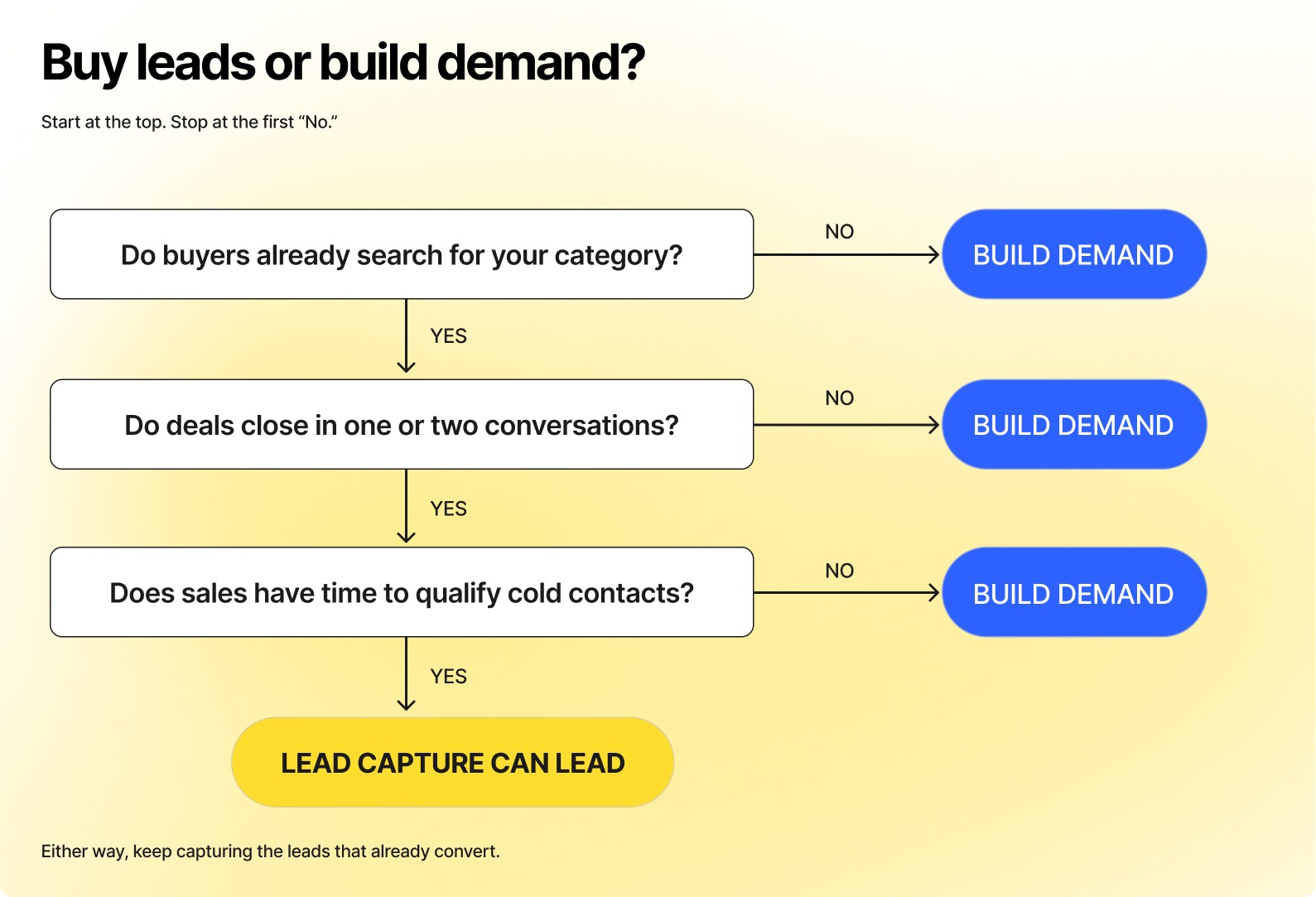
On a first call, we use a simple rule. If nobody is searching for what you sell, you have a demand problem.
If people search but few enquire, you have a lead problem. In emerging categories, that usually suggests that you circle back to the drawing board and work on positioning or pricing.
When this doesn't apply: These questions point you in a direction. They aren't a verdict, and a mix often works best.
When does lead generation still make sense?
Lead generation still makes sense when the demand already exists. That's true when buyers search for your category, deals close in one or two conversations, or you're following up with people who know you. Your job then is to capture demand before a competitor does.
You don't have to stop buying lead lists either. Keep the ones that bring in people who fit your ideal customer profile.
When this doesn't apply: Even here, judge lead generation by the opportunities it creates, not the lead count.
How has AI search changed demand generation vs lead generation?
As of November 2026, AI search has moved the top of the funnel, as a growing percentage of buyers now skip the reading and ask an AI tool for a solution and a shortlist. If your brand gets cited in that answer, you've successfully created demand without a lead form.
In 2015, the playbook was simple. Publish ungated blogs, offer a lead magnet, collect the form fill, and pass the lead to sales.
Today, buyers ask for a solution straight away. Their intent is different from the Google era, so the old top of the funnel is broken.
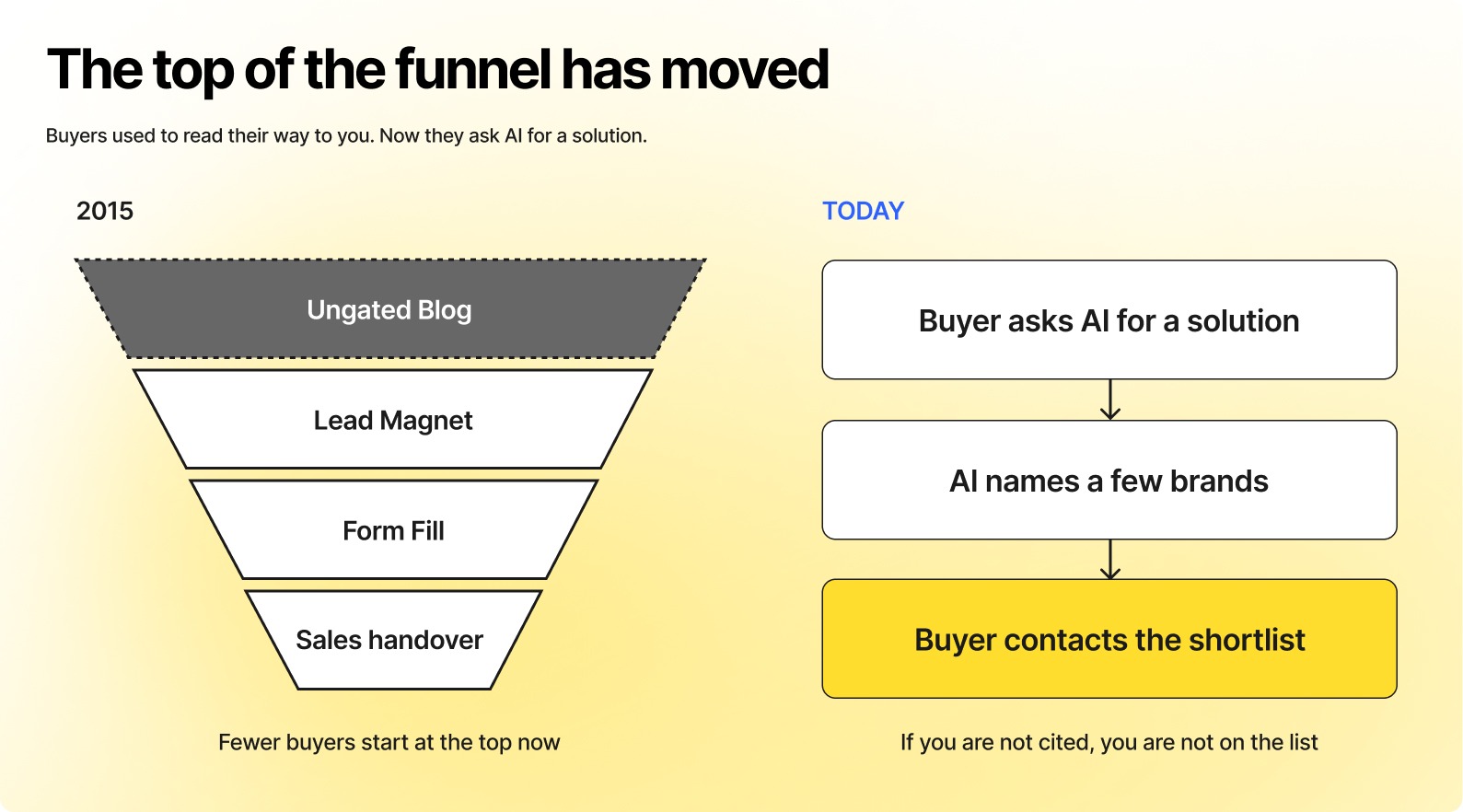
Semrush's March & April 2026 survey backs this up. Of American professionals using AI at work, 66% regularly use it to research vendors. Most describe their use case or problem (61%).
Illustrative example: An online store owner asks an AI assistant this: "Suggest a performance marketing agency that can improve return on ad spend for my e-commerce store."
Agencies that clearly say they serve e-commerce are easier for the tool to recommend than generalists.
We've seen this in our own business. When we described ourselves the same way everywhere, AI tools repeated that description with very little search optimisation behind it.
When this doesn't apply: AI answers change often. Therefore, it is a good practice to use tracking tools and run a fixed set of prompts on a regular schedule, rather than trusting one screenshot.
Do you need a demand generation agency or a lead generation agency?
A lead generation agency is usually paid for lead volume, so leads are what you get. A demand generation agency should be accountable for pipeline: the qualified conversations your sales team can close. Ask any agency what it reports on each month, because the answer shows what it's really selling.
- What do you report on each month: leads or qualified pipeline?
- Who owns the number on our account?
- Do you promise a set number of leads or meetings?
We don't promise leads or meetings. We build you a pipeline engine using the Pipeline Engine Framework: Build, Fill, Compound. It filters for your ideal customer profile, and even if the contract ends, the engine stays.
When this doesn't apply: If you only need meetings booked for an offer buyers already want, an appointment-setting agency may be enough.
How do you move from lead generation to demand generation without losing pipeline?
Don't switch off lead generation overnight. You may choose to keep the lead sources that turn into qualified opportunities, and then move the rest of the effort towards demand one step at a time. Align the new target with sales before you change tactics, then let the numbers show what works.
- Define your ideal customer profile (ICP) with sales. Align on the six filters discussed above first.
- Audit what converts. Trace qualified opportunities, instead of form fills, back to their source.
- Keep what works. Campaigns that bring ICP-fit (Ideal Customer Profile) leads keep running. Don’t reinvent the wheel.
- Become easy to cite. Elucidate with extreme clarity who you serve and what you solve, the same way everywhere.
- Ask buyers. Add "How did you hear about us?" to the demo form.
- Review monthly. Move money towards what converts.
When this doesn't apply: Lead volume may fall as you tighten your ICP. That's expected, so watch qualified opportunities instead.
What else do people ask about demand generation vs lead generation?
Buyers usually ask four more things about demand generation vs lead generation. They ask how it differs from brand awareness, where outbound fits, and whether small companies can do it. They also want to know how long it takes before demand generation shows up in the pipeline.
Is demand generation the same as brand awareness?
No. Brand awareness measures how many people know you. Demand generation aims at people who could buy, and is judged on qualified pipeline.
Is outbound demand generation or lead generation?
It can be either, so it doesn't fit neatly in one box. We treat outbound as one channel inside a pipeline engine, aimed at accounts that fit your ideal customer profile (ICP).
Can a small company do demand generation?
Yes. Team size matters less than whether you can fund marketing consistently, for long enough for the engine to build.
How long before demand generation shows up in pipeline?
It depends on your sales cycle and starting point. Early signals such as more traffic, ICP-fit leads, and more sales conversations come first. Pipeline follows.
Where should you start?
You may start by finding out which of your leads are buyers and which are just names. Our Free Pipeline Audit looks at your revenue, traffic, leads, deal size, lead sources, tools, and lead quality. It ends with clear recommendations on positioning, channels, and automation for your stage.
- Lead generation captures buyers who are ready. Demand generation creates the next ones.
- Judge every lead source by cost per qualified opportunity.
- Get clear on your ideal customer profile before you change tactics.