







Table of contents
Get in touch
Expect response in 4 hours.
.png)
An acquirer does not buy your agency for what it earned last year. They buy the expectation that it will still earn that in three years without you in the building. AI search barely touches last year's revenue. It goes straight to the three-year expectation, which sets your valuation.
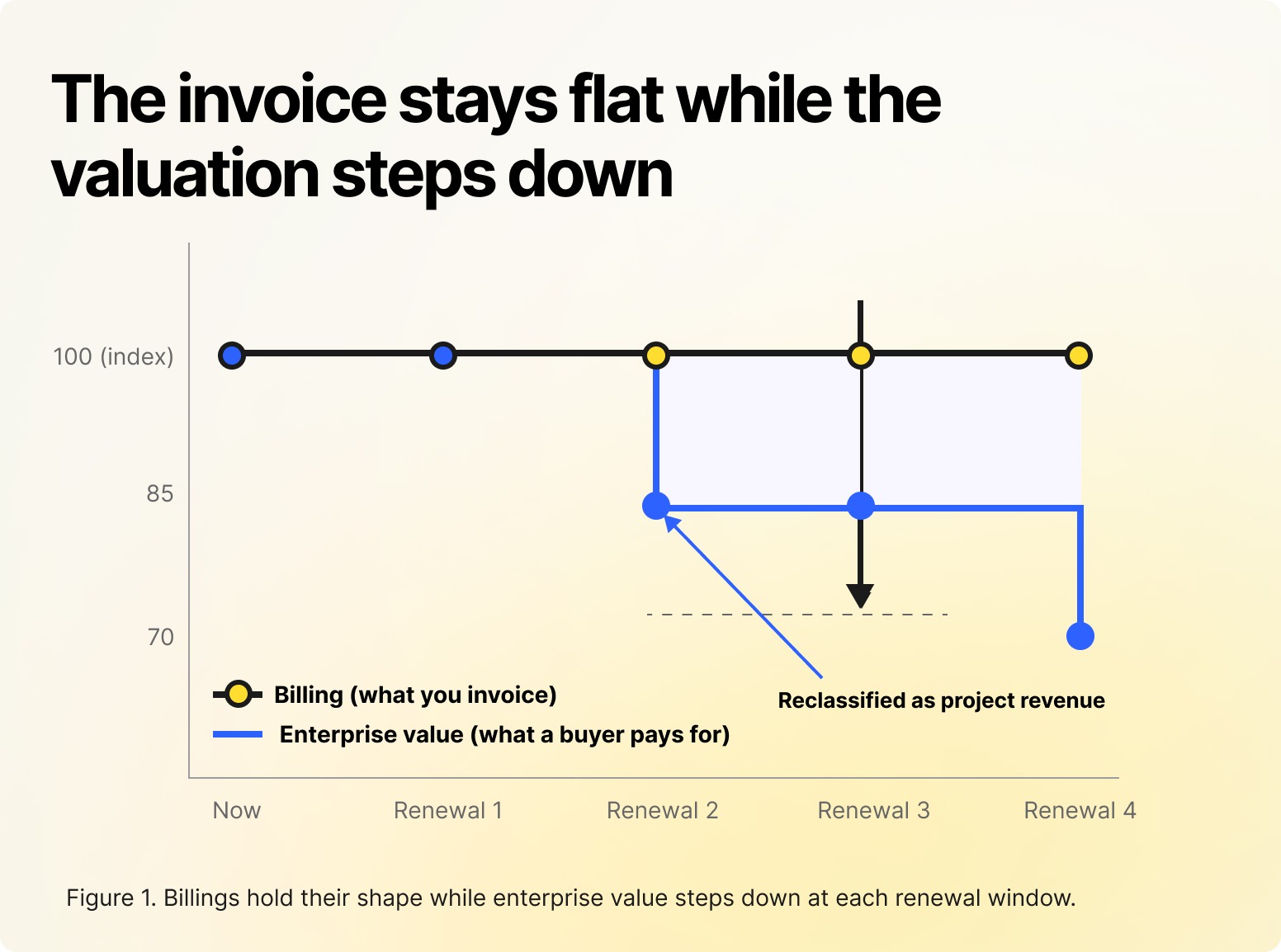
That is the part most owners miss. Revenue is contracted, so it remains unchanged until the renewal call. Enterprise value is a forecast, so it drops the moment a buyer stops believing your retainers will renew at today's price.
Here is the mechanic in plain terms. Before a buyer prices your agency, they sort your revenue into two piles. Recurring revenue is money they believe will arrive again next year without anyone selling it again. Project revenue is money they believe has to be won again from scratch.
Recurring revenue is worth materially more per dollar, often two full points of multiple more. That sorting has nothing to do with how you invoice. It depends entirely on whether the buyer believes the client will renew at today's price. AI search changes that belief without changing a single invoice.
The traffic charts everyone is circulating are not the real issue. The real issue is how those charts change the way a buyer sorts your revenue, and that re-sorting is already happening to agencies that just closed a strong quarter.
AI search and agency growth are one conversation. AI search and agency valuation are a different conversation, and the valuation one is moving faster.
This article covers what AI search actually changes about how agencies are valued, why the traffic data everyone quotes is being misread, which retainers are exposed, how buyers are repricing them in 2026, and the scoring model Mavlers Agency runs across a book of business before the problem surfaces in a data room.
Definitions used throughout.
Enterprise value: The headline price a buyer pays for the business. In practice, it is adjusted EBITDA multiplied by a multiple.
Adjusted EBITDA: earnings before interest, taxes, depreciation, and amortization, with owner-specific and one-time costs normalized out. It is the number a buyer multiplies.
Multiple, and one "turn" of multiple: The multiple is what adjusted EBITDA gets multiplied by. One turn is one full point on that multiplier. On $500,000 of adjusted EBITDA, one turn is $500,000 of enterprise value.
Non-branded organic sessions: Visits from Google searches that did not include the client's brand name.
Retrade: A price cut a buyer asks for after their initial offer, usually triggered by something found in diligence.
Share of answer: The percentage of a defined set of buying-intent prompts where the client is named in the AI answer.
Statement of work (SOW): The signed document defining scope, duration, and fee. Buyers count signed multi-month SOWs as evidence of recurring revenue.
Recurring vs project revenue: Recurring revenue is what a buyer believes renews without a new sale. Project revenue is what a buyer believes has to be re-sold. The same account can be filed either way, and the choice is worth roughly 2x on most books.
Underwrite: What a buyer does when they decide how much of your revenue they are willing to believe. If they "underwrite a retainer as project revenue," they are paying you the lower multiple for it.
Diligence and the data room: Diligence is the verification period after a buyer makes an offer. The data room is the shared folder of contracts, financials, and client history they dig through. A price cut discovered during diligence is called a retrade.
Answer layer: the interface where an AI system synthesizes a response instead of returning a list of links.
Why does AI search hit agency valuation before it hits agency revenue?
Because valuation is a forecast, while revenue is a receipt; you are paid for the month that just closed. You are bought for the next thirty-six.
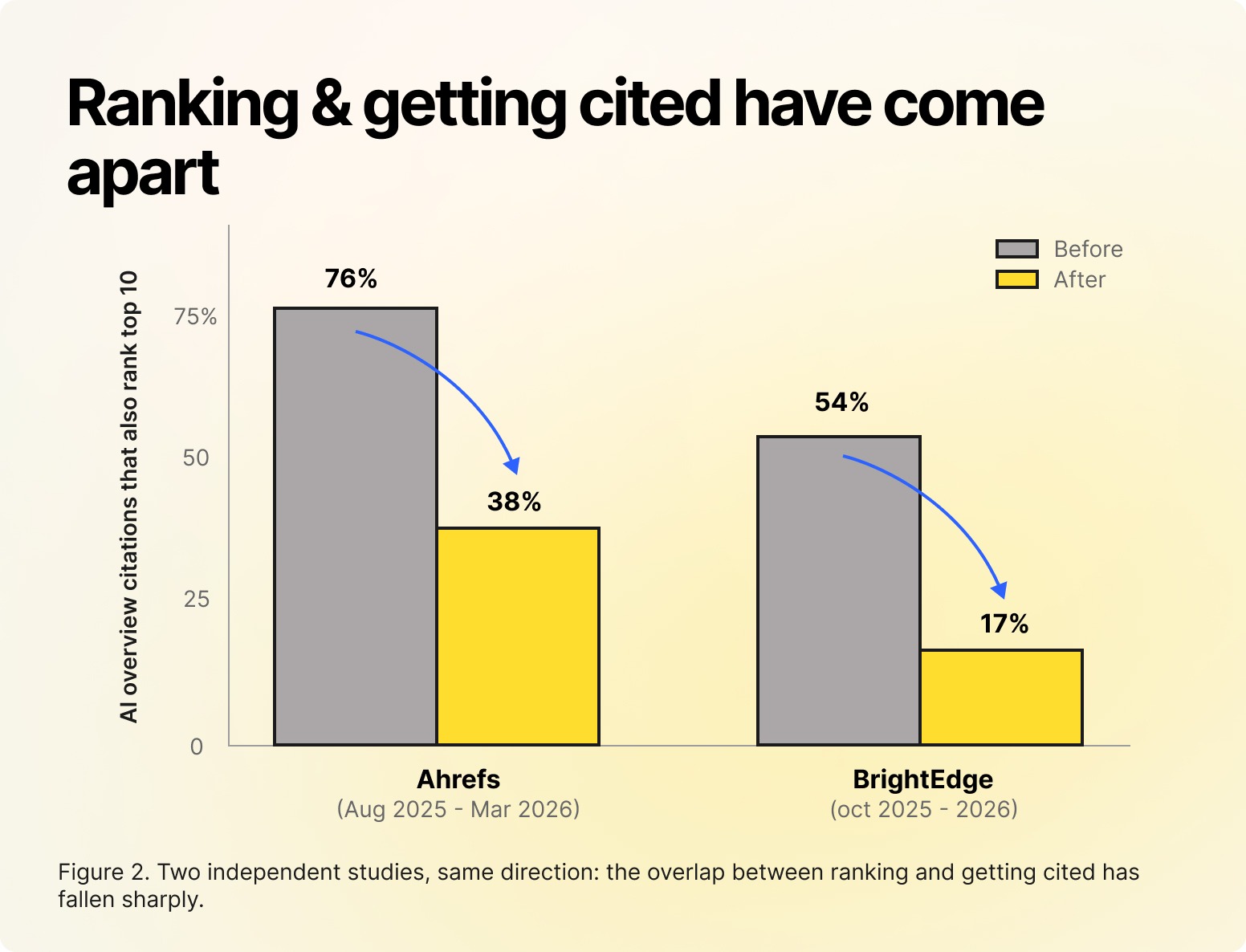
The split between the two is now measurable. Ahrefs analyzed 863,000 keyword SERPs and roughly 4 million AI Overview URLs. They found that only 38% of pages cited in AI Overviews also rank in the top 10, down from 76% seven months earlier (via Search Engine Journal, March 2026).
Here’s what that stat actually says. Being cited in an AI Overview means the AI answer names your client's page as a source. Ranking in the top 10 means the page sits on page one of classic search results. Those used to be the same set of pages. Now roughly six out of ten cited pages are not in the top 10 at all, which means a client can be winning in AI answers while their rank report looks flat, or losing in AI answers while their rank report looks fine.
That is a contract problem, not an SEO problem. Ranking used to be enough to win a renewal argument, and it no longer is. Your clients run this math before you do. Most of them do not cut the scope. They renegotiate the rate. This is why AI visibility reporting belongs in the contract as a named deliverable rather than a talking point.
Two caveats: the honest version of this data wins renewals, and the alarmist version loses them. BrightEdge put the same citation overlap nearer 17%, down from 54% in October 2025. Ahrefs also notes that part of its own decline reflects better citation detection in its tooling rather than a change at Google. The direction of travel is not in dispute. The exact number is, and no single average describes your specific client.
Key takeaway: A retainer whose headline KPI is a ranking is contracted against a number shown to under-predict the client’s real outcome. That is a valuation event before it is a churn event.
Is search traffic actually collapsing, or just redistributing?
Both, depending on whose site you are looking at. The industry answers this with whichever dataset suits the pitch, so here is the reconciliation.
One note on the Graphite study. Its traffic estimates were checked against real Google Search Console data and matched at 0.86 on a scale where 1.0 is perfect agreement. That is unusually tight for third-party traffic data, which is why the study is hard to wave away.
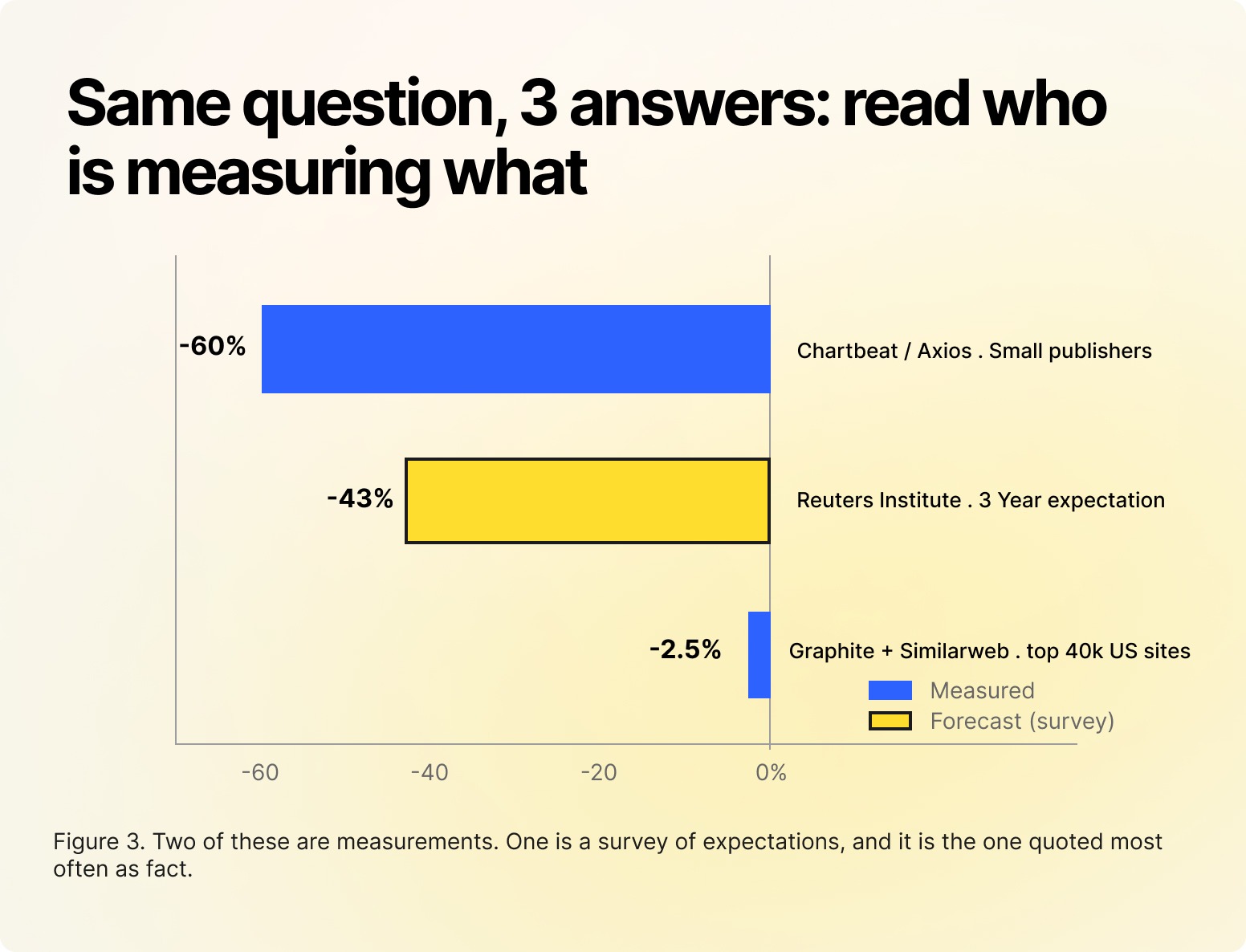
Publishers are the leading indicator, not the whole population. Their economics are almost entirely referral-based, so they feel the shift first and hardest. Here is the Chartbeat number nobody quotes: total network page views fell only 6% between 2024 and 2025. Traffic moved. It did not disappear.
Barry Adams of FT Strategies adds that these aggregated publisher datasets ignore site size, which leaves them open to distortion by a handful of large clients hit by a single Google core update. A core update is one of Google's periodic ranking overhauls, and one of them landing on two big sites in a small sample can swing an industry-wide headline.
Here’s what "the distribution" means for your book. An average of minus 2.5% across the market can easily contain one client down 55% and another up 12% in the same quarter. If your renewal deck quotes the average, you are describing nobody. Quote a 60% collapse in a renewal meeting, a competent CMO pulls up the Graphite study, and you have lost the room. Walk in with your client's own position inside that spread, and you are the only person in the process who did the work.
Key takeaway: The aggregate is stable, and the distribution is brutal. Quote the aggregate to sound credible and the distribution to be useful. Publisher numbers do not describe your client, but they do describe where your client is heading if their discovery sits on one surface.
What are buyers actually repricing in 2026?
Definitely not the category! Most digital marketing agencies still trade between 3x and 7x adjusted EBITDA, with strategic outliers reaching 8x to 12x, per FE International's May 2026 valuation guide. Peak Business Valuation puts the typical advertising agency band lower still, at 3.21x to 4.30x (March 2026).
Every figure above is drawn from the named source directly. Ranges differ between advisors because their comp sets differ, so treat any single band as a starting point rather than a quote.
The resorting is the whole event. Recurring revenue is the strongest lever in that table, and it is the one AI search attacks without touching a dollar of billings. An agency at 70% recurring, which is really 70% rank-reporting work, does not get underwritten at 70% recurring. Diligence is where that story ends. Nobody sends a letter telling you your revenue got reclassified. You find out in a data room, once.
Surface concentration (a Mavlers Agency term): the share of a client's discovery that depends on a single channel continuing to behave the way it did in 2021. Client concentration is about which logos pay you. Surface concentration is about where those logos get their customers from. If most of your book carries that dependency, you hold a concentration problem that never appears in your client list.
The discount request lands less often than the panic suggests. Productive's survey of 181 agencies (November 2025) found 27% had been asked for an AI-related discount, only 13% of those actually cut rates, and 65% still reported revenue growth. The discount is survivable. The reclassification is the part that is not.
Rand Fishkin made the client-side version of this point in a SparkToro post on May 25, 2026, arguing that marketers should stop chasing traffic and start building presence where their audience already pays attention. His phrase for it: “influence is the new traffic.” For an agency, the same logic decides your multiple, because the visibility you can prove is what a buyer underwrites as durable.
Key takeaway: Buyers did not lower the bands. They moved agencies between them. The three drivers AI search touches are recurring revenue classification, retention durability, and a new form of concentration that sits in your clients' channel mix rather than your client list.
Which retainers are most exposed? Score them with the Retainer Durability Index
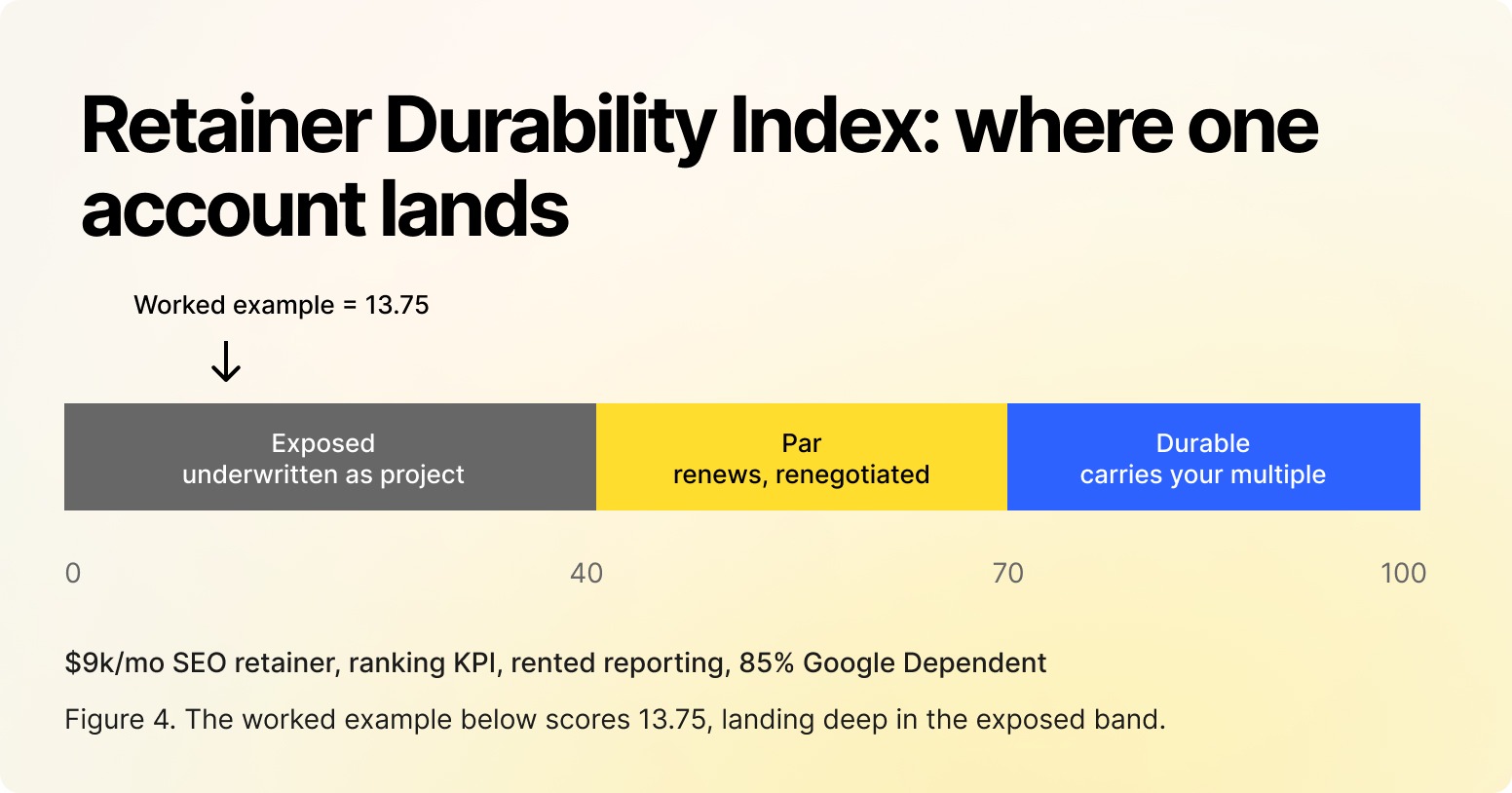
Retainer Durability Index (RDI): A Mavlers Agency scoring model that rates a single retainer from 0 to 100 on how likely it is to survive both an AI search shift and a buyer’s diligence. Score each input from 0 to 100, apply the weight, and sum.
RDI = (Who controls the KPI × 0.35) + (Who owns the measurement × 0.25) + (Judgment vs production × 0.25) + (Surface concentration × 0.15)
Two of these terms are worth unpacking. Share of answer is the percentage of a defined set of buying-intent prompts where the client gets named in the AI answer. Assisted revenue is closed revenue where the channel appeared somewhere in the path, not just on the last click.
Read the score like this:
- Below 40, exposed. A buyer underwrites this as project revenue regardless of the billing cadence.
- 40 to 70, par. It renews, and it also gets renegotiated, usually downward, usually once a year.
- Above 70, durable. This is the revenue that carries your book into the retainer-heavy band.
An illustrative worked example
Take a $9,000-per-month SEO retainer with a mid-market client. The contracted KPI is non-branded organic sessions. Reporting comes from a rank tracker the client could license directly. Scope is eight blogs, meta work, and a monthly deck. Google drives 85% of inbound.
Here is how each input scores, and why:
- Who controls the KPI: 10. Non-branded organic sessions is a number Google sets. The agency can influence it and cannot own it.
- Who owns the measurement: 20. The rank tracker costs the client a few hundred dollars a month to license themselves. The only agency-owned layer is the commentary on the deck.
- Judgment vs production: 15. Eight blogs and meta work are the bulk of the invoice, and both are compressing fastest. There is judgment in the deck, but it is not what the client is buying.
- Surface concentration: 10. At 85% Google dependency, this client sits inside the exposed band by definition.
RDI = (10 × 0.35) + (20 × 0.25) + (15 × 0.25) + (10 × 0.15) = 13.75
The revenue is real, but the durability is not. At a 25% delivery margin, that account throws off roughly $27,000 of annual EBITDA, which is $162,000 of enterprise value at a 6x recurring multiple and $108,000 at 4x. A buyer who files it as project work in a monthly wrapper takes $54,000 off that single account, and the invoice still arrives on time every month while they do it.
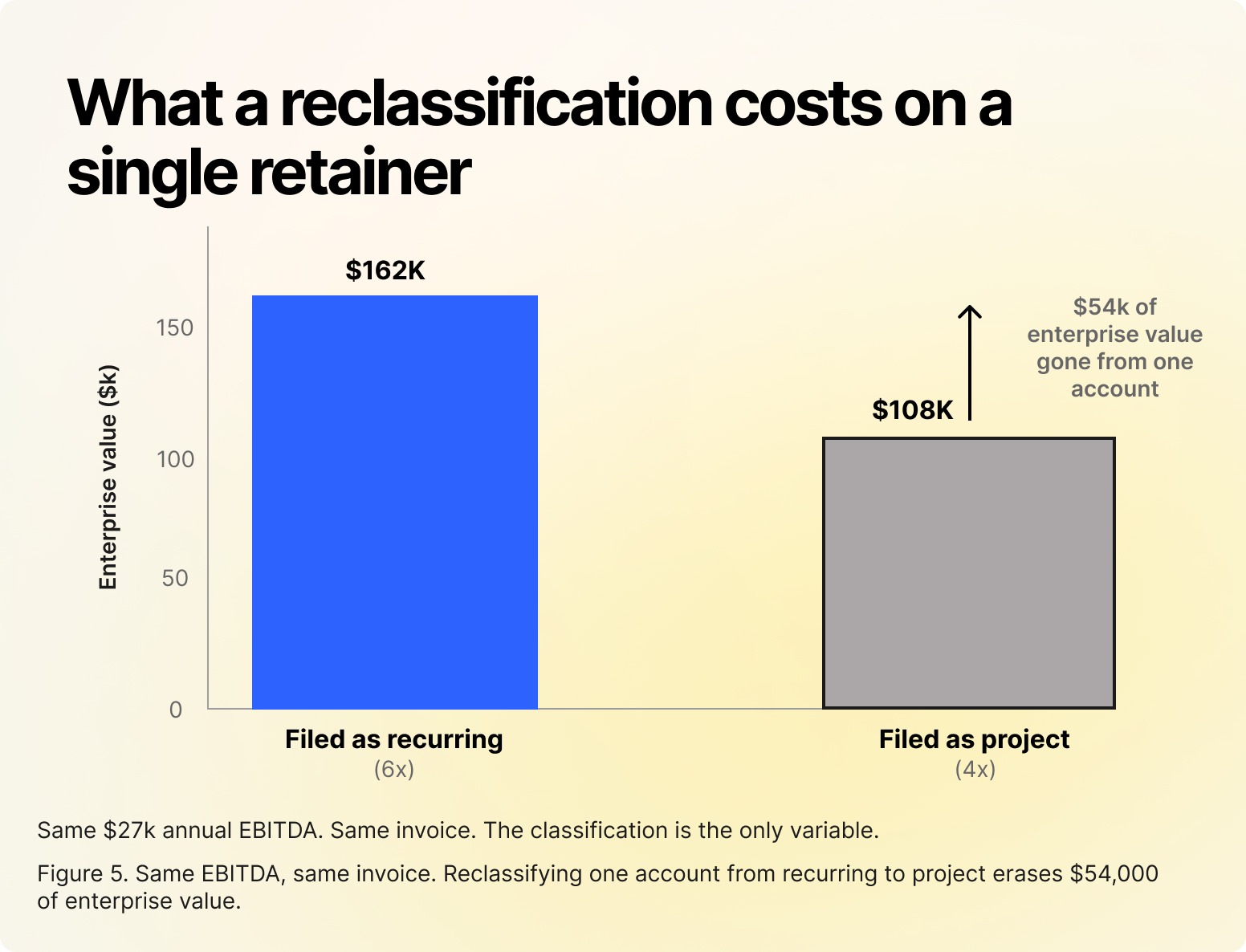
Key takeaway: Run the RDI across your ten largest retainers this quarter. The combined revenue of everything scoring under 40 is the slice of your enterprise value AI search has already taken and has not told you about.
How do you rebuild a retainer that survives the answer layer?
This cannot be done with a new service page, nor by renaming the SEO retainer. An AI-ready agency is not one with AI in the deck. It is one whose contracts measure something the answer layer cannot take away. You fix this by changing what the contract measures, and here is the sequence Mavlers Agency runs across a partner’s book, in order.
- Re-contract the KPI before the client raises it. We use the GEO Visibility Index (GVI): citation frequency, prompt coverage, and answer sentiment across the engines that matter to that client. The acronym is not the point. Setting the baseline yourself is beneficial because the number is then yours to explain when it moves.
- Instrument before you reprice. Fix a written baseline across the client’s highest-intent prompts. A repriced retainer without a baseline is a hope with an invoice attached.
- Price the judgment, not the production. Schema, entity work, and content are all compressing. Clients renew for your read on why they lost a citation and what it costs to win it back.
- Document the renewal, not the invoice. Buyers count signed multi-month SOWs. Rolling project work billed monthly is not retainer revenue, whatever your P&L calls it.
What does this mean for white-label agencies specifically?
White-label sits one layer down, which changes the exposure in both directions.
- The compression reaches you second and lands harder. Your partner agency fields the AI discount request. It travels downstream inside a quarter, and you have less room to absorb it than they do.
- Your durability is your partner’s durability. If their client contracts are priced on rankings, your delivery revenue inherits that exposure without ever sitting in the pricing conversation. Score their retainers, not just your own scopes.
- The AI search competitive advantage is one that almost nobody can build alone. Answer-engine visibility reporting takes prompt libraries, a sampling methodology, and baseline discipline that no partner agency wants to build from zero. A delivery partner who arrives holding that is not a vendor. That is the thing that the partner’s own multiple now depends on.
Agencies are no longer buying production capacity. They are buying the evidence that lets them defend a retainer.
Key takeaway: A white-label partner’s exposure is inherited. Run the RDI on your partners’ client contracts, because that is where your revenue gets classified.
FAQ
What is the impact of AI search on agencies?
It shows up in valuation before revenue. Contracts keep paying, so billings look stable, but buyers stop treating retainers priced against rankings as recurring revenue and underwrite them as project work. Recurring revenue is the strongest lever on an agency's multiple, so that costs turns of multiple while the P&L looks healthy.
Is SEO still worth selling as a retainer in 2026?
Yes, but not priced against rankings. Graphite, with Similarweb across the top 40,000 US sites, found organic traffic down just 2.5% year over year against a narrative predicting 25% to 60%. The aggregate is stable; the distribution is not. Sell against visibility, and the work underneath barely changes.
Does building an AI-first agency protect my valuation?
Only where it lands in numbers, a buyer already underwrites. First Page Sage found agencies clearing the 8x to 12x top end in 2025 shared four things: three years of double-digit growth, low client concentration, long client lifespans, and M&A advisory representation. None is an AI story. FE International credits credible AI integration with a 1x to 2x premium, but only where it lands in those four.
How much of my valuation is actually at risk?
Score your ten largest retainers on the RDI and total the annual EBITDA of everything below 40. Multiply that EBITDA by the gap between your recurring multiple and a project multiple, roughly 2x on most books. That figure is the enterprise value AI search has already moved out of the recurring column, and it stays invisible until diligence.



.webp)