White label

1.4M CRM Records Migrated with 99.998% Data Fidelity

Project Overview

Organization

Enterprise B2B SaaS company

Industry

B2B enterprise technology and SaaS

Technology stack

Salesforce Sales Cloud, HubSpot Enterprise Suite, custom staging middleware

Project type

CRM data migration and real-time bidirectional synchronization

Products / Services Used

  • Salesforce Sales Cloud
  • HubSpot Sales Hub
  • HubSpot Service Hub
  • Salesforce Bulk API 2.0
  • HubSpot CRM APIs
  • SQL staging environment
  • Custom Middleware

The client had grown rapidly over five years, but its CRM setup had not kept pace.

Sales and customer success teams worked in a heavily customized Salesforce environment, while marketing operated inside HubSpot Enterprise. The two systems were connected through the standard HubSpot-Salesforce connector, but the integration could not reliably handle the client’s custom Apex triggers, validation rules, and complex object structure.

‍

The business needed to move from Salesforce to HubSpot without losing years of customer history, sales activity, ownership records, pipeline data, or reporting accuracy.

Mavlers designed a phased migration and synchronization framework that allowed both systems to operate together during the transition.

Performance Insights

Key results for the client

1.4M+

CRM records migrated

99.99%

Overall data fidelityΒ 

$140K

Annual platform licensing costs reclaimed

18%

Increase in cold-to-warm pipeline conversions
Client Objectives

The challenges the client faced

1.
Salesforce and HubSpot had become disconnected

Marketing worked in HubSpot; sales, account management, and customer success stayed in Salesforce. Changes in one system frequently failed to appear in the other - leading to cold acquisition campaigns being served to existing enterprise buyers, and sales reps working from outdated contact data.

2.
The standard connector could not handle the Salesforce setup

The client’s Salesforce environment included hundreds of custom Apex triggers, complex validation rules, and deeply nested custom object tables.

The standard integration struggled under that structure. It created frequent synchronization failures and made the existing setup difficult to maintain.

3.
Historical sales activity was at risk

A standard import would have timestamped hundreds of thousands of historical activities - calls, emails, meeting notes, Intercom conversations - as created on the migration date, and attributed them to the administrator running the import.Β 

That would have erased the customer timeline context that account managers rely on for renewals and expansion conversations.

4.
Historic pipeline reporting could have been flattened

The client relied on historical timestamps such as CreatedDate, StageChangeDate, and ClosedDate to measure sales velocity, conversion cycles, and Net Revenue Retention.

If those timestamps were altered during migration, the business would no longer be able to distinguish between deals created years earlier and records processed during the migration.

5.
The business was paying for unnecessary platform complexity.

Licensing costs for two platforms plus third-party consolidation middleware were running high. Adding product-usage data to Salesforce required lengthy custom development. The business needed a single environment where marketing, sales, account management, and usage data could coexist without a specialist to maintain each connection.

‍

Mavlers Strategy

A staged architecture designed for a controlled migration

Mavlers Agency avoided a single cutover weekend.

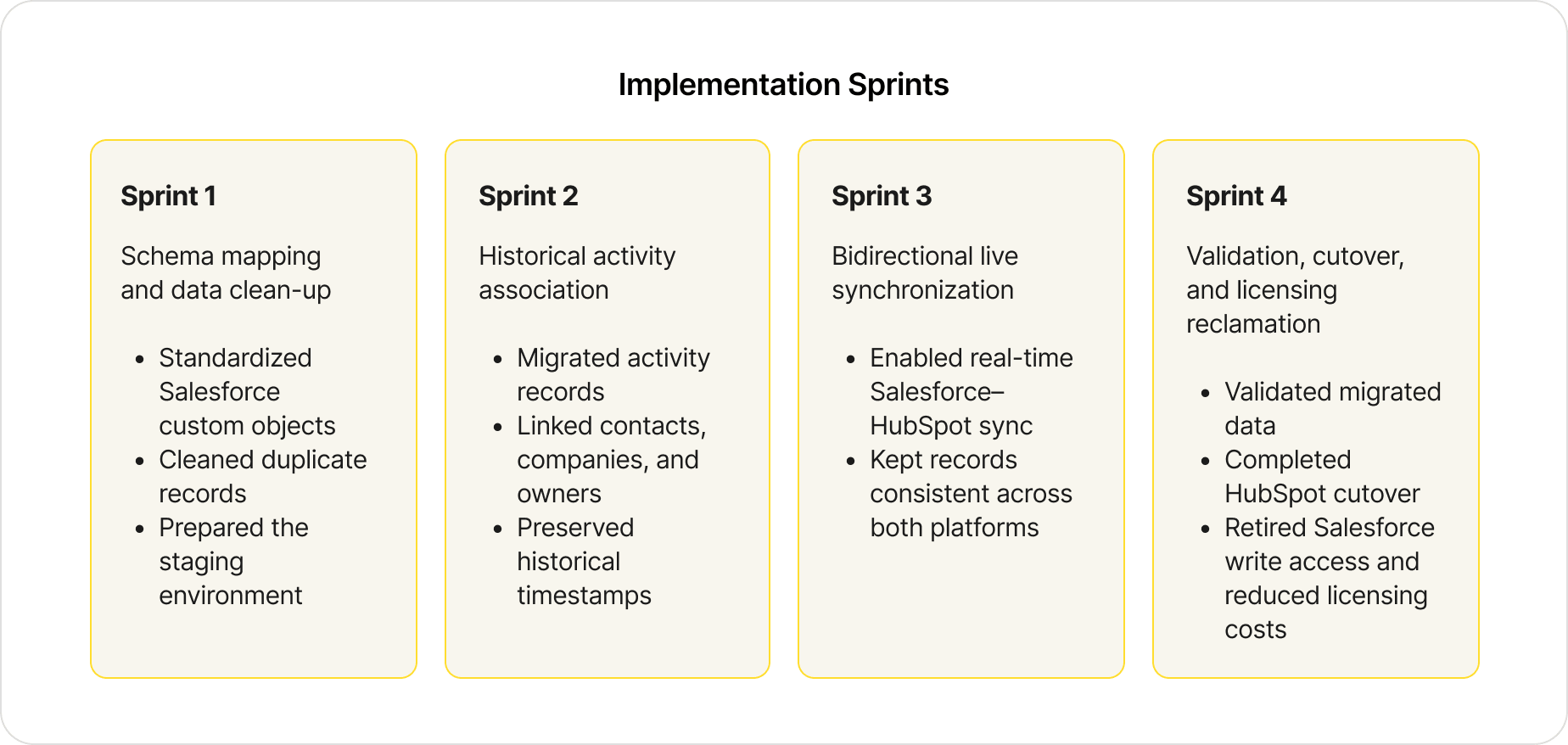
Instead, the team deployed a white-label Phased Coexistence Framework supported by a custom bidirectional synchronization layer. This allowed different divisions to move to HubSpot gradually while Salesforce remained active for teams that had not yet transitioned.

For 60 days, changes made in one CRM were reflected in the other.


1.
Built a secure staging environment

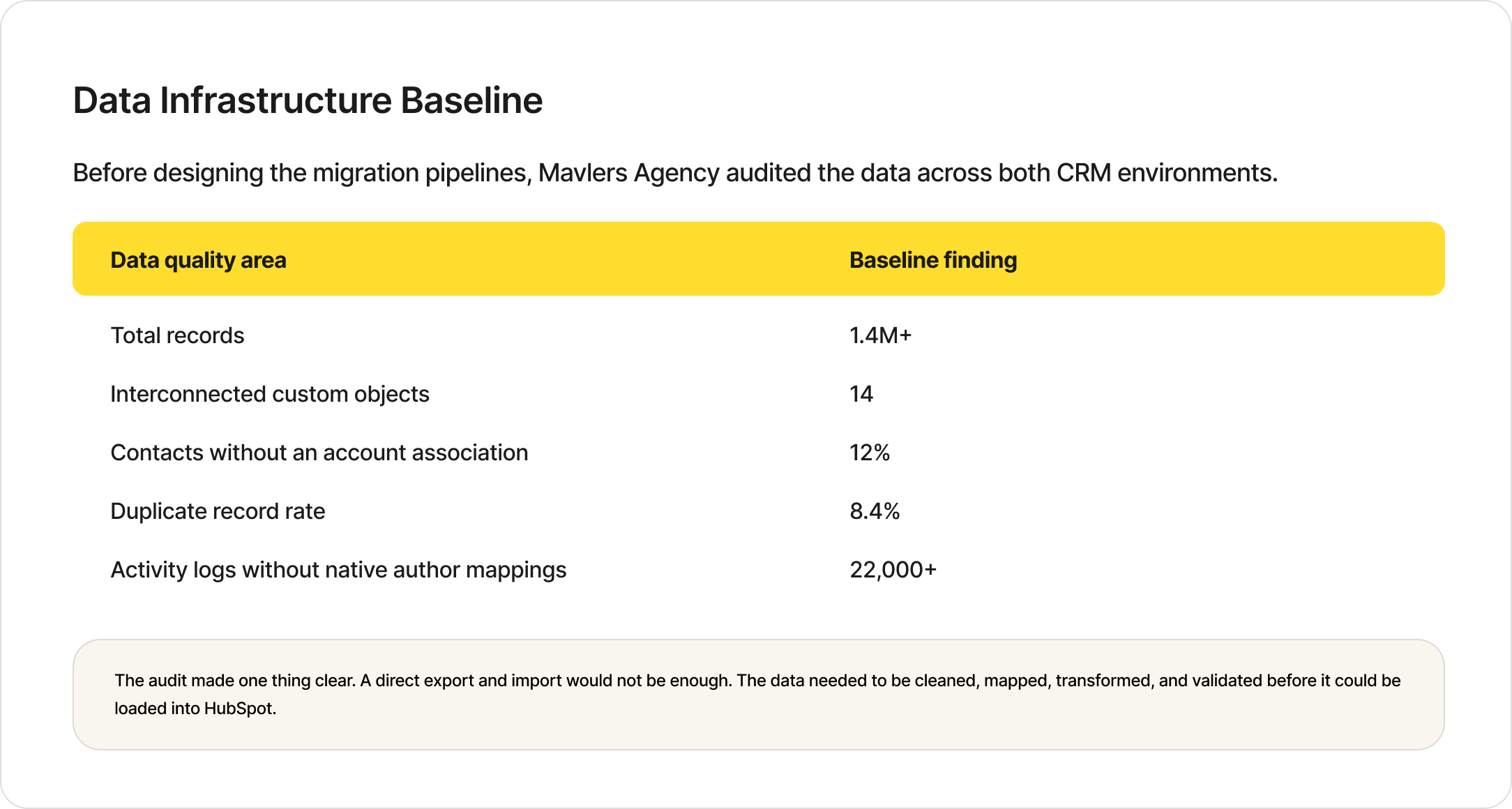
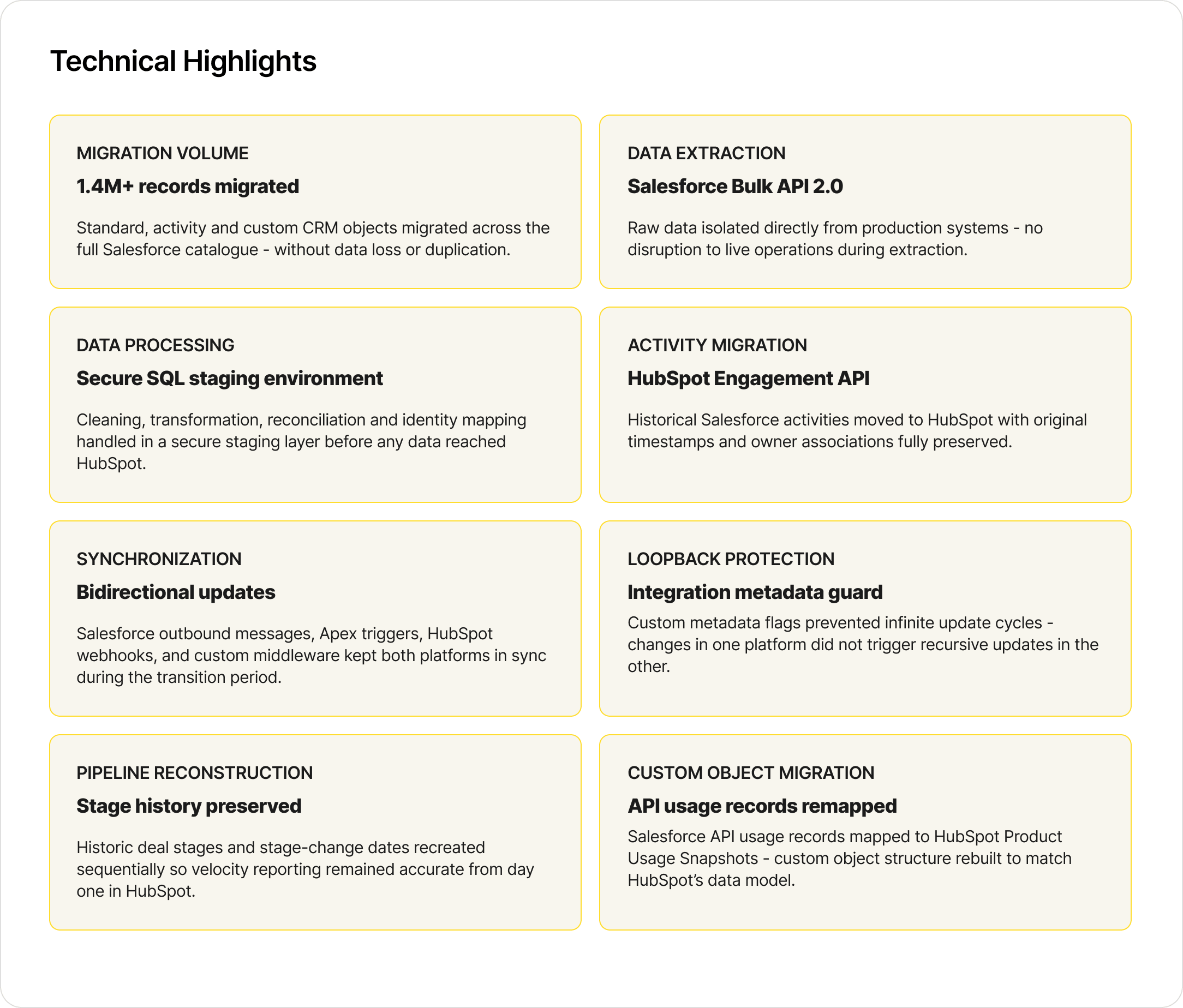
Raw records were extracted from Salesforce using Bulk API 2.0 and processed in an isolated SQL staging environment - outside the live CRM systems. This allowed the team to standardise records, remove 8.4% duplicate rate, and map complex relationships without placing any load on production systems.

2.
Mapped Salesforce objects to HubSpot objects

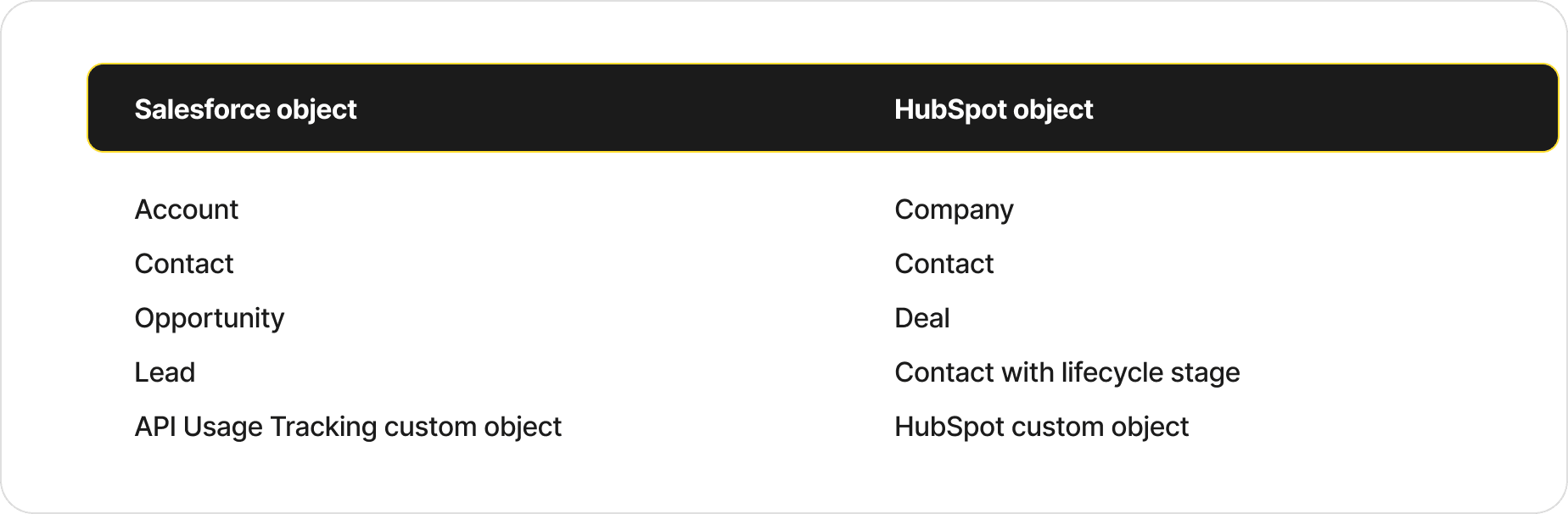
The migration mapped the existing Salesforce structure to the corresponding HubSpot architecture.
We mapped the Salesforce relational architecture to HubSpot's object structure according to the following matrix:


To preserve relationships between records, the team created an identity mapping dictionary.
The dictionary tracked the relationship between every legacy Salesforce ID and its new HubSpot ID. It also recorded the record type and whether the relationship had been reconciled.

This mapping became the foundation for the activity migration, object associations, and bidirectional synchronization.

3.
Preserved historical activities and ownership

The migration engine processed Salesforce tasks, events, notes, and emails individually instead of importing them as unstructured text.

For each activity, the system resolved:

  • The corresponding HubSpot company
  • The associated HubSpot contact
  • The original Salesforce owner
  • The original activity creation date
  • The relevant historical status and content

The activity data was then posted into HubSpot using the engagement API with historical timestamp values. Due to which, the client retains the original timeline of customer interactions instead of showing every migrated activity as if it had been created on the import date.

4.
Reconstructed historic deal movement

Deals were not imported only at their final stage. The migration engine recreated each deal's full journey - starting at the original stage, moving through subsequent milestones, and applying the original stage-change dates through API pipeline overrides. This preserved the data needed for sales velocity reporting and ARR projections.

5.
Created a bidirectional synchronization engine

During the transition, Salesforce outbound messages and Apex triggers captured changes on the Salesforce side; HubSpot webhooks captured changes on the HubSpot side.Β 

Both streams passed through a middleware worker that normalised data, applied identity mappings, and passed updates to the destination system -Β  keeping both CRMs in sync while different teams transitioned at different paces.

6.
Prevented synchronization loops

Bidirectional sync creates a risk of infinite update cycles: a Salesforce change triggers a HubSpot update, which triggers another Salesforce update, and so on.Β 

Integration metadata was embedded in both systems so the sync engine could detect whether an update originated from the integration itself -Β  and block the duplicate before it propagated.

7.
Migrated product-usage data into HubSpot

The client's Salesforce API usage tracking object was mapped to a new HubSpot Enterprise custom object - Product Usage Snapshots. Each snapshot was associated with the correct company using the identity mapping dictionary, allowing growth marketers to build workflows that trigger when a user's API consumption crosses 85% of their plan threshold.
‍

Results

What the client achieved

Data migration precision


The final validation results showed high data fidelity across the migrated objects.


CRM data object Salesforce records Successfully loaded Data integrity Rejected or lost
Accounts and companies 142,500 142,500 100% 0
Contacts 485,200 485,192 99.998% 8 malformed email records
Opportunities and deals 94,800 94,800 100% 0
Historical activity tasks 682,000 681,940 99.991% 60 corrupted text records
Custom object records 120,000 120,000 100% 0

Global synchronization latency improved from a five-minute delay to 1.8 seconds - a 99.4% reduction in processing time.

Historical customer context was preserved

Account managers could open a HubSpot record on day one and view the client's full activity history - calls, notes, emails, and conversations -Β  with original dates, associated contacts, and owner attribution. Nothing was stamped with the import date.

Sales and marketing worked from the same data

Lead-status changes that previously took up to 24 hours to reflect across systems now processed in 1.8 seconds. Marketing workflows could respond to real sales status in real time - reducing irrelevant outreach to leads already engaged with sales, and lifting cold-to-warm pipeline conversions by 18%.

Licensing costs were reduced

By deprecating the Salesforce Sales Cloud setup and removing third-party data consolidation middleware, the client reclaimed $140,000 in annual licensing costs.

Sales representatives reclaimed time

With marketing activity, sales opportunities, and historical engagement data available through a unified platform, sales representatives no longer needed to spend as much time switching between systems or updating records in duplicate. The change saved each sales representative an average of 4.5 hours per week.

Executive reporting retained historical accuracy

Because historic timestamps and deal-stage sequences were preserved, the operations team could continue running quarter-over-quarter revenue forecasts and Net Revenue Retention reports without gaps caused by the migration. The business also retained the historical context required during consecutive finance reviews.


Before and After


Before After
Salesforce and HubSpot operated as disconnected systems HubSpot became the unified CRM environment
Standard connector struggled with custom Salesforce architecture Custom middleware handled complex data structures
Historical activities risked being imported as new records Original timestamps & ownership were preserved
Sales teams logged data in two systems One platform removed duplicate record entry
Lead-status changes could take up to 24 hours to sync Updates processed in approximately 1.8 seconds
Product-usage data was difficult to use in the CRM Usage snapshots were mapped to a HubSpot custom object
Platform and middleware costs remained high $140,000 in annual licensing costs were reclaimed

‍

Sandra Field

Related Case Studies

Results that speak
for them selves.

Migrating 9,000+ pages across 12 languages

Successful migration of 9,000+ pages across 12+ languages, with no critical downtime.

80% CPR reduction and 3x ROI over 6 years

Multi-channel strategy driving 50%+ monthly registration growth.

35% cost reduction while scaling SEO delivery globally

Ogilvy needed to scale SEO delivery across multiple markets without expanding headcount. Mavlers stepped in as their invisible production partner.